
Difference Between Category I, II, and III AIFs Explained

How to Build a Multi-AIF Investment Strategy: Allocating Across Categories I, II, and III

There is more than Alternative Investment Funds (AIFs) which have become the most one of the preferred investment vehicles for the high-net-worth individuals (HNIs), family offices, institutional investors, and startups are looking for the well structured capital solutions in India.There are many investors and businesses who are still in doubt to understand the difference between Category I, Category II, and Category III AIFs.

If someone is planning to invest in AIFs, and want to launch an investment fund, or explore emerging AI-driven investment technologies, understanding these categories are very important for making informed financial decisions.

In this guide, we will try to explain everything about Category I, II, and III AIFs in a very simple language — including the structure, benefits, taxation, regulations, examples, and how technology and AI are transforming the AIF ecosystem.

What is an AIF?

There is An Alternative Investment Fund (AIF) is a privately pooled investment vehicle regulated by the Securities and Exchange Board of India (SEBI). The funds used to collect money from the sophisticated investors and invest in assets beyond traditional stocks and bonds.

AIFs generally invest in:

  • Startups company
  • Private equity
  • Venture capital
  • Real estate
  • Infrastructure development
  • Debt instruments
  • Hedge funds

AIFs is regulated by the SEBI (Alternative Investment Funds) under the Regulations, 2012.

Types of AIFs in India

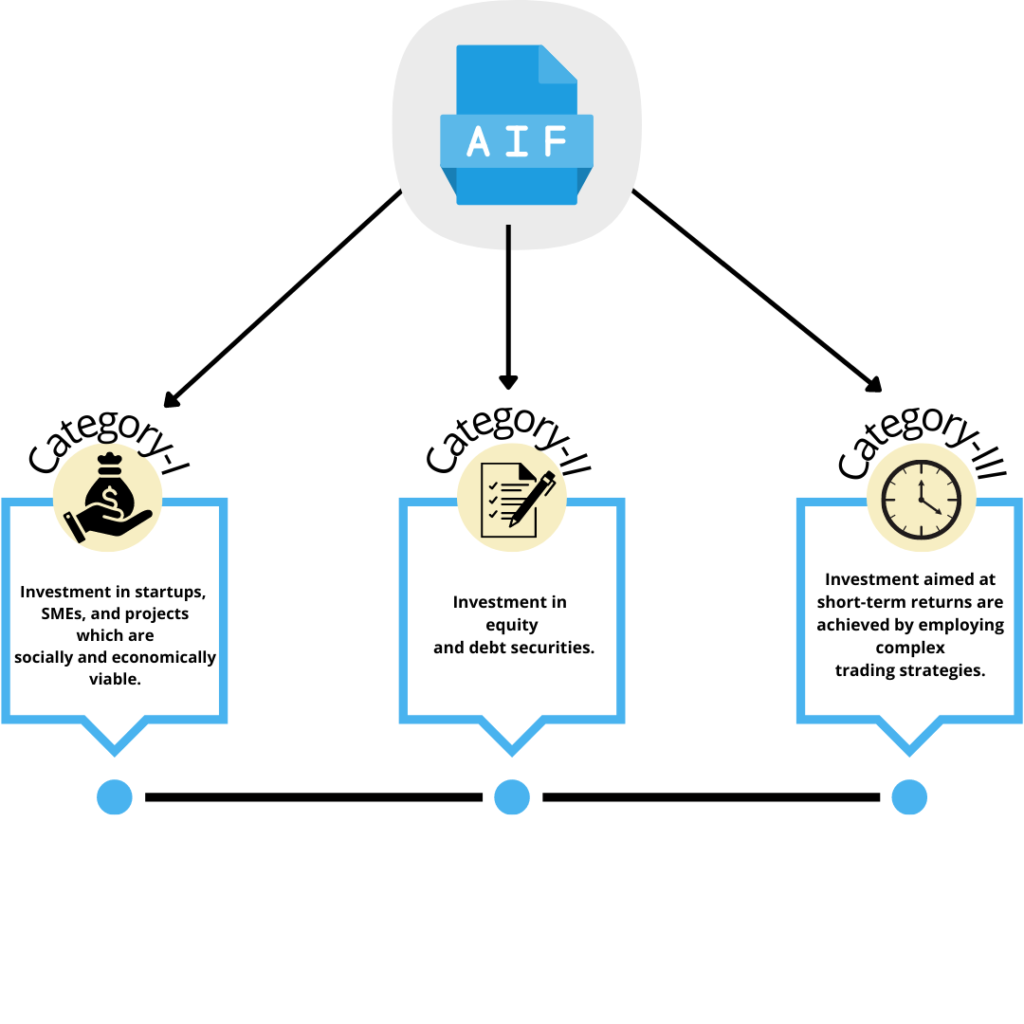
The SEBI is classified in AIFs in three categories

  1. Category I AIF
  2. Category II AIF
  3. Category III AIF

Every category has different investment strategies like risk levels, tax implications, and the regulatory benefits.

Category I AIF Explained

The Category I AIFs invest in those sectors which are considered socially and economically beneficial for India.

These kinds of funds receive more incentives and support from the government because this sector contribute to economic growth as well as innovation.

Key Features of Category I AIFs

  • Invest in the startups in the Newly businesses
  • The promotion of the Entrepreuneurship
  • Have less investment risk
  • Government incentives may apply
  • Long-term investment opportunity

Types of Category I AIFs

Venture Capital Funds (VCFs)

Investing in the startups and the high-growth companies.

SME Funds

These are focused in Medium enterprise

Infrastructure Funds

In these Investment in the infrastructure project for example Roads , energy and logistics.

Social Venture Funds

In these the company which creates social welfare gets Funds

Who Should Invest in Category I AIFs?

Category I AIFs are suitable for:

  • For the Long-term investors
    • Startup-focused investors which can create innovation
  • Investors seeking government-supported sectors
  • High-risk, high-growth investors

Category II AIF Explained

Category II AIFs are the most common type of AIF in India. These kinds of funds don’t receive incentive through the the government and do not have aggresive trading strategies compare to Category III.

They primarily invest in the private companies, debt instruments, and the unlisted businesses.

Features of Category II AIFs

  • There is no leverage expectation for operations.
  • Mature business gets investment
  • From medium to long term investment
    • It is Stable compared to Category III
  • Widely used by private equity firms

Different types of Category II AIFs

Private Equity Funds

Private companies which is established gets Investment

Debt Funds

Invest in debt for securities of companies.

Fund of Funds

Invest in other AIFs.

Real Estate Funds

Invest in commercial and residential projects.

Who Should Invest in Category II AIFs?

Ideal for:

  • High Net worth individual
  • Institutional investors
  • Family offices
  • Investors seeking balanced risk and return

Category III AIF Explained

In Category III AIFs they use high complex trading strategies and may employ leverage to generate short-term investment returns.

These funds are similar to the hedge funds and actively trade across markets.

Features of Category III AIFs

  • Use for leverage and derivatives
  • High risk for investment
  • Short-term opportunities for trading
  • Higher flow of liquidity
  • Suitable for sophisticated investors

Examples of Category III AIFs

  • Hedge Funds : wide range of assets , debt , real estates
  • Quantitative Trading Funds
  • AI-powered Algorithmic Trading Funds
  • Long-short equity funds

Who Should Invest in Category III AIFs?

Suitable for the :

  • Aggressive investors
  • HNIs
  • Institutional traders
  • Investors comfortable with market fluctuations of price

Difference Between Category I, II, and III AIFs

FeatureCategory I AIFCategory II AIFCategory III AIF
Investment Focus onStartups, SMEs, infrastructurePrivate equity, debtTrading & hedge strategies
Government Incentives presenceYesNoNo
Risk LevelModerate to HighModerateVery High
Leverage AllowedLimitedLimitedYes
Investment time periodLong-termMedium to Long-termShort-term to Medium-term
LiquidityLowModerateHigh
Type of investorGrowth investorsBalanced investorsAggressive investors
Examples:Venture capital fundsPE fundsHedge funds

Taxation of AIFs in India

Taxation differs depending on the category of the AIF.

Category I and II AIF Taxation

These are categories who generally enjoy pass-through taxation status, meaning income is taxed in the hands of investors rather than the fund itself.

Category III AIF Taxation

Category III do not receive any pass through status and are taxed at their fund level.

Tax regulations can change frequently, so professional tax consultation is advisable.

According to SEBI regulations:

  • Minimum investment should be 1 crore rupee for the investor.
  • And For the directors/employees/managers of the fund should be 25 lakhs.

These are mainly designed for sophisticated investors.

Benefits of Investing in AIFs

Portfolio Diversification

In AIFs we explore beyond traditional equity and also for the debt markets.

Access to High-Growth Opportunities

Investors can directly participate in startups, private companies, and emerging sectors for the high return.

Fund Management by professional

It is Managed by experienced professionals and investment experts to reduced the risk and uncertainties of your funds.

Potential for Higher Returns

Alternative assets can be generated higher returns compare to conventional investments.

Risks Associated with AIFs

AIFs offer strong growth potential, they also come with high risks:

  • Limited liquidity
  • Market uncertainty
    • Government Regulation
  • High minimum investment
  • Complex structures

Investors should evaluate their risk appetite more carefully before investment in company.

How AI is Transforming the AIF Industry

Artificial Intelligence is changing very fast the way Alternative Investment Funds operate.

Modern AIF firms are using AI for:

  • Portfolio optimization
  • For identifying the risk
  • Detection of funds
  • Predictive analytics
  • Algorithmic trading
  • Investor reporting automation

AI agents can process a huge financial datasets in real-time, helping the fund managers make faster decision and more reliable investment decisions.

Businesses looking to integrate intelligent automation into investment operations can leverage custom AI solutions from Winklix AI Agent Development Services. Their AI-driven systems help enterprises build autonomous AI agents for finance, investment management, and operational automation.

Why Understanding AIF Categories Matters

Choosing the right AIF category depends on several factors:

  • Investment goals
  • Risk tolerance
  • Liquidity requirements
  • Tax planning
  • Investment horizon

A startup-focused investor may prefer Category I, while a stable private equity investor may choose Category II. Aggressive investors looking for high-frequency strategies may opt for Category III.

Understanding these differences helps investors make smarter financial decisions.

Future of AIFs in India

India’s alternative investment market is expected to grow further in future due to significantly aspects:

  • Rising the ecosystem
    • Due to Increased HNI participation
  • The growth of the private capital
  • AI-driven investment management
  • Increase of fintech and wealthtech platforms

As the financial technology is evolving, AI -powered fund management and automation is likely to become more in future of AIFs .

Final Thoughts

Alternative Investment Funds are reshaping India’s investment landscape by offering sophisticated investors access to private markets, startups, and advanced trading opportunities.

The understanding of difference between Category I, II, and III AIFs is very important key aspects before making any investment decisions. Each and every category serves different investor needs, risk profiles, and financial goals.

As AI automate and continue to transform financial services, the future of AIF management will become more increasingly data-driven and intelligent. Businesses and investment firms are adopting AI-powered solutions early will gain a strong competitive advantage in the evolving alternative investment ecosystem.

Frequently Asked Questions (FAQs)

1. What is the main difference between Category I, II, and III AIFs?

Category I focuses on startups and socially beneficial sectors, Category II focuses on private investment and debt investments, while Category III invest in complex trading and hedge fund strategies.

2. Which AIF category is the safest?

The category II AIFs are find safe and considered relatively stable for the investment.Category III is avoided because of leverage trading strategies .

3. Can Category III AIFs use leverage?

Yes, Category III AIFs are allowed to use leverage and derivatives for investment strategies.

4. What is the minimum investment required for AIFs in India?

The minimum investment amount is generally ₹1 Crore per investor.

5. Are AIFs regulated in India?

Yes, AIFs are regulated by the (SEBI)Securities and Exchange Board of India 

6. Which AIF category invests in startups?

The Category I AIFs primary focus on investment in startups, SMEs, and innovative driven businesses.

7. How is AI being used in AIF management?

AI helps in many aspects like prediction analytics, algorithmic trading, investor analytics, portfolio management, and automation of investment operations.

8. Are AIFs better than mutual funds?

AIFs offer access to alternative assets and potentially higher returns, but they also comes with the higher barrier risk and it take larger investments compared to mutual funds.

Global Initiatives to Prevent Money Laundering

Money laundering is the unlawful process of presenting “dirty” money as legitimate rather than ill-gotten and there is a die-hearted need to prevent money laundering. Money laundering is explained in Article 1 of the European Communities Directive and Convention on the Laundering, Search, and Confiscation of the Proceeds of Crime as the conversion of property knowing that certain property is derived from serious crime, concealing or disguising the illicit origin of the property, or supporting any person who is engaged in committing such offences. Money laundering may also be defined as the practice of making it appear as though significant sums of money gained through major crimes came from a lawful source. Money laundering is also specified in Section 3 of the Prevention of Money Laundering Act, 2002.

In India, money laundering is carried out via a traditional practice known as ‘Hawala.’ Hawala is an alternate system in which “financial services, historically functioning outside the normal banking sector, where value or assets are transferred from one geographical place to another” are provided. Transactions through Hawala take in effect without any governmental oversight, making it simpler for people to make deposits and withdrawals through ‘hawala dealers’ instead of financial organizations.

Impact of Money Laundering

  1. Throws away international investment
  2. creates financial crisis
  3. The impact on currency and interest rate volatility
  4. Promotes a culture of tax avoidance
  5. Give a boost to illegal activity
  6. Negative effects on the financial markets’ and institution’s image

Global efforts to prevent money laundering and terrorism funding

Money laundering is not a new phenomenon; instead, it is an international one. Many international agreements address money laundering, and various projects have been launched to address this global issue.

  • The United Nations Convention against Illicit Trafficking in Drugs and Psychotropic Substances, 1988 – The Vienna Convention

This event took place in December 1988 and was one of the earliest initiatives aimed to prevent money laundering. The primary goal of this convention is to establish efforts to counter money laundering by requiring member states to criminalise the laundering of money from drug trafficking (Article 6), as well as to promote international cooperation in investigations, prosecutions, and jurisdictions (Article 7) and to make extradition between member states possible (Article 6). Furthermore, it established a concept that local banking secrecy rules should not interfere with international criminal investigations.

  • The Basel Committee on Banking Regulation and Supervisory Practices

In December 1988, the Basel Committee on Banking Regulations and Supervisory Practices declared its intention to promote the banking sector to take a consistent approach to guarantee that banks are not used to hide or launder money obtained via illicit or unlawful activity. However, that statement does not limit itself to any drug-related money laundering; instead, it extends to laundering through financial systems, including deposit, transfer, and any form of concealment of money from drugs, terrorism, fraud, and so on. It also concentrates on the sector wherein the individual will not be permitted to utilise any financial system that is involved in any type of money laundering.

  • The council of Europe Convention

It creates a common policy on the subject of money laundering, provides a common description of money laundering, and provides means for dealing with it. It also establishes certain international collaboration among member nations, which may include governments not affiliated with the Council of Europe. The key objective of this agreement is to improve international cooperation in the areas of investigative assistance, search, seizure, & confiscation of the revenues of all sorts of criminal activity, including drug trafficking, terrorist crimes, and arms trafficking.

  • Financial Action Task Force on Money Laundering

FATF is an intergovernmental organisation was founded in 1989 at the G7 summit in Paris with the notion and goal of establishing high standards and promoting the efficient implementation of any legal, regulatory, and operational measures to combat the evil practise of money laundering and terrorist financing. FATF has acknowledged several suggestions that are recognised by international money laundering standards. In October 2001, 8 special recommendations were announced, and in October 2004, a 9th special suggestion was issued, discussing the improvement of international standards for fighting money laundering and terrorism funding. In 2012, the FATF Recommendations were revised.

  • Interpol

The International Criminal Police Organization was founded in 1923 and now has 194 members. With the mutual assistance of national police authorities worldwide, Interpol works to preserve global security. Interpol plays an essential role in tracking down criminals, conducting cooperative investigations, capacity development and training, and sharing and providing data access to governments. Interpol created the Interpol Money Laundering Automated Search Service (IMLASS) to aid anti-money laundering efforts by building a database and tracking, connecting, and identifying suspects and people from all countries, as well as tracking the flow of unlawful funds.

  • UN Global Program against Money Laundering

It was founded in 1997 with the goal of increasing the efficiency of all international measures to prevent money laundering via technical cooperation services provided to governments. The major objective of this programme is technical cooperation, which includes actions such as raising awareness and training and developing institutions. It also intends to aid in the creation of financial investigative services to ensure the effective operation of the laws.

Indian Legal Framework to prevent Money Laundering

  • Money Laundering Bill – India is a signatory to the United Nations Resolution, 1998, that calls on member states to take strict action against money laundering, the Indian government enacted the Prevention of Money Laundering Bill, 1999, that describes money laundering as the act of acquiring, owning, or possessing any proceeds of crime and intentionally entering into any transaction involving a crime listed in IPC, 1860. The act’s goal is to prohibit and regulate illicit financial operations involving drugs and narcotics, as well as other crimes.
  • Prevention of Money Laundering Act of 2002 – This Act was enacted in 2002 in order to prevent money laundering as well as to penalise those who benefit from it. This statute empowered our government or any other authorised public authority to seize property obtained through illicit earnings and money. In this legislation, the Financial Intelligence Unit examines all records to detect and identify any suspected transactions, and the Enforcement Directorate subsequently conducts an inquiry.
  • Prevention of Terrorism Act of 2002 – This is the Indian government’s first legal effort to combat terrorism and other connected issues. Under Section 8 of this Act, the Central Government is allowed to forfeit proceeds of terrorism regardless of whether or not the person whose possession it is seized or attached is prosecuted under the given act. It also strives to prevent terrorist operations in fact and implement seizure and blocking of cash for terrorism financing.
  • Financial Intelligence Unit – Although it is not a regulatory authority, the major function of this unit is to acquire all financial intelligence in collaboration with regulatory agencies such as the RBI, SEBI, and IRDA, as well as to monitor all suspicious transactions and report them. It is in charge of coordinating and enhancing all national and international intelligence.

Guidelines on Anti-money Laundering

SEBI Guidelines

  1. These regulations apply to SEBI-registered intermediaries.
  2. It imposes specific obligations on SEBI-registered intermediaries to implement policies and processes to support policies.
  3. It also discusses how to prevent money laundering, which will include the dissemination of anti-money laundering and illegal activity regulations, such as terrorism funding.
  4. It is in charge of customer account information, securities transactions, client acceptance policy, customer due diligence procedures, and record keeping.

RBI Guidelines

  1. These standards are applicable to all banking and non-bank financial firms regulated by the RBI.
  2. KYC Implantation (Know Your Customer).
  3. The major goal is to prevent people and businesses from misusing banks and non-bank financial institutions (NBFCs) for money laundering.

Other Initiatives to combat Money Laundering

  1. Bank Obligations – It is the legal responsibility of the banks to keep the details of consumers at the moment of creating a new account confidential as possible and to guarantee that all the details are in safe hands and that no one can misuse that information. It is also the legal duty of banks to make sure that the data sought and gathered from the customer is relevant to the perceived risk and must be sought separately with the consent of the customer.
  2. KYC Policy – The bank must create a KYC policy for each customer that includes certain fundamental aspects such as Customer Acceptance Policy, Customer Identification Procedures, Risk Agreement, and Transaction Monitoring.

Conclusion

Money laundering and terrorism funding represent a major danger to our financial well-being and also any country’s sovereignty. Terrorism funding is another big issue that appears to be nearly difficult to track down and capture because the majority of these transactions are in cash and no institutions are engaged in the process. The Prevention of Money Laundering Act, 2002 (PMLA) has been amended to include financing activities connected to terrorism. The RBI and the SEBI each has their own set of anti-money laundering principles. The FIU prefers to receive as many reports as possible in electronic form. Even though India has this PMLA Act and so many recommendations, it still has numerous high-profile money laundering instances; it just need to execute those rules and regulations appropriately in order to prevent money laundering.

Foreign Direct Investment: Overview, Types, Advantages & Disadvantages of FDI

Foreign Direct Investment: Overview, Types, Advantages & Disadvantages of FDI

Foreign direct investment or FDI is one of the most important sources of direct investment in countries. Unlike foreign portfolio investment, an investor in a country holds control of any business or organization in foreign lands receiving investment. FDI also indicates the political and socio-economic stability of a country. In this article, we will discuss about the types of FDI and foreign direct investment.

Overview of FDI

Foreign investment can be either organic or inorganic. In the case of organic investment, a foreign investor pumps in money to accelerate expansion and growth in established businesses. In the case of inorganic investment, an investment institution buys a business in its target country.

Foreign direct investment in a developing economy in India and parts of South East Asia gives a lot of boost to businesses that are in poor financial condition. The Government of India employed various measures to ensure that large-scale investment in sectors such as defense, telecom sector, PSUs and IT sector came into the country.

FDI is a non-debt financial resource, it has the potential to become a major driver for economic development in the country. With globalization and internationalization, FDI has become a reality. Whereas, according to scholarly opinion, foreign investment has been released keeping in mind the following factors: 

  • It aims to control companies in a foreign land.
  • It has helped businesses overthrow monopoly practices.
  • Considering market imperfections, such investments help companies make an impact in case of a sharp and unpredictable drop in business activity.

Types of Foreign Direct Investment

There are various types of foreign direct investment. Let us discuss its types in this segment.

  • Horizontal FDI

Horizontal FDI is the first of its kind. It is checked when a business enters a foreign country through the FDI route without changing its original activities or for any other reason for its expansion. It is also one of the most common sort of FDI. An example of this type of FDI is McDonald’s investing in an Asian country to increase the number of stores in the region.

  • Vertical FDI

Vertical FDI is another form of FDI. This FDI occurs when an investment is made in a company within a specific supply chain and which may or may not be related to the same industry. When vertical FDI occurs, a business invests in a foreign firm that supplies or sells products. An example of vertical FDI is if McDonald’s purchases a large-scale meat processing plant in the European country, to boost its meat supply chain in the target country.

  • Conglomerate FDI

When the investment is made in two different companies of different industries, the transaction is called Conglomerate FDI. As such, FDI is not directly linked to investor business. An example would be in this case when American retailer Walmart invests in Indian automobile manufacturer Tata Motors.

  • Platform FDI

Among the types of FDI, platform FDI means expansion of business in a foreign country, but everything manufactured there is exported to a third country. This form of FDI is seen in the trade-free zones of FDI-starved countries. For example- French perfume brand Chanel set up a manufacturing plant in the US and exported products to other parts of Asia and Europe.

If you want to invest through FDI, it is important to know about various types of FDI, including examples. With FDI, the money invested can be used to start a new business in a foreign land or to invest in an existing business in a foreign land.

Advantages & Disadvantages of these types of Foreign Direct Investment

FDI has its advantages as well as disadvantages. Let’s take a look at these two sides of FDI.

Advantages

  • With the increase in FDI, businesses benefit through tax breaks or incentives and the ability to further diversify.
  • For the country receiving FDI, benefits such as more excellent employment opportunities, access to latest technologies and modern management methods etc. can be enjoyed.
  • FDI can help create a level of dependency between countries that will maintain a peaceful environment.

Disadvantages

  • Large corporations take over the market, and this hurts local businesses. One of the examples is walmart.
  • There is a risk of profit repatriation which means that the profit generated in India will not enter the domestic economy.
  • FDI can affect a country’s exchange rates.

Conclusion

FDI has been an important driver of economic growth and also an important source of non-debt finance for India’s economic development. Therefore, there should be a robust and easily accessible FDI system. Once the epidemic ends and the economy opens up completely, analysts predict various types of foreign direct investment to flood.

What is a Business Loan?

Business Loan For Business In India

Business Loan is a kind of financing you can avail to meet the business needs of your growing business. 

In short if you need funds to expand your business, or you need to buy machinery or boost production then you can opt for business loan.

Different types of Business Loan

Following are the types of business loan and they are as follows-

  • Working Capital Loans-  When there is a need of Short term business liquidity, they need to have an adequate and constant cash flow. Then working capital loans comes in the picture.
  • Machinery Loans- When there is a need to purchase a machinery or are planning to upgrade their plants and machinery, so it requires a funds in both the situations. Machinery loans are one of the types of business finance that provides capital for your fixed asset needs.
  • SME and MSME Loans- Loans are provided to small businesses owners who are looking to expand their business operations and market each. 

Things your Business Loan Application must include-

Whoever needs a bUsiness Loan is required to give an application with their Business Plan. By submitting a business plan to any Bank authority it is easier for them to evaluate whether that business is economically viable business or not and that decides the repayment capacity loan of yours to the Bank. it is obvious to translate your ideas on paper and the bank can see your vision. Here are some of the principal sections to include-

  1. Executive Summary- an Executive summary gives a short summary of your entire plan. This allows banks and other lenders to evaluate the economic viability of your business.
  1. Business Description- After Executive Summary, them comes Business description. Make sure that it includes all the main aspects of your business. 
  1. Human Resources- It is important for a business before seeking for business loan that they have a strong team behind the business. Principle this should include the profiles of the executive team which includes, CEO and CFO and anyone else involved in the higher level. Make sure to add their previous achievements to demonstrate their ability to run their business.
  1. Budget and Finance- this is one section that bank will scrutinize in every possible detail. While the idea is important to them they really want to see that how much you want to invest, what your regularly expenses would be and how will you be making revenue.
  1. Promotional Plan- lastly, it should include the Business or Promotional Plan. how will you get you services or product out there.

Supporting Documents requirements-

Following are the supporting Documents that are needed-

  1. Identification
  2. Bank Statements
  3. Proof of address
  4. Business Registration Documents

FAQs

  • What are the things which you need to know before applying for a business Loan?

Prior to starting you application with Bank, it is always advisable to be well prepared. Here are the following things which you should consider before submitting an application

  1. Check your credit rating- A large portion of investors decides to give loan to you by checking your CIBIL score. So before applying for the loan it is a good idea to check your credit score. 
  2. Every time you apply for a  loan, your credit report registers this. If you have too many applications then your credit score could go down. So the best option is to shop around first before submitting an application.
  3. Lastly, you should consider hiring someone to help you with the application process. Often times business owners are really good at their side of the business or are not the best at Finance and writing. The business plan is an essential section in your application, so it might be a good idea to have someone help you out in writing of the business plan. It may also be helpful to hire a finance analyst to aid with the budget section of your Business plan.

What is Fixed Deposit?

What is Fixed Deposit?

Fixed Deposit is a kind of investment which is offered by Banks and Non Banking Financial companies, where you can deposit money for a higher rate of interest which is higher than the interest rate offered by banks and NBFCs in their savings account. Where a lump sum amount of money is deposited for a fixed period of time, which varies for every financier. Usually Fixed Deposit amount cannot be withdrawn before the date of maturity but someone wants to withdraw it in case of an emergency then he can do so in exchange for the penalty.

Features of Fixed Deposit

  1. Fixed deposits enables investors to earn a higher rate of interest on their surplus funds.
  2. You can deposit money for fixed deposit account only once, and if more amount is to be deposited by the investor then for that he needs to create another account.
  3. Though liquidity in case of Fixed deposit is lesser, therefore one can expect a higher rate of interest.
  4. Fixed deposits can easily be renewed.
  5. Tax is deducted as per Income Tax Act, 1961 from the interest of the fixed deposit.

Benefits of Fixed deposit

There are several advantages of fixed deposits and they are as follows-

  1. This form of investment is the safest form of investment instrument.
  2. Return on fixed deposit is fixed and there is no risk involved.
  3. There is no effect of market fluctuations on your fixed deposit, which ensures greater safety of your investment capital.
  4. Higher rate of interest is availed on fixed deposit.
  5. Some financers also offer greater returns on fixed deposit to senior citizens.

Documents for starting Fixed Deposit

  • Latest photograph
  • Certified KYC documents

Public or private limited Company-

  • PAN
  • Certificate of Incorporation
  • Memorandum and Articles of association
  • Partnership deed
  • Board resolution for opening the FD account
  • ID proof of authorized signatory

Partnership Firm-

  • PAN
  • KYC documents of the firm
  • Certificate of Registration
  • Partnership deed
  • List of authorized signatories with specimen signatures
  • ID proofs of authorized signatories

Hindu Undivided Family

  • Certified KYC documents
  • Self-attested PAN card bearing the name of the HUF
  • Deed of declaration of HUF
  • Bank account statement/DEMAT statement in the name of the HUF
  • KYC documents for all adult members of HUF

Statutory Board/Local Authority

  • PAN
  • KYC documents
  • List of authorized signatories with specimen signatures
  • Self-certification on letterhead

Registered Societies

  • PAN
  • KYC documents
  • Copy of Registration certificate under the Societies Registration act
  • List of members of the managing committee
  • Committee resolutions for persons authorised to act as authorised signatory, with other specimen signatures
  • True copies of society’s rules and by-laws, certified by the chairman or secretary.

Why invest in BIAT consultant Fixed deposits

BIAT consultants offers you a greater returns with a higher rate of interest on your Fixed deposits. You can start investing with Rs. 25000/-. 

FAQs

  • What is Provident Fund (PF)?

PF is an investment fund contributed to by employees, employers and (sometimes) the State, out of which a lump sum is provided to each employee on retirement.

  • How to get Maximum returns from fixed Deposits?

In order to get maximum returns following steps is required to be taken and they are as follows-

  1. Plan your investment strategy
  2. File your returns on time
  3. Ladder you FDs for liquidity and tax benefits
  4. Chose cumulative FDs over non-cumulative one.
  • What is the interest rate on fixed Deposit?

The interest rate is the percentage of money you can earn from your fixed deposit over the course of your tenure. 

  • What is TDS on fixed deposit?

Tax which is deducted from the interest of your fixed deposit which ranges from 0 to 30% depending upon your income tax bracket.

WHY IS YOUR CREDIT REPORT IMPORTANT?

biat credit report important why

When we go for financial advice, first thing we get is advice about checking the credit report. But what is credit report? And why is it so important? Let’s find
out!
What is credit report?
Credit report is the report of all your borrowings. It contains details about all
your current and past loans, credit cards. It sums up the entire details of your
life regarding loans and credit cards. It contains a 3 digit number ranging from
300 to 900 which is assigned by the credit bureaus. It is similar to grading of
your credit history as good, average and bad.
What is considered a good and bad credit report?
A good credit report shows all the positive feedback of your credit history. If
you have a score more than 700, then you are considered to have a good credit report. A good credit score mean that you have paid all you instalments timely.

However, less credit score ranges from 300 to 500. If you have a bad score
then it means that you have not paid instalments at proper times. If a person
has a credit score ranging from 500 to 700, then he has moderate credit score.

Why is credit report essential?
Credit report is essential if you want to take a loan or want to take
responsibility to pay someone else’s loan. The banks check that you have a
good credit score or not and accordingly they allow you to take loan. Let us
look at some points and understand why credit report is important.
 Approval for your loan is much simpler with good credit report as the
banks trust the person who has good credit score
 Lower Interest rates are available for loans
 You are able to negotiate better loan terms
 You can easily get best credit cards.
When you are co-signing a loan for you relative or friend, it is essential to have
a good credit score because the co-signer is responsible for paying the loan or credit if the loan borrower fails to pay. So this is very essential when someone
is co-signing.

Why it is important to check your credit report regularly?
It is important to check the report regularly because it is updated periodically
by financial institutions. There are various benefits of checking your credit
report regularly. Some of them are:
 You will always know the credit score so there is no need to worry
about.
 If the credit score is decreasing, you can always increase it by paying the
credits timely.
 You can correct the errors if there are any in your reports. This may
improve the score if your error is corrected.
Inference
As we can see how much the credit report is valuable in taking financial
decisions. You must consult a chartered accountant before taking any financial decision. These are designated people that will guide you to take better decisions. Maintain a good credit score and it will assist you in taking financial decisions like taking a loan etc.


BIATconsultant is providing financial consultant to small , medium as well as large enterprises since 2004 .

THINGS TO CONSIDER BEFORE COSIGNING A LOAN

biat

What is meant by co-signing?
A co-signer is a person who agrees to pay the debt of a borrower if he/she fails
to pay the loan and this process is known as co-signing. A co-signer generally
have huge amount of credits which increase the loan approval chances of a
borrower. Co-signers play a huge role in this world as many people will find it
difficult to get their loan approved without the help of co-signers.
People generally co-sign a loan to assist the family members, siblings, friends
and others. However, helping the family member by co-signing for a loan can
feel rewarding but it come with its own drawbacks. Let us look at some of the
things to consider before co-signing a loan.

”Why would someone ask me to co-sign a loan?”
It is very important to think about the question- why would someone ask me
to co-sign a loan? There might be possibility that the person has a very bad
record of past loan credit, missed EMI etc. However, there can also be a case
where a person like you own children, who are new to credit or who haven’t
taken a loan before may need you to co-sign a loan.

“How does co-signing a loan affect your credit score?”
Co-signing a loan is a very important step and it must be done cautiously. You
have co-signed for the loan means that you have good credit score. When the
borrower fails to pay the loan, you will have to pay the loan. If you also fail to
pay the loan or miss the EMI, then it will impact negatively on your credit
score. On the credit score, it will add to your debt. More debt means that it will
reduce your credit score and you may face a problem while taking another
loan.
However if you pay the loan and pay the instalments timely, it will improve
your credit score. It will help you in taking loans in future. You can always
check the credit score online.

“What are the disadvantages of co-signing a loan?”

Here are the following disadvantages of co-signing a loan
 If the borrower fails to pay the loan, you will have to pay the remaining
loan
 If the borrower defaults the loan, your credit score will decrease
 In case of default, if a loan donor like bank file a suit for the loan, they
are likely to sue the co-signer due to their high credit score
 Co-signer cannot take the name off the loan agreement once the loan is
approved
 If the borrower delays the instalments, it will decrease your credits
“How to be safe while co-signing a loan?”
You can never feel safe while co-signing a loan, there is always a danger lying
around. However, you can take following precautions to reduce risks
 Always co-sign for a person who you know better. Ensure that they are
capable of paying the loan by themselves.
 Be prepared for paying the loan if the borrower defaults the loan
 Ensure that you have all the copies of everything related to the loan
agreement.


Contact BIATConsultant.com to have a consigning loan services in India.

BRUTAL MISTAKES WHICH INVESTORS MAKE THAT CAN DESTROY THEIR LIFE

deadly mistake biatconsultant


Investing is a tricky concept. It can lead you to huge business revenues.
However, if proper steps are not followed while investing, it can lead to huge
losses. It has the ability to completely destroy someone’s life if investing is not
done cautiously. Let us look at some of the mistakes which investors make that destroy their lives:
 Depending too much on the company’s health cover
There are some people who depend too much on the company’s health
cover. If a person is caught up with a very serious disease, it may
happen that the cost of the medication is too much. The bank will be
pay only a part of the patient’s expenses which can lead to huge
financial trouble. This results in huge financial loss and will eat away all
your savings. So it is better to have ‘personal’ health cover rather than
depending on company’s health cover.
 Excessive use of credit card and loans
Sometimes people are so involved in taking loans that they end up in
deep trouble. Their saving becomes nil and they become bankrupt.
People are attracted towards various schemes to buy things in low cost
EMIs and using credit card to pay for things. Excessive use and addiction
of these things may lead you into big debts which are difficult to pay
later on. So it is very essential to makes proper and judicial use of the
credit card and loans.
 Overspending due to social pressure
People have the trait to show off. This can be very dangerous
sometimes. People spend so much in buying big houses, big cars and in
weddings just to show off. They do it to feel superior over the others.
This can lead to the downfall of a person and make his finances go down
sharply. So we must invest in only those things which are productive in
future or in those things which we need. Spending just to show off is
stupidity.

 Heavy spending problems
Some people are so much addicted towards spending that they do not
even calculate the future savings. If you spend on unrequired things,
then one day you may have to sell things you need. This is very essential
to see whether buying something is valuable to you or not. If it is
essential, then only we must buy it, otherwise not as it may drain all
your savings.
 Attracted toward free advice
People have the tendency to get easily attracted towards the free
advice. In India, everyone has an advice for you. Even the person who
doesn’t have any knowledge about a certain profession will have advice
for you. These advices may cost you deeply. So, it is always better to
take advice from the professionals.
As we have observed that there are certain mistakes which investors make
that destroys their lives. So it is better to have some precautions while taking
an investing decisions or you will fall into dept. Advice must be taken from
professionals like chartered accountant who will give you the best advice
although every advice is subject to market risk. But mostly they will show you
the right way and process to invest.


Consult BIATconsultant to get best investing guide for your business .

FINANCIAL ADVISORY SERVICES TO MAXIMISE PROFITS

financial advisory services biat

Handling big firms and organizations is a very challenging task especially the
financial aspects of the company. Every organization requires financial advices
for the growth and expansion of the company. These are valuable advices that
contribute in the betterment of the firm. Chartered Accountants are normally
hired to give their valuable advices.

Confidentiality of advices is essential
It is very vital that the advisory services which an organization is getting must
have high confidentiality. This is because the information shared is very
precious and the information should not be leaked to the third party.
Organizations must make sure that the chartered accountants who they hire
are trustworthy because leaking of information means that company’s stakes
are at risk. Another company may exploit that information to its own benefit
leading to the downfall of the company whose private information has been
compromised.

Financial Advisory is subject to market risks…
Advisory Services are subject to the current market trends and the stock
market. The growth or downfall of stocks is unpredictable. It is very difficult to
guess whether there will be growth or downfall of a certain stock. These are
subject to market risk. That is exactly why the best brains in the business are
hired to give advisory services.
According to the past history and the probability of success of the product in
the market, they give their valuable advice to the customer. They need to
ensure that the greater part of the information is given to the person giving
the guidance to get valuable advice. They have to see the financial history and
where the organization is going.

Benefits of Advisory Services:

Helps in the growth of a company
There are numerous benefits of hiring a Chartered Accountant for advisory
services. Not only they help in providing a best solution to a certain situation but they also help in the growth of the company. They help the company to expand itself by giving an edge over other companies.
Advisory services are life saviours of a company!!
Sometimes, in critical times, during a downfall of a company, these advisory
services can act as saviours. These services help these drowning organization to take positive steps and survive. The world follows the policy “Survival of the fittest”. So only fittest of the fit companies excel in today’s times. That is why these services play a vital role in the development of a company.

Helps in investing money
Investment is another prospect that a company is very cautious about. We
know that money is an integral part of company. Their aim is to generate huge
amount of revenues. To generate these revenues, huge amount of investments are required like purchasing an office for a company etc. So, these are the areas, where good advisory services are needed. Expenses are regularly monitored by chartered accountants who help in keeping an eye on the financial situation of the company.

Tax, Loan issues
There are many consultancy firms that provide advisory services on whether to take a loan or not? From which bank, loan should be taken so that the interest rate is less when compared to others which will ultimately benefit the
company. Tax related issues are important. Even for these issues, advisory
services are needed.

These services come at a cost…
As explained above, you can see how valuable these advices are to a company.
Obviously, these services are not offered for free of cost. A big amount of fees
is charged by chartered accountants for providing these services. Despite
having high fees, these services are advisable to have if you are running a
company. Not having these services may result in the downfall of the
organisation.


BIATconsultant.com is leading financial advisory consultant with presence in India , prividing expert guidance since 2004 .