
AIF Registration in India: Step-by-Step Process Explained

Hedge Fund AIFs: A Closer Look at Category III Funds

Introduction

India’s alternative investment fund market is grown significantly over the last few decades , making Alternative Investment Funds (AIFs) is one of the most preferred investment for the private firms, ventures, hedge funds and the institutional investors. To operate this legally in India, this AIF must contain registration from the Securities and Exchange Board of India (SEBI) SEBI (Alternative Investment Funds) Regulations, under 2012.

If you want plan for launching an investment fund in India, the understanding of AIF registration process is most important element for understanding AIF. This guide explains each step by step in detail.

What is an Alternative Investment Fund (AIF)?

An Alternative Investment Fund (AIF) is a specialized investment vehicle that pools capital from multiple investors to invest in non-traditional asset classes, such as private equity, real estate, hedge funds, venture capital, and commodities. These funds are typically managed by professional fund managers and are structured as limited partnerships or limited liability companies.

AIFs can be structured as:

  • Trusts
  • Limited Liability Partnerships (LLPs)
  • Companies
  • Body Corporates

These are the funds which are regulated by SEBI and are generally used for the investments in startups, private companies, infrastructure projects, real estate, private equity, venture capital, debt instruments, and hedge fund strategies.

Categories of AIFs in India

Before starting any registration process the fund managers has to choose the appropriate AIF category according to need.

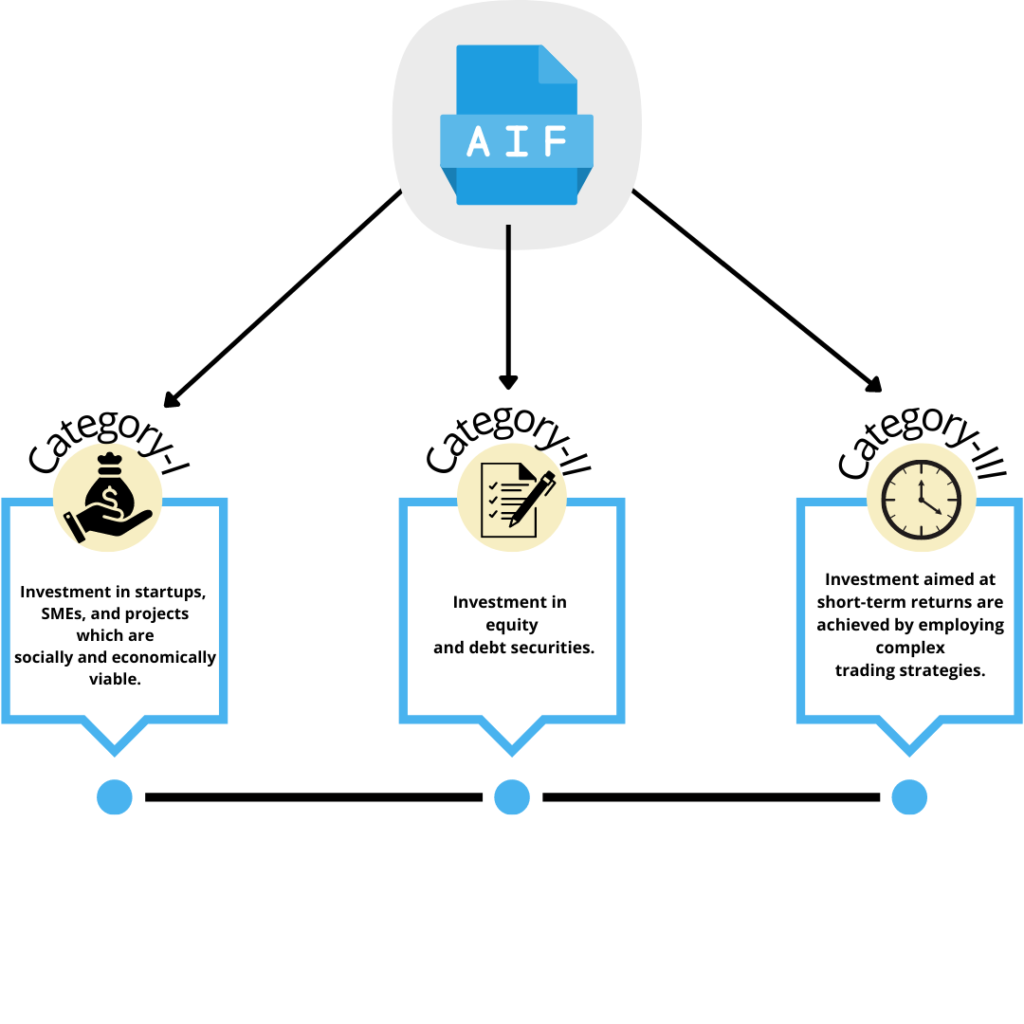
Category I AIF

These are AIFs that invest on start up and early stage venture , small and medium enterprises , infrastructure . AIFs I also Include investment in social and economically desire group. Category I considered to have moderate risk and low regulatory restriction compare to other AIFs categories.

Examples:

  • Venture Capital Funds
  • Angel Funds
  • Infrastructure Funds
  • SME Funds
  • Social Venture Funds

Category II AIF

These are AIFs that do not fall under both categories AIFs I and AIFs II . This category known for moderate risk and uncertainites for investment . These category include private Equity funds , debt funds , and funds invest in real state among India.

Examples:

  • Private Equity Funds
  • Debt Funds
  • Fund of Funds

Category III AIF

Category III Use complex stragies for These are AIFs that use complex trading strategies and leverage to generate high returns for investors, such as hedge funds, among others.

Step-by-Step AIF Registration Process in India

Step 1: Determine the Fund Structure

The first step is decide the legal structure of the fund for investment process.

And determining whether the funds fall in which category either is category I , II, Or III . Choosing the correct category is critical because regulatory requirements differ for each category.

You must:

  • Create the trust, LLP, or company
  • Draft constitutional documents
  • Obtain PAN and other registrations
  • Establish the investment management entity

SEBI reviews the legal structure carefully before granting approval.

Step 2: Select the Appropriate AIF Category

The second step is to determine whether the the fund falls under which is it Category I, Category II, or Category III.

The category affects investment restrictions, compliance requirements, and operational guidelines. Selecting the correct category at the beginning helps avoid regulatory complications later.

Step 3: Appoint the Sponsor and Investment Manager

Every AIF requires a sponsor and an investment manager for the analyising of funds.

The sponsor establishes the fund and contributes the required continuing interest, while the investment manager is responsible for managing investments and making portfolio decisions.

SEBI reviews the qualifications, experience, and regulatory track record of these entities during the registration process.

Step 4: Draft the Private Placement Memorandum (PPM)

The Private Placement Memorandum (PPM) is one of the most important documents for the AIF registration in India.

It contains key information such as:

  • Investment strategy for the investors
  • Risk factors and uncertainty
  • Governance structure
  • Fee structure
  • Investor rights
  • Exit mechanisms

A well-drafted PPM improves transparency and increases the likelihood of regulatory approval.

Step 5: Prepare Documentation

The Applicants must have all the documents which are needed for the investment before filing the application.

Common documents include:

  • Trust Deed or LLP Agreement
  • Certificate of Incorporation
  • PAN card details
  • Bank account details
  • Sponsor information
  • Investment manager details
  • Financial statements
  • Compliance declarations
  • Private Placement Memorandum

Accurate documentation helps prevent delays during SEBI review.

Step 6: Submit the Application to SEBI

This is one of the most important key element of the AIFs registration because application is officially submitted and the review as well as approval will be done SEBI. The application for AIF registration is submitted through SEBI’s online intermediary portal. The document should well prepared for the delay of registration.

The applicant must complete Form A, upload supporting documents, and pay the applicable fees.

Once submitted, SEBI begins its review process.

Step 7: Respond to SEBI Queries

Before the approval the SEBI may seek clarifications regarding the fund structure, investment strategy, governance framework, or the documentation.

Timely and accurate responses are essential for smooth approval.

Step 7: Respond to SEBI Queries

These is the final step SEBI will ask for the document clarification regarding several step for the investment. Respond to SEBI Queries objective is to ensure that the proposed Alternative Investment Fund complies with all regulatory requirements and adequately protects investor interests. In these several Queries may ask :

Asking for the missing documents , clarification regarding the fund structure, Investors protection, Governance and compliance framework concern.

How Long Does AIF Registration Take?

The time taken for AIF registration process depends on the situation of complexity of the application and the quality of documentation that has been submitted.

In most cases:

  • Fund Structuring: 2–4 Weeks
  • Documentation Preparation: 3–6 Weeks
  • SEBI Review: 4–12 Weeks
  • Final Approval: 2–4 Weeks

Most AIF registrations are completed within 2 to 8 months.

Conclusion

AIFs is very important crucial step for every fund manager , venture capital funds ,private equity funds and investment professionals looking to establish a regulated investment platform in India. By selecting the best AIFs category , fund structure , preparing all the documents and analysing the document which is needed for the AIFs registration process. By selecting the appropriate fund structure, preparing robust documentation, drafting a comprehensive PPM, and complying with SEBI regulations, applicants can successfully launch and operate an Alternative Investment Fund.

Frequently Asked Questions (FAQs)

What is a SEBI AIF Registration?

An Alternative Investment Fund that has registered with the Securities and Exchange Board of India (SEBI) is known as a SEBI AIF Registration. AIFs are investment vehicles that invest in assets such as private equity, venture capital, real estate, and debt securities.

What is AIF Registration?

All the registration process are done and approval from the SEBI is most important . In these approval from SEBI to establish and operate an Alternative Investment Fund in India.

Is SEBI Registration Mandatory for AIFs?

Yes, it is very important in every Alternative investment funds, and must be register with SEBI.

Who Can Register an AIF in India?

A Trust, LLP, Company, or Body Corporate can apply for AIF registration subject to SEBI regulations.

How Long Does AIF Registration Take?

It takes almost 2-8 months according to document submission to SEBI. If any document is not missing it will approve soon.

What is a Private Placement Memorandum (PPM)?

A PPM is a legal document that outlines the fund’s investment strategy, risks, fee structure, governance, and investor rights.

What Are the Benefits of AIF Registration?

AIF registration provides regulatory recognition, investor confidence, fundraising opportunities, and a structured framework for managing investments.

Difference Between Category I, II, and III AIFs Explained

How to Build a Multi-AIF Investment Strategy: Allocating Across Categories I, II, and III

There is more than Alternative Investment Funds (AIFs) which have become the most one of the preferred investment vehicles for the high-net-worth individuals (HNIs), family offices, institutional investors, and startups are looking for the well structured capital solutions in India.There are many investors and businesses who are still in doubt to understand the difference between Category I, Category II, and Category III AIFs.

If someone is planning to invest in AIFs, and want to launch an investment fund, or explore emerging AI-driven investment technologies, understanding these categories are very important for making informed financial decisions.

In this guide, we will try to explain everything about Category I, II, and III AIFs in a very simple language — including the structure, benefits, taxation, regulations, examples, and how technology and AI are transforming the AIF ecosystem.

What is an AIF?

There is An Alternative Investment Fund (AIF) is a privately pooled investment vehicle regulated by the Securities and Exchange Board of India (SEBI). The funds used to collect money from the sophisticated investors and invest in assets beyond traditional stocks and bonds.

AIFs generally invest in:

  • Startups company
  • Private equity
  • Venture capital
  • Real estate
  • Infrastructure development
  • Debt instruments
  • Hedge funds

AIFs is regulated by the SEBI (Alternative Investment Funds) under the Regulations, 2012.

Types of AIFs in India

The SEBI is classified in AIFs in three categories

  1. Category I AIF
  2. Category II AIF
  3. Category III AIF

Every category has different investment strategies like risk levels, tax implications, and the regulatory benefits.

Category I AIF Explained

The Category I AIFs invest in those sectors which are considered socially and economically beneficial for India.

These kinds of funds receive more incentives and support from the government because this sector contribute to economic growth as well as innovation.

Key Features of Category I AIFs

  • Invest in the startups in the Newly businesses
  • The promotion of the Entrepreuneurship
  • Have less investment risk
  • Government incentives may apply
  • Long-term investment opportunity

Types of Category I AIFs

Venture Capital Funds (VCFs)

Investing in the startups and the high-growth companies.

SME Funds

These are focused in Medium enterprise

Infrastructure Funds

In these Investment in the infrastructure project for example Roads , energy and logistics.

Social Venture Funds

In these the company which creates social welfare gets Funds

Who Should Invest in Category I AIFs?

Category I AIFs are suitable for:

  • For the Long-term investors
    • Startup-focused investors which can create innovation
  • Investors seeking government-supported sectors
  • High-risk, high-growth investors

Category II AIF Explained

Category II AIFs are the most common type of AIF in India. These kinds of funds don’t receive incentive through the the government and do not have aggresive trading strategies compare to Category III.

They primarily invest in the private companies, debt instruments, and the unlisted businesses.

Features of Category II AIFs

  • There is no leverage expectation for operations.
  • Mature business gets investment
  • From medium to long term investment
    • It is Stable compared to Category III
  • Widely used by private equity firms

Different types of Category II AIFs

Private Equity Funds

Private companies which is established gets Investment

Debt Funds

Invest in debt for securities of companies.

Fund of Funds

Invest in other AIFs.

Real Estate Funds

Invest in commercial and residential projects.

Who Should Invest in Category II AIFs?

Ideal for:

  • High Net worth individual
  • Institutional investors
  • Family offices
  • Investors seeking balanced risk and return

Category III AIF Explained

In Category III AIFs they use high complex trading strategies and may employ leverage to generate short-term investment returns.

These funds are similar to the hedge funds and actively trade across markets.

Features of Category III AIFs

  • Use for leverage and derivatives
  • High risk for investment
  • Short-term opportunities for trading
  • Higher flow of liquidity
  • Suitable for sophisticated investors

Examples of Category III AIFs

  • Hedge Funds : wide range of assets , debt , real estates
  • Quantitative Trading Funds
  • AI-powered Algorithmic Trading Funds
  • Long-short equity funds

Who Should Invest in Category III AIFs?

Suitable for the :

  • Aggressive investors
  • HNIs
  • Institutional traders
  • Investors comfortable with market fluctuations of price

Difference Between Category I, II, and III AIFs

FeatureCategory I AIFCategory II AIFCategory III AIF
Investment Focus onStartups, SMEs, infrastructurePrivate equity, debtTrading & hedge strategies
Government Incentives presenceYesNoNo
Risk LevelModerate to HighModerateVery High
Leverage AllowedLimitedLimitedYes
Investment time periodLong-termMedium to Long-termShort-term to Medium-term
LiquidityLowModerateHigh
Type of investorGrowth investorsBalanced investorsAggressive investors
Examples:Venture capital fundsPE fundsHedge funds

Taxation of AIFs in India

Taxation differs depending on the category of the AIF.

Category I and II AIF Taxation

These are categories who generally enjoy pass-through taxation status, meaning income is taxed in the hands of investors rather than the fund itself.

Category III AIF Taxation

Category III do not receive any pass through status and are taxed at their fund level.

Tax regulations can change frequently, so professional tax consultation is advisable.

According to SEBI regulations:

  • Minimum investment should be 1 crore rupee for the investor.
  • And For the directors/employees/managers of the fund should be 25 lakhs.

These are mainly designed for sophisticated investors.

Benefits of Investing in AIFs

Portfolio Diversification

In AIFs we explore beyond traditional equity and also for the debt markets.

Access to High-Growth Opportunities

Investors can directly participate in startups, private companies, and emerging sectors for the high return.

Fund Management by professional

It is Managed by experienced professionals and investment experts to reduced the risk and uncertainties of your funds.

Potential for Higher Returns

Alternative assets can be generated higher returns compare to conventional investments.

Risks Associated with AIFs

AIFs offer strong growth potential, they also come with high risks:

  • Limited liquidity
  • Market uncertainty
    • Government Regulation
  • High minimum investment
  • Complex structures

Investors should evaluate their risk appetite more carefully before investment in company.

How AI is Transforming the AIF Industry

Artificial Intelligence is changing very fast the way Alternative Investment Funds operate.

Modern AIF firms are using AI for:

  • Portfolio optimization
  • For identifying the risk
  • Detection of funds
  • Predictive analytics
  • Algorithmic trading
  • Investor reporting automation

AI agents can process a huge financial datasets in real-time, helping the fund managers make faster decision and more reliable investment decisions.

Businesses looking to integrate intelligent automation into investment operations can leverage custom AI solutions from Winklix AI Agent Development Services. Their AI-driven systems help enterprises build autonomous AI agents for finance, investment management, and operational automation.

Why Understanding AIF Categories Matters

Choosing the right AIF category depends on several factors:

  • Investment goals
  • Risk tolerance
  • Liquidity requirements
  • Tax planning
  • Investment horizon

A startup-focused investor may prefer Category I, while a stable private equity investor may choose Category II. Aggressive investors looking for high-frequency strategies may opt for Category III.

Understanding these differences helps investors make smarter financial decisions.

Future of AIFs in India

India’s alternative investment market is expected to grow further in future due to significantly aspects:

  • Rising the ecosystem
    • Due to Increased HNI participation
  • The growth of the private capital
  • AI-driven investment management
  • Increase of fintech and wealthtech platforms

As the financial technology is evolving, AI -powered fund management and automation is likely to become more in future of AIFs .

Final Thoughts

Alternative Investment Funds are reshaping India’s investment landscape by offering sophisticated investors access to private markets, startups, and advanced trading opportunities.

The understanding of difference between Category I, II, and III AIFs is very important key aspects before making any investment decisions. Each and every category serves different investor needs, risk profiles, and financial goals.

As AI automate and continue to transform financial services, the future of AIF management will become more increasingly data-driven and intelligent. Businesses and investment firms are adopting AI-powered solutions early will gain a strong competitive advantage in the evolving alternative investment ecosystem.

Frequently Asked Questions (FAQs)

1. What is the main difference between Category I, II, and III AIFs?

Category I focuses on startups and socially beneficial sectors, Category II focuses on private investment and debt investments, while Category III invest in complex trading and hedge fund strategies.

2. Which AIF category is the safest?

The category II AIFs are find safe and considered relatively stable for the investment.Category III is avoided because of leverage trading strategies .

3. Can Category III AIFs use leverage?

Yes, Category III AIFs are allowed to use leverage and derivatives for investment strategies.

4. What is the minimum investment required for AIFs in India?

The minimum investment amount is generally ₹1 Crore per investor.

5. Are AIFs regulated in India?

Yes, AIFs are regulated by the (SEBI)Securities and Exchange Board of India 

6. Which AIF category invests in startups?

The Category I AIFs primary focus on investment in startups, SMEs, and innovative driven businesses.

7. How is AI being used in AIF management?

AI helps in many aspects like prediction analytics, algorithmic trading, investor analytics, portfolio management, and automation of investment operations.

8. Are AIFs better than mutual funds?

AIFs offer access to alternative assets and potentially higher returns, but they also comes with the higher barrier risk and it take larger investments compared to mutual funds.

AIF Registration and Licensing: What Fund Managers Need to Know

AIF Registration and Licensing: What Fund Managers Need to Know

Alternative Investment Funds (AIFs) have become a pivotal component of India’s investment landscape, offering avenues beyond traditional equity and debt markets. For fund managers aiming to establish or expand their presence in this sector, understanding the nuances of AIF registration is crucial. This guide delves into the essentials of AIF registration in India, highlighting the process, requirements, and the role of AIF registration consultants.

Understanding AIF Registration in India

AIFs are categorized into three types by the Securities and Exchange Board of India (SEBI):

  • Category I AIFs: These funds invest in start-ups, social ventures, SMEs, or infrastructure, promoting economic development and employment.
  • Category II AIFs: These funds do not undertake leverage or borrowing other than to meet day-to-day operational requirements and are not classified under Category I or III.
  • Category III AIFs: These funds employ diverse or complex trading strategies and may employ leverage, including through investment in listed or unlisted derivatives.

Each category has specific regulatory requirements and investment strategies, influencing the registration process.

Steps for Online AIF Registration in India

The process of AIF registration involves several key steps:

  1. Determine the Appropriate Category: Assess your fund’s investment strategy to select the appropriate AIF category.
  2. Prepare Required Documentation: Gather necessary documents, including:
    • Draft Placement Memorandum
    • Details of the investment strategy and business plan
    • Company registration certificate
    • Trust deed or partnership deed, as applicable
  3. Submit Application via SEBI’s Online Portal: Complete and submit the application form through SEBI’s online platform, ensuring all information is accurate and comprehensive.
  4. Pay Registration Fees: The registration fees vary by category:
    • Category I: ₹5,00,000
    • Category II: ₹10,00,000
    • Category III: ₹15,00,000
  5. Await SEBI’s Approval: SEBI will review the application and may request additional information or clarification.
  6. Obtain Registration Certificate: Upon approval, SEBI will issue the AIF registration certificate.

Role of an AIF Registration Consultant

Navigating the AIF registration process can be complex. Engaging an AIF registration consultant can provide several benefits:

  • Expert Guidance: Consultants offer insights into the most suitable AIF category based on your fund’s objectives.
  • Documentation Assistance: They assist in preparing and reviewing necessary documents, ensuring compliance with SEBI’s guidelines.
  • Application Support: Consultants help in accurately completing and submitting the online application, reducing the risk of errors.
  • Ongoing Compliance: Post-registration, they can advise on maintaining compliance with SEBI’s regulations, including reporting requirements and audits.

Regulatory Compliance and Reporting Requirements

Post-registration, AIFs must adhere to SEBI’s regulatory framework, which includes:

  • Periodic Reporting: AIFs are required to submit quarterly and annual reports detailing their financial status, investment activities, and performance metrics.
  • Event-Based Reporting: Any significant changes, such as alterations in key personnel or investment strategies, must be promptly reported to SEBI.
  • Investor Communication: Regular updates to investors regarding fund performance, risks, and other pertinent information are mandatory.
  • Audit and Valuation: Regular audits and independent valuations are essential to ensure transparency and compliance.

Conclusion

Establishing an AIF in India offers significant opportunities for fund managers to diversify investment portfolios and cater to a broader investor base. However, the registration and regulatory compliance processes require careful planning and execution. By understanding the steps involved and seeking professional assistance from an AIF registration consultant, fund managers can navigate the complexities of AIF registration in India effectively.

Comparing AIFs with Mutual Funds and ETFs: Which Offers Better Returns?

Comparing AIFs with Mutual Funds and ETFs: Which Offers Better Returns?

As Indian investors increasingly look beyond traditional investment options, Alternative Investment Funds (AIFs) have gained significant attention. While mutual funds and Exchange-Traded Funds (ETFs) remain popular for retail and institutional investors alike, the higher risk-return potential of AIFs has prompted many high-net-worth individuals (HNIs) to consider this route. But how do AIFs stack up in terms of returns compared to mutual funds and ETFs? Let’s dive into the key differences, benefits, and which might offer better returns depending on your investment profile.

What Are AIFs, Mutual Funds, and ETFs?

  • Alternative Investment Funds (AIFs): These are privately pooled investment vehicles that collect funds from sophisticated investors for investing according to a defined strategy. AIFs in India are categorized into three types (Category I, II, and III) and are regulated by SEBI. Common AIF examples include private equity funds, hedge funds, and venture capital funds.
  • Mutual Funds: Regulated by SEBI, mutual funds pool money from various investors to invest in stocks, bonds, or a mix of both. They are highly liquid and suitable for a broad investor base.
  • ETFs (Exchange-Traded Funds): These are investment funds traded on stock exchanges, much like stocks. ETFs typically track an index and offer liquidity, transparency, and lower expense ratios.

Return Potential: AIFs vs. Mutual Funds vs. ETFs

Alternative Investment Funds (AIFs)

AIFs typically offer higher return potential compared to mutual funds and ETFs, especially in Category III AIFs (like hedge funds). They are actively managed and focus on niche investment opportunities, including private equity, distressed assets, and real estate.

However, this comes with higher risk and longer lock-in periods, making AIFs more suitable for seasoned investors or HNIs.

For those interested in accessing such high-growth potential vehicles, AIF Registration in India is a must. You can now easily apply through Online AIF Registration in India portals with the help of an expert AIF Registration Consultant.

Mutual Funds

Mutual funds offer moderate returns with lower risk compared to AIFs. The return potential depends on the fund category (debt, equity, hybrid). They are regulated, transparent, and suitable for long-term wealth creation for the average investor.

ETFs

ETFs generally deliver returns that mirror the underlying index (e.g., Nifty 50 or Sensex). They have the lowest expense ratios and are ideal for passive investors looking for market-linked returns with high liquidity.

Risk-Return Comparison

Investment TypeRisk LevelReturn PotentialLiquidityIdeal For
AIFsHighHighLowHNIs, Sophisticated Investors
Mutual FundsModerateModerateHighRetail & Long-term Investors
ETFsLow-ModerateMarket-linkedVery HighPassive Investors, Traders

Regulatory Compliance and Registration

AIFs require strict compliance under SEBI regulations. If you’re planning to set up an AIF in India, understanding the legal framework is crucial. The process involves:

Engaging a professional AIF Registration Consultant can streamline the process of AIF Registration Online in India, ensuring regulatory compliance and faster approvals.

Final Verdict: Which One is Better?

  • If you’re a retail investor with a moderate risk appetite, mutual funds or ETFs may offer better consistency and ease.
  • If you’re an HNI looking for high alpha, access to unique investment strategies, and are comfortable with higher risks, AIFs may outperform in terms of returns.

That said, each investment vehicle has its own place in a well-diversified portfolio. The choice ultimately depends on your investment goals, time horizon, and risk tolerance.

Conclusion

As India’s investment ecosystem matures, AIFs are becoming an attractive option for investors looking to go beyond the conventional. With the rise in Online AIF Registration in India, setting up an AIF is now more accessible than ever. Whether you’re a fund manager, wealth advisor, or investor, partnering with an experienced AIF Registration Consultant can help you navigate the regulatory landscape and capitalize on this growing opportunity.

If you’re exploring Alternative Investment Fund Registration in India, don’t hesitate to seek professional advice to make informed, compliant, and strategic investment decisions.

The Shift Towards Thematic AIFs: Investing in Disruptive Industries

The Shift Towards Thematic AIFs: Investing in Disruptive Industries

The investment landscape is evolving rapidly. One of the most significant trends shaping this evolution is the rise of thematic Alternative Investment Funds (AIFs), especially those focused on disruptive industries like artificial intelligence, renewable energy, fintech, biotechnology, and more. As investors seek to align their portfolios with future-forward sectors, the importance of AIF Registration in India and securing the right AIF Registration Consultant has grown considerably.

What Are Thematic AIFs?

Unlike traditional investment approaches that focus primarily on asset classes, thematic AIFs revolve around major trends and transformative technologies that are reshaping the global economy. These funds identify and invest in businesses poised to benefit from long-term structural shifts, providing investors exposure to innovation-led growth.

Why the Surge in Interest?

Several factors are fueling the shift towards thematic AIFs:

  • Disruption as the New Normal: Technology and innovation are no longer isolated sectors; they are integral to every industry. Thematic AIFs enable investors to participate directly in these disruptive trends.
  • Diversification: By investing across industries linked by a theme rather than a sector, investors achieve better diversification.
  • Enhanced Returns: Early investments in disruptive industries often yield superior returns compared to traditional sectors.

Given these advantages, many fund managers and institutions are actively pursuing Online AIF Registration in India to launch thematic funds that cater to growing investor demand.

AIF Registration Process in India

Setting up an Alternative Investment Fund requires regulatory approval from the Securities and Exchange Board of India (SEBI). The process includes:

  • Preparation of legal documents like the Private Placement Memorandum (PPM)
  • Formation of the fund entity
  • Submission of applications through SEBI’s online portal
  • Compliance with Category I, II, or III AIF norms based on the fund’s structure

For those looking for a seamless experience, Online Alternative Investment Fund Registration in India has simplified the application procedure, but expertise is still critical. Partnering with an experienced AIF Registration Consultant ensures that your documentation, structuring, and regulatory compliance meet SEBI’s standards effectively.

Benefits of Online AIF Registration

The rise of digital platforms has made AIF Registration Online in India much more efficient, reducing paperwork, improving communication with regulatory authorities, and speeding up approval timelines. This efficiency enables fund managers to focus on portfolio construction around high-potential disruptive themes without being bogged down by administrative hurdles.

Conclusion: Future-Proofing Portfolios

Thematic investing through AIFs offers a unique opportunity to future-proof portfolios by gaining exposure to the industries and technologies of tomorrow. Whether it’s blockchain, electric vehicles, genomics, or clean energy, these themes have the potential to deliver significant long-term rewards.

For fund managers and investors interested in capitalizing on these trends, understanding the nuances of Alternative Investment Fund Registration in India is critical. Working with a trusted AIF Registration Consultant ensures not only a smoother setup but also strategic positioning for success in a competitive market.

Ready to explore thematic investing and participate in the next wave of innovation? Start with efficient and compliant Online AIF Registration in India today!

AIFs and the Rise of Impact Investing: Aligning Profit with Purpose

AIFs and the Rise of Impact Investing: Aligning Profit with Purpose

In recent years, the investment landscape has experienced a paradigm shift. Investors are no longer focused solely on financial returns—they’re seeking to make a difference while making a profit. This growing trend, known as impact investing, has led to a significant rise in the popularity of Alternative Investment Funds (AIFs) in India.

Understanding Impact Investing

Impact investing is a strategy that aims to generate both financial returns and measurable social or environmental impact. Whether it’s promoting clean energy, supporting education, or fostering inclusive financial systems, impact investing blends purpose with profit in a meaningful way.

The Role of AIFs in Impact Investing

Alternative Investment Funds (AIFs) have emerged as a preferred vehicle for channeling impact-driven capital. These funds are privately pooled investment vehicles that collect funds from investors for investing according to a defined investment policy. In India, AIFs are categorized into three types:

  • Category I AIFs: Investments in socially or economically desirable sectors (e.g., infrastructure, SMEs, social ventures).
  • Category II AIFs: Private equity funds or debt funds.
  • Category III AIFs: Funds that employ complex strategies or invest in listed/unlisted derivatives.

Of these, Category I AIFs are particularly popular among impact investors due to their alignment with national priorities and developmental goals.

Why AIFs Are Ideal for Impact Investing

  1. Flexibility in Strategy
    AIFs offer more strategic freedom than traditional mutual funds, allowing for customized impact-driven investment models.
  2. Long-term Investment Horizon
    Impact investing often requires a longer timeline to see both financial and social returns. AIFs are structured to accommodate such horizons.
  3. Support from Regulators
    SEBI (Securities and Exchange Board of India) has streamlined the AIF Registration in India, encouraging more players to enter the space and contribute to the growth of socially beneficial projects.

AIF Registration in India: A Gateway to Impact

Setting up an AIF requires registration with SEBI. The process can be complex, involving regulatory compliance, legal structuring, and operational planning. This is where an AIF Registration Consultant becomes invaluable.

For those looking to align investments with social causes, obtaining Online AIF Registration in India offers a more accessible pathway. Many professionals and platforms now offer AIF Registration Online in India, simplifying the setup process for both domestic and international investors.

With streamlined digital processes and experienced consultants guiding fund managers, Online Alternative Investment Fund Registration in India has never been easier or more efficient.

Final Thoughts

As the world moves towards more responsible and sustainable investing, AIFs are at the forefront of this evolution. They offer a robust framework for impact-driven investing in India, making it possible to align profit with purpose.

Whether you’re a socially conscious investor or a fund manager aiming to make a difference, starting your journey with Alternative Investment Fund Registration in India can be your first step toward meaningful capital deployment. And with the convenience of online AIF registration counsltant in India, that step is now more accessible than ever.

Key Players in the AIF Industry: Fund Managers, Regulators, and Investors

"Fund Managers vs. Direct Investments: Why AIFs Could Be the Smart Choice

The Alternative Investment Fund (AIF) industry in India is rapidly evolving, attracting a wide range of high-net-worth individuals (HNIs), institutions, and international investors. With a more sophisticated approach to investing and diversified portfolios, AIFs have emerged as a powerful investment vehicle in the Indian financial ecosystem.

However, the success and stability of this sector rest on the dynamic interplay between three key players: Fund Managers, Regulators, and Investors. Whether you are planning to launch your own fund or invest in one, understanding the roles of these stakeholders is crucial.

If you’re exploring AIF Registration in India, knowing how these entities interact will also help you navigate the regulatory landscape more effectively.

1. Fund Managers: The Strategic Architects

Fund managers are the backbone of any AIF. They are responsible for formulating investment strategies, making asset allocation decisions, and managing the day-to-day operations of the fund.

Responsibilities of Fund Managers:

  • Designing the fund’s investment thesis
  • Conducting due diligence and risk assessments
  • Managing investor relationships
  • Ensuring compliance with SEBI norms
  • Delivering returns in line with stated objectives

If you’re looking to become a fund manager or set up an AIF, starting with the Online AIF Registration in India process is essential. Many fund managers work closely with an AIF Registration Consultant to ensure smooth compliance and documentation.

2. Regulators: Ensuring Compliance and Transparency

In India, the primary regulator for AIFs is the Securities and Exchange Board of India (SEBI). SEBI ensures that all alternative investment funds operate within the defined legal framework to protect investor interests and maintain market integrity.

Key Functions of Regulators:

  • Issuing guidelines and frameworks for AIF operations
  • Reviewing and approving AIF registration applications
  • Monitoring fund disclosures and periodic reports
  • Taking corrective actions in case of violations

Before launching a fund, understanding the Alternative Investment Fund Registration in India process is essential. SEBI regulations must be strictly followed to avoid penalties and maintain investor confidence.

For a streamlined experience, many new fund houses opt for Online Alternative Investment Fund Registration in India with the help of legal and financial experts.

3. Investors: Fueling the AIF Ecosystem

Investors in AIFs typically include high-net-worth individuals, family offices, institutional investors, and corporate entities. They provide the capital that fund managers use to build diverse investment portfolios across private equity, venture capital, hedge funds, real estate, and more.

What Investors Look For:

  • Track record and credibility of fund managers
  • Clear and transparent investment strategy
  • Regulatory compliance and reporting standards
  • Potential for high returns with managed risk

For investors, knowing that a fund has completed proper AIF Registration Online in India adds an additional layer of trust and confidence. It ensures that the fund is regulated by SEBI and operates within a secure and structured environment.

AIF Registration in India: Why It Matters

Getting your AIF registered is the first legal step toward operating a legitimate and credible investment vehicle. The AIF Registration in India process involves several steps, including documentation, legal scrutiny, and SEBI approval.

To simplify this complex process, many fund managers rely on experienced AIF Registration Consultants who offer:

  • End-to-end guidance and compliance support
  • Assistance with documentation and SEBI communication
  • Expert legal and financial advice tailored to your fund model

With the option of AIF Registration Online in India, the process has become more streamlined, accessible, and efficient—especially with expert consultants guiding the way.

Final Thoughts

The AIF industry is a collaborative space where fund managers design, regulators supervise, and investors fuel growth. To operate smoothly and gain investor trust, it’s critical to ensure proper Alternative Investment Fund Registration in India, ideally with the help of an experienced AIF Registration Consultant.

Whether you’re a fund manager planning your launch or an investor exploring new opportunities, understanding the key roles in the AIF ecosystem can help you make better, more informed decisions.

Need help with Online AIF Registration in India? Consult a trusted AIF Registration Consultant and take the first step toward building a compliant and successful alternative investment fund.

Understanding AIF Fund Structures: Open-Ended vs. Close-Ended Funds

Understanding AIF Fund Structures: Open-Ended vs. Close-Ended Funds

Introduction

Alternative Investment Funds (AIFs) have gained significant traction in India as an attractive investment vehicle for high-net-worth individuals and institutional investors. AIFs are regulated by the Securities and Exchange Board of India (SEBI) and require proper AIF Registration in India to operate legally. This article explores the differences between open-ended and close-ended AIF fund structures to help investors make informed decisions.

What Are Alternative Investment Funds (AIFs)?

AIFs are privately pooled investment funds established or incorporated in India, which collect funds from investors to invest in accordance with a defined investment policy. These funds are categorized into three main types:

  • Category I AIFs: Funds that invest in start-ups, SMEs, and other socially or economically beneficial sectors.
  • Category II AIFs: Funds that do not undertake leverage or borrowing other than to meet daily operational requirements.
  • Category III AIFs: Funds that employ diverse trading strategies and may use leverage.

Before launching an AIF, fund managers must complete Online AIF Registration in India through SEBI’s portal or consult an AIF Registration Consultant for a hassle-free process.

Open-Ended vs. Close-Ended AIFs

AIFs can be structured as open-ended or close-ended funds. Understanding their differences can help investors choose the right option.

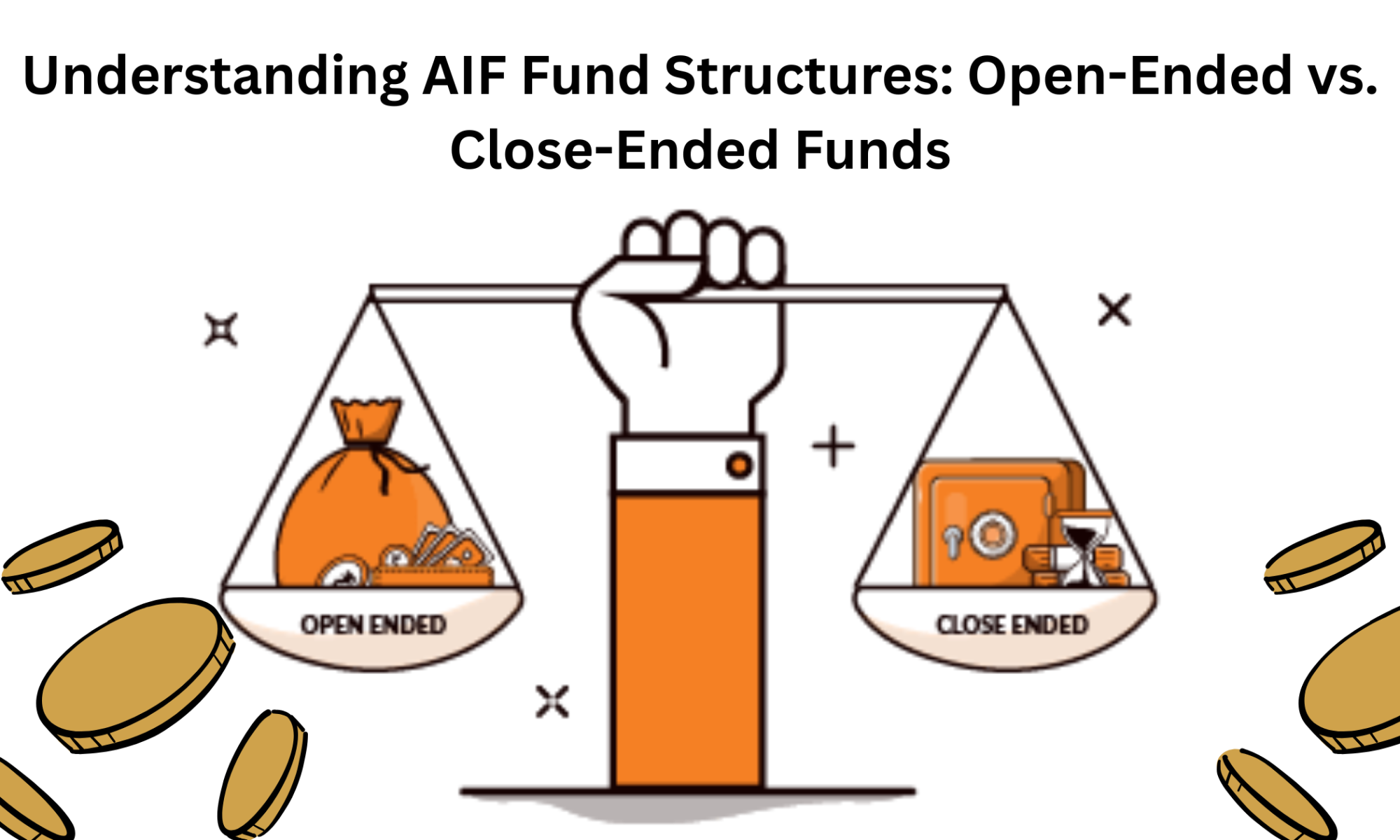
Open-Ended AIFs

Open-ended funds allow investors to enter and exit at any time, offering flexibility and liquidity. Some key characteristics include:

  • Liquidity: Investors can redeem their investments periodically.
  • No Fixed Maturity: There is no predetermined lock-in period.
  • Continuous Fundraising: These funds can accept investments on an ongoing basis.
  • Market Volatility Exposure: Returns may fluctuate due to frequent investor redemptions and market conditions.

While open-ended AIFs provide liquidity benefits, they require efficient management to handle redemption pressures.

Close-Ended AIFs

Close-ended funds have a fixed tenure, typically between 3 to 10 years, and do not allow investors to withdraw their money before maturity. Key features include:

  • Fixed Investment Period: Investors commit their funds for a specified duration.
  • Better Portfolio Stability: Fund managers can implement long-term investment strategies without concerns about frequent withdrawals.
  • Potentially Higher Returns: These funds may offer better returns as investments are held for a longer duration.
  • Limited Liquidity: Investors may exit only through secondary market transactions, if available.

Choosing the Right AIF Structure

Investors should consider the following factors before choosing an AIF structure:

  1. Liquidity Needs: Those requiring flexibility may prefer open-ended AIFs.
  2. Investment Horizon: If long-term capital appreciation is the goal, close-ended AIFs might be more suitable.
  3. Risk Appetite: Open-ended funds are more sensitive to market volatility, whereas close-ended funds offer stability.
  4. Regulatory Compliance: Ensure proper AIF Registration Online in India before investing.

The Importance of AIF Registration

To operate legally, all AIFs must complete Alternative Investment Fund Registration in India with SEBI. Fund managers can seek assistance from an AIF Registration Consultant to ensure compliance and avoid regulatory challenges. The process includes submitting detailed documentation and adhering to SEBI’s guidelines.

Conclusion

Choosing between an open-ended and close-ended AIF depends on investment goals, risk tolerance, and liquidity requirements. Whether opting for an open-ended fund’s flexibility or a close-ended fund’s stability, securing Online Alternative Investment Fund Registration in India is crucial. Investors and fund managers should consult an AIF Registration Consultant to streamline the registration process and ensure regulatory compliance.

Investing in Infrastructure Through AIFs: A Long-Term Growth Strategy

Investing in Infrastructure Through AIFs: A Long-Term Growth Strategy

Infrastructure investment has long been a critical component of economic growth, providing essential services and facilities that drive national progress. For investors seeking long-term growth opportunities, Alternative Investment Funds (AIFs) have emerged as a viable option. With the increasing demand for infrastructure development in India, investing through AIFs presents a strategic avenue for sustainable returns.

Understanding Alternative Investment Funds (AIFs)

Alternative Investment Funds (AIFs) are pooled investment vehicles that cater to high-net-worth individuals (HNWIs) and institutional investors. These funds invest in various asset classes, including infrastructure, real estate, venture capital, private equity, and hedge funds. With a well-regulated framework, AIFs provide investors with diversified exposure to high-growth sectors.

Why Invest in Infrastructure Through AIFs?

  1. Stable and Long-Term Returns: Infrastructure projects, such as highways, airports, and energy plants, generate steady cash flows over extended periods, making them an attractive investment avenue.
  2. Government Support: The Indian government actively promotes infrastructure development through policy support, tax benefits, and public-private partnerships (PPPs), enhancing the viability of such investments.
  3. Diversification: Infrastructure AIFs offer diversification, reducing the risk associated with traditional investment avenues like stocks and bonds.
  4. Inflation Hedge: Infrastructure investments often provide inflation-adjusted returns, ensuring long-term wealth preservation.

AIF Registration in India: The Process

For investors and fund managers looking to set up an AIF focused on infrastructure, understanding the AIF Registration in India is crucial. The Securities and Exchange Board of India (SEBI) governs AIFs under the SEBI (Alternative Investment Funds) Regulations, 2012. The registration process involves:

  • Identifying the category of AIF (Category I, II, or III) suitable for infrastructure investment.
  • Preparing a comprehensive application, including investment strategies and compliance documents.
  • Submitting the application through Online AIF Registration in India via the SEBI portal.
  • Meeting capital requirements and regulatory compliance before operationalizing the fund.

Advantages of Online AIF Registration in India

With advancements in digital infrastructure, AIF Registration Online in India has streamlined the approval process. Online submissions facilitate quick processing, reduce paperwork, and enhance transparency. Fund managers and investors benefit from:

  • Simplified documentation
  • Faster regulatory approvals
  • Secure and transparent transactions

Role of AIF Registration Consultants

Navigating the complex process of Alternative Investment Fund Registration in India requires expertise. Engaging an AIF Registration Consultant can ease the process by ensuring compliance with SEBI guidelines, preparing necessary documentation, and facilitating smooth approvals. Consultants provide valuable insights into fund structuring, investment strategies, and risk mitigation.

Conclusion

Investing in infrastructure through AIFs offers a compelling opportunity for long-term growth. With structured frameworks, regulatory support, and a streamlined Online Alternative Investment Fund Registration in India process, investors can leverage AIFs for sustainable wealth creation. By partnering with an experienced AIF Registration Consultant, fund managers can navigate the regulatory landscape efficiently and capitalize on India’s growing infrastructure sector.

If you’re looking to enter the infrastructure investment space through AIFs, ensuring seamless AIF Registration in India is the first step towards unlocking lucrative opportunities. Embrace the future of investment by leveraging the benefits of Online AIF Registration in India and secure a strong financial future.

Understanding the Different Categories of AIFs: Which One Suits Your Investment Strategy?

Understanding the Different Categories of AIFs: Which One Suits Your Investment Strategy?

Introduction

Alternative Investment Funds (AIFs) have emerged as a popular investment option in India, providing investors with diversified opportunities beyond traditional financial instruments. The Securities and Exchange Board of India (SEBI) regulates AIFs, categorizing them into three distinct classes to align with varying investment strategies. If you’re considering AIF Registration in India, it’s crucial to understand these categories to determine which one best suits your financial goals.

Categories of Alternative Investment Funds (AIFs)

1. Category I AIFs

Category I AIFs primarily invest in startups, Small and Medium Enterprises (SMEs), and socially or economically beneficial ventures. SEBI encourages investments in these funds by offering incentives and concessions due to their positive impact on the economy.

Types of Category I AIFs:

  • Venture Capital Funds (VCFs): Focus on funding early-stage startups.
  • SME Funds: Invest in small and medium enterprises to promote growth.
  • Social Venture Funds: Support businesses with a social cause.
  • Infrastructure Funds: Invest in infrastructure development projects.

Best Suited For: Investors looking for long-term growth and economic impact while willing to take high risks.

2. Category II AIFs

Category II AIFs do not receive any specific government incentives but have flexible investment strategies. These funds typically include private equity, debt funds, and other structured investments.

Types of Category II AIFs:

  • Private Equity Funds: Invest in unlisted companies for growth capital.
  • Debt Funds: Provide structured debt instruments to businesses.
  • Fund of Funds: Invest in other AIFs instead of direct securities.

Best Suited For: Investors seeking moderate to high returns through diverse investment avenues.

3. Category III AIFs

Category III AIFs use complex trading strategies and leverage to generate high returns in both listed and unlisted securities. These funds are often hedge funds that adopt dynamic investment strategies.

Types of Category III AIFs:

  • Hedge Funds: Engage in short-selling, derivatives trading, and arbitrage.
  • Multi-Strategy Funds: Utilize a combination of investment approaches.

Best Suited For: High-net-worth individuals (HNIs) and institutional investors looking for aggressive, high-risk investment opportunities.

AIF Registration Process in India

To set up an AIF in India, it is essential to complete the AIF Registration Online in India through SEBI. The steps involved in the Online Alternative Investment Fund Registration in India include:

  1. Choose the Right Category: Determine the appropriate AIF category based on investment goals.
  2. Prepare the Documentation: Submit a detailed application, including fund structure, investment strategy, and compliance policies.
  3. SEBI Approval: The application undergoes scrutiny before receiving SEBI approval.
  4. Operational Compliance: Ensure ongoing regulatory compliance post-registration.

How an AIF Registration Consultant Can Help

Navigating the complexities of AIF Registration Online in India can be challenging. An experienced AIF Registration Consultant can provide professional guidance on compliance, documentation, and regulatory requirements to streamline the process efficiently.

Conclusion

Understanding the different categories of AIFs is crucial for aligning your investment strategy with the right fund type. Whether you’re interested in venture capital, private equity, or hedge funds, selecting the appropriate category is key to maximizing returns. If you’re considering Alternative Investment Fund Registration in India, leveraging professional consultancy services can ensure a smooth registration process.

For expert assistance with Online AIF Registration in India, consult an experienced professional today and take a strategic step toward diversified investments!