
Difference Between Category I, II, and III AIFs Explained

How to Build a Multi-AIF Investment Strategy: Allocating Across Categories I, II, and III

There is more than Alternative Investment Funds (AIFs) which have become the most one of the preferred investment vehicles for the high-net-worth individuals (HNIs), family offices, institutional investors, and startups are looking for the well structured capital solutions in India.There are many investors and businesses who are still in doubt to understand the difference between Category I, Category II, and Category III AIFs.

If someone is planning to invest in AIFs, and want to launch an investment fund, or explore emerging AI-driven investment technologies, understanding these categories are very important for making informed financial decisions.

In this guide, we will try to explain everything about Category I, II, and III AIFs in a very simple language — including the structure, benefits, taxation, regulations, examples, and how technology and AI are transforming the AIF ecosystem.

What is an AIF?

There is An Alternative Investment Fund (AIF) is a privately pooled investment vehicle regulated by the Securities and Exchange Board of India (SEBI). The funds used to collect money from the sophisticated investors and invest in assets beyond traditional stocks and bonds.

AIFs generally invest in:

  • Startups company
  • Private equity
  • Venture capital
  • Real estate
  • Infrastructure development
  • Debt instruments
  • Hedge funds

AIFs is regulated by the SEBI (Alternative Investment Funds) under the Regulations, 2012.

Types of AIFs in India

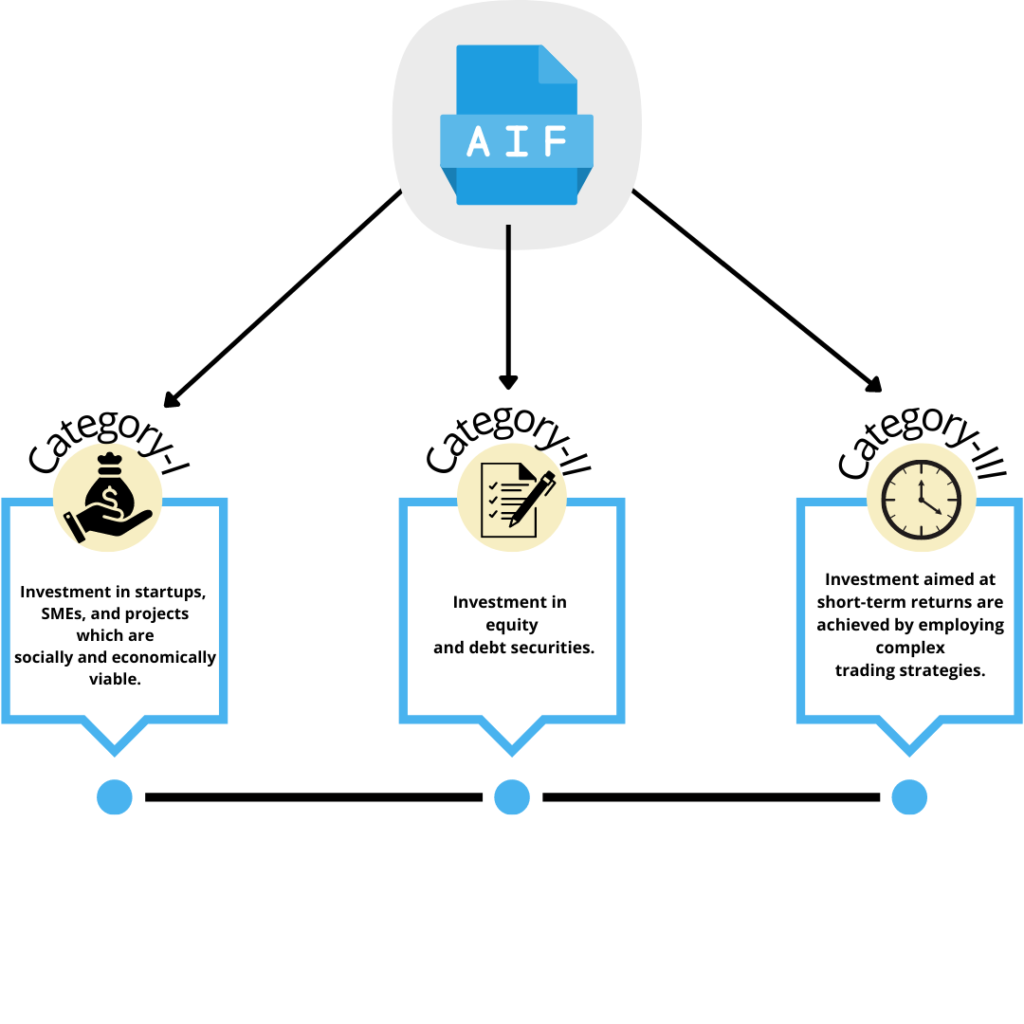
The SEBI is classified in AIFs in three categories

  1. Category I AIF
  2. Category II AIF
  3. Category III AIF

Every category has different investment strategies like risk levels, tax implications, and the regulatory benefits.

Category I AIF Explained

The Category I AIFs invest in those sectors which are considered socially and economically beneficial for India.

These kinds of funds receive more incentives and support from the government because this sector contribute to economic growth as well as innovation.

Key Features of Category I AIFs

  • Invest in the startups in the Newly businesses
  • The promotion of the Entrepreuneurship
  • Have less investment risk
  • Government incentives may apply
  • Long-term investment opportunity

Types of Category I AIFs

Venture Capital Funds (VCFs)

Investing in the startups and the high-growth companies.

SME Funds

These are focused in Medium enterprise

Infrastructure Funds

In these Investment in the infrastructure project for example Roads , energy and logistics.

Social Venture Funds

In these the company which creates social welfare gets Funds

Who Should Invest in Category I AIFs?

Category I AIFs are suitable for:

  • For the Long-term investors
    • Startup-focused investors which can create innovation
  • Investors seeking government-supported sectors
  • High-risk, high-growth investors

Category II AIF Explained

Category II AIFs are the most common type of AIF in India. These kinds of funds don’t receive incentive through the the government and do not have aggresive trading strategies compare to Category III.

They primarily invest in the private companies, debt instruments, and the unlisted businesses.

Features of Category II AIFs

  • There is no leverage expectation for operations.
  • Mature business gets investment
  • From medium to long term investment
    • It is Stable compared to Category III
  • Widely used by private equity firms

Different types of Category II AIFs

Private Equity Funds

Private companies which is established gets Investment

Debt Funds

Invest in debt for securities of companies.

Fund of Funds

Invest in other AIFs.

Real Estate Funds

Invest in commercial and residential projects.

Who Should Invest in Category II AIFs?

Ideal for:

  • High Net worth individual
  • Institutional investors
  • Family offices
  • Investors seeking balanced risk and return

Category III AIF Explained

In Category III AIFs they use high complex trading strategies and may employ leverage to generate short-term investment returns.

These funds are similar to the hedge funds and actively trade across markets.

Features of Category III AIFs

  • Use for leverage and derivatives
  • High risk for investment
  • Short-term opportunities for trading
  • Higher flow of liquidity
  • Suitable for sophisticated investors

Examples of Category III AIFs

  • Hedge Funds : wide range of assets , debt , real estates
  • Quantitative Trading Funds
  • AI-powered Algorithmic Trading Funds
  • Long-short equity funds

Who Should Invest in Category III AIFs?

Suitable for the :

  • Aggressive investors
  • HNIs
  • Institutional traders
  • Investors comfortable with market fluctuations of price

Difference Between Category I, II, and III AIFs

FeatureCategory I AIFCategory II AIFCategory III AIF
Investment Focus onStartups, SMEs, infrastructurePrivate equity, debtTrading & hedge strategies
Government Incentives presenceYesNoNo
Risk LevelModerate to HighModerateVery High
Leverage AllowedLimitedLimitedYes
Investment time periodLong-termMedium to Long-termShort-term to Medium-term
LiquidityLowModerateHigh
Type of investorGrowth investorsBalanced investorsAggressive investors
Examples:Venture capital fundsPE fundsHedge funds

Taxation of AIFs in India

Taxation differs depending on the category of the AIF.

Category I and II AIF Taxation

These are categories who generally enjoy pass-through taxation status, meaning income is taxed in the hands of investors rather than the fund itself.

Category III AIF Taxation

Category III do not receive any pass through status and are taxed at their fund level.

Tax regulations can change frequently, so professional tax consultation is advisable.

According to SEBI regulations:

  • Minimum investment should be 1 crore rupee for the investor.
  • And For the directors/employees/managers of the fund should be 25 lakhs.

These are mainly designed for sophisticated investors.

Benefits of Investing in AIFs

Portfolio Diversification

In AIFs we explore beyond traditional equity and also for the debt markets.

Access to High-Growth Opportunities

Investors can directly participate in startups, private companies, and emerging sectors for the high return.

Fund Management by professional

It is Managed by experienced professionals and investment experts to reduced the risk and uncertainties of your funds.

Potential for Higher Returns

Alternative assets can be generated higher returns compare to conventional investments.

Risks Associated with AIFs

AIFs offer strong growth potential, they also come with high risks:

  • Limited liquidity
  • Market uncertainty
    • Government Regulation
  • High minimum investment
  • Complex structures

Investors should evaluate their risk appetite more carefully before investment in company.

How AI is Transforming the AIF Industry

Artificial Intelligence is changing very fast the way Alternative Investment Funds operate.

Modern AIF firms are using AI for:

  • Portfolio optimization
  • For identifying the risk
  • Detection of funds
  • Predictive analytics
  • Algorithmic trading
  • Investor reporting automation

AI agents can process a huge financial datasets in real-time, helping the fund managers make faster decision and more reliable investment decisions.

Businesses looking to integrate intelligent automation into investment operations can leverage custom AI solutions from Winklix AI Agent Development Services. Their AI-driven systems help enterprises build autonomous AI agents for finance, investment management, and operational automation.

Why Understanding AIF Categories Matters

Choosing the right AIF category depends on several factors:

  • Investment goals
  • Risk tolerance
  • Liquidity requirements
  • Tax planning
  • Investment horizon

A startup-focused investor may prefer Category I, while a stable private equity investor may choose Category II. Aggressive investors looking for high-frequency strategies may opt for Category III.

Understanding these differences helps investors make smarter financial decisions.

Future of AIFs in India

India’s alternative investment market is expected to grow further in future due to significantly aspects:

  • Rising the ecosystem
    • Due to Increased HNI participation
  • The growth of the private capital
  • AI-driven investment management
  • Increase of fintech and wealthtech platforms

As the financial technology is evolving, AI -powered fund management and automation is likely to become more in future of AIFs .

Final Thoughts

Alternative Investment Funds are reshaping India’s investment landscape by offering sophisticated investors access to private markets, startups, and advanced trading opportunities.

The understanding of difference between Category I, II, and III AIFs is very important key aspects before making any investment decisions. Each and every category serves different investor needs, risk profiles, and financial goals.

As AI automate and continue to transform financial services, the future of AIF management will become more increasingly data-driven and intelligent. Businesses and investment firms are adopting AI-powered solutions early will gain a strong competitive advantage in the evolving alternative investment ecosystem.

Frequently Asked Questions (FAQs)

1. What is the main difference between Category I, II, and III AIFs?

Category I focuses on startups and socially beneficial sectors, Category II focuses on private investment and debt investments, while Category III invest in complex trading and hedge fund strategies.

2. Which AIF category is the safest?

The category II AIFs are find safe and considered relatively stable for the investment.Category III is avoided because of leverage trading strategies .

3. Can Category III AIFs use leverage?

Yes, Category III AIFs are allowed to use leverage and derivatives for investment strategies.

4. What is the minimum investment required for AIFs in India?

The minimum investment amount is generally ₹1 Crore per investor.

5. Are AIFs regulated in India?

Yes, AIFs are regulated by the (SEBI)Securities and Exchange Board of India 

6. Which AIF category invests in startups?

The Category I AIFs primary focus on investment in startups, SMEs, and innovative driven businesses.

7. How is AI being used in AIF management?

AI helps in many aspects like prediction analytics, algorithmic trading, investor analytics, portfolio management, and automation of investment operations.

8. Are AIFs better than mutual funds?

AIFs offer access to alternative assets and potentially higher returns, but they also comes with the higher barrier risk and it take larger investments compared to mutual funds.

The Role of SPACs (Special Purpose Acquisition Companies) in AIFs

The Role of SPACs (Special Purpose Acquisition Companies) in AIFs

Introduction

Special Purpose Acquisition Companies (SPACs) have become a new way for businesses to go public, especially for fast-growing startups that may not follow the usual IPO timelines. SPACs are gaining traction worldwide, and India’s investment scene is starting to feel their impact.

At the same time, Alternative Investment Funds (AIFs) are playing an important role in directing private money into startups, infrastructure, and new industries. As regulators and investors look for new structures, the connection between AIFs and SPACs is becoming more important.

For investment managers interested in this area, Online AIF Registration in India is a growing trend that makes compliance and market entry easier.

What are SPACs?

A SPAC is a “blank-cheque company” set up to raise money through an IPO with the goal of acquiring or merging with another business later. Key features include:

  • No commercial operations at start
  • Funds are held in trust until a suitable target is found
  • Set timelines to finish acquisitions
  • Investors receive shares plus warrants for potential upside

SPACs offer a quicker way to enter the public market compared to traditional listings.

Understanding AIFs in India

AIFs are private investment vehicles regulated by SEBI. They invest in alternative asset types like unlisted companies, debt instruments, and infrastructure projects. With increasing public involvement and easier compliance systems such as Online AIF Registration in India, more fund managers are entering this field.

Types of AIFs involved in private deal structures:

CategoryInvestment Focus
Category IStartups, SMEs, socially beneficial sectors
Category IIPrivate equity funds, debt funds
Category IIIHedge funds, high-volume trading strategies

How SPACs and AIFs Work Together

AIFs frequently invest in businesses before they go public. SPACs can offer a smooth way for these companies to list worldwide. This arrangement benefits both investors and target businesses.

Key collaborations include:

  • AIFs can invest in SPAC sponsors or SPAC IPO units
  • PE/VC funds (Category II AIFs) back the pipeline targets for SPAC mergers
  • AIFs step in as post-acquisition investors to help with business growth after listing

This creates liquidity and exit options for AIF investors, which is a significant edge over traditional private equity timelines.

Regulatory Environment in India

SPAC listings are still in the early stages in India, but SEBI and the government are actively working on regulatory frameworks. AIFs currently gain SPAC exposure through:

  • Overseas investment limits
  • Partnerships in the global SPAC market
  • India-focused SPAC sponsor teams

As regulations develop, it is likely that India-based SPACs will become more common, encouraging more Online Alternative Investment Fund Registration in India.

Benefits of SPAC-AIF Collaboration

BenefitImpact
Faster exits for AIF investorsBetter liquidity
Access to international capital marketsHigh-growth companies expand more quickly
Lower IPO risksLess uncertainty during market fluctuations
Value discovery at earlier stagesImproved pricing outcomes for portfolio companies

Challenges to Consider

Despite the potential, there are some concerns:

  • Lack of clear regulations in India
  • Increased risk if a SPAC fails to find a target
  • Possible valuation differences during mergers

This is where expert advice from an AIF Registration Consultant becomes essential to manage risk, structuring, and compliance.

Future Outlook

India is gradually aligning with global investment trends. As SPACs gain acceptance, AIFs are poised to play a vital role in:

  • Finding valuable acquisition opportunities
  • Offering strategic funding before and after mergers
  • Channeling domestic capital into global growth stories

With easier processes for Online AIF Registration in India, more investment managers can effectively take advantage of SPAC-related opportunities.

Conclusion

SPACs and AIFs form a powerful partnership that can transform India’s investment landscape. As the regulatory environment changes, early movers with the right expertise can enjoy diversified exposure and profitable exits.

If you’re planning to start a fund that can tap into these emerging opportunities, consider getting advice from a qualified AIF Registration Consultant to ensure smooth compliance and structuring.

Hedge Fund AIFs: A Closer Look at Category III Funds

Hedge Fund AIFs: A Closer Look at Category III Funds

Alternative Investment Funds (AIFs) are quickly becoming key options for sophisticated investors in India. Among these, Category III AIFs, often called hedge funds, attract those looking for higher risk and reward opportunities. These funds use complex strategies, including long and short positions, derivatives, and leverage, to achieve returns that exceed those of traditional investments.

As interest grows, both local and international investors are exploring Online AIF Registration in India to set up or join hedge fund structures legally and easily.

What Are Category III AIFs?

Category III AIFs are funds that use various complex trading strategies:

  • Hedge strategies
  • Arbitrage
  • Derivative trading
  • High turnover investments
  • Leveraged transactions

Their goal is straightforward: maximize short-term or long-term returns while taking advantage of market inefficiencies.

These funds are best suited for high-net-worth investors (HNIs) and institutional participants who understand market volatility.

Key Features of Category III AIFs

FeatureDescription
Investor ProfileHNIs and institutional investors
Risk LevelHigh
Investment StrategyDerivative trading, short selling, leverage, etc.
Return PotentialHigh
Regulated bySEBI (Securities and Exchange Board of India)

Because of the higher risks involved, SEBI has strict compliance requirements for Category III funds under Alternative Investment Fund Registration in India.

How Category III AIFs Benefit Investors

  • Diversification beyond equity and fixed-income assets
  • Flexibility in strategy for both rising and falling markets
  • Professional Fund Management with research-based decisions
  • Better Risk-Adjusted Returns for informed investors

While volatility is higher, experienced fund managers work to protect capital through hedging techniques.

SEBI Guidelines for Category III AIFs

SEBI requires specific regulatory frameworks, including:

  • Disclosure requirements for all investments and risks
  • Restrictions on leverage and borrowing
  • Mandatory custodian and independent valuation

Thus, AIF Registration Online in India must adhere to compliance checks that ensure transparency and protect investors.

Who Should Consider Investing in Category III AIFs?

Category III hedge funds are ideal for:

  • Individuals with a high risk appetite
  • Investors seeking aggressive returns
  • Those who understand market derivatives and volatility
  • HNIs looking for diversification and tax efficiency

If you are new to this area, consulting a qualified advisor is strongly advised.

Online AIF Registration in India: Why It Matters

Setting up a Category III AIF requires various approvals, documentation, and regulatory checks. Businesses and promoters often seek help from an expert AIF Registration Consultant to simplify:

  • SEBI Application Filing
  • Fund Structure Design
  • Legal and Compliance Support
  • Investor Documentation
  • Fund Launch Process

Working with a knowledgeable advisor ensures smooth Online Alternative Investment Fund Registration in India, with full compliance with regulations.

Conclusion

Category III AIFs provide access to hedge fund-like strategies meant for sophisticated investors aiming to maximize returns through market opportunities and strategic trading. As the popularity of Alternative Investment Fund Registration in India increases, so does the demand for expert regulatory support.

Whether you plan to invest in or launch a Category III AIF, make sure you have the right financial knowledge and regulatory guidance to navigate this exciting and evolving investment landscape.

Global Trends in AIFs: What India Can Learn

Global Trends in AIFs: What India Can Learn

Introduction

One of the most active sectors of the global investment market is Alternative Investment Funds (AIFs). AIFs are changing how investors diversify their portfolios beyond conventional stocks and bonds, from hedge funds in the United States to private equity in Europe and venture capital in Southeast Asia. This industry has grown quickly in India as well, owing to digital initiatives like Online AIF Registration in India, clearer regulations, and more sophisticated investors.

As global markets evolve, India’s AIF ecosystem can draw valuable lessons from international best practices to strengthen its position as a global investment hub.

1. The Global Surge of AIFs

Globally, AIFs have seen exponential growth over the last decade. According to data from Preqin and PwC, the global alternative assets under management (AUM) crossed $13 trillion in 2024, driven by strong institutional participation and technology-enabled fund management. Key global trends include:

  • Digital Fund Registration and Compliance: Many countries now allow seamless online fund registration, ensuring faster onboarding and greater transparency.
  • Diversification of Asset Classes: Global AIFs now invest in new-age sectors such as fintech, green energy, and digital infrastructure.
  • RegTech Integration: Automated compliance and reporting systems are becoming standard across developed markets.

India can benefit from these global models by streamlining its AIF Registration Online in India processes and promoting cross-border collaborations.

2. The Indian AIF Landscape

The Indian AIF industry has grown remarkably since SEBI introduced regulations in 2012. With a growing appetite for alternative investments among high-net-worth individuals (HNIs), family offices, and institutional investors, AIFs are now integral to India’s financial ecosystem.

However, compared to global peers, the domestic ecosystem is still evolving in areas like digital registration, fund transparency, and cross-border fundraising. By embracing Online Alternative Investment Fund Registration in India, SEBI and fund managers can make the process faster, simpler, and more investor-friendly.

  1. Lessons India Can Learn from Global AIF Leaders

a. Streamlined Online Registration

In Luxembourg and Singapore, some digital-first systems allow investors and funds managers to set up funds, online, and complete compliance steps. India registration of Alternative Investment funds is online and is also a good step in this direction.

b. Enhanced Transparency and Investor Protection

To gain investors’ trust, global AIFs tighten their disclosure requirements and use independent audits. For emerging fund managers in India, the credibility deck particularly for emerging fund managers in India.

c. Encouraging Green and Impact Investing

Across the world, focusing on sustainable investing is a growing AIF global trend. India’s regulations could do more to promote this type of investing through tax incentives and AIF compliance.

d. Leveraging Technology

Globally, AI and blockchain technology are used for fund administration and risk management. AIFs in India can use technology for more accurate, rapide, risk analysis for fund management.

4. The Role of AIF Registration Consultants

Setting up an AIF in India requires compliance with SEBI’s extensive regulatory requirements. Engaging an experienced AIF Registration Consultant can simplify the process — from drafting the placement memorandum to securing approval for Online AIF Registration in India. Consultants also ensure compliance with the latest SEBI guidelines and help investors choose the most suitable category of AIF (Category I, II, or III).

5. The Road Ahead

India stands at the cusp of becoming a global AIF powerhouse. The introduction of Online AIF Registration in India and the government’s push for digital governance signal a strong commitment to modernization. By learning from global leaders, encouraging innovation, and strengthening investor protection, India can unlock the next phase of AIF growth.

Conclusion

As the world transitions toward digital and transparent investment ecosystems, India’s AIF sector must keep pace with global innovation. By embracing Online Alternative Investment Fund Registration in India, improving regulatory efficiency, and adopting technology-driven compliance, India can not only attract global investors but also emerge as a key player in the alternative investment domain.

AIFs vs PMS vs Mutual Funds: Which is Right for You?

AIFs vs PMS vs Mutual Funds: Which is Right for You?

When it comes to investing in India, the financial landscape offers a range of vehicles — Alternative Investment Funds (AIFs), Portfolio Management Services (PMS), and Mutual Funds. Each comes with unique structures, risk profiles, and return potential. Understanding these differences can help investors make informed decisions based on their goals, risk appetite, and investment horizon.

Understanding the Basics

1. Alternative Investment Funds (AIFs)

AIFs are privately pooled investment funds that collect capital from sophisticated investors and invest according to a defined strategy. They typically include hedge funds, venture capital funds, private equity funds, and other alternative asset classes.

To operate in India, an AIF must undergo Online AIF Registration in India with the Securities and Exchange Board of India (SEBI). The process ensures regulatory compliance and investor protection. Consulting an AIF Registration Consultant can simplify the procedure and ensure adherence to SEBI guidelines.

AIFs are categorized into three types:

  • Category I AIFs: Invest in startups, SMEs, or infrastructure projects.
  • Category II AIFs: Include private equity or debt funds that do not leverage beyond permitted limits.
  • Category III AIFs: Engage in complex trading strategies and may use leverage.

AIFs usually cater to high-net-worth individuals (HNIs) seeking portfolio diversification and higher returns.

2. Portfolio Management Services (PMS)

PMS involves professional fund managers customizing portfolios for individual investors. Unlike mutual funds, where funds are pooled, PMS portfolios are tailor-made and managed separately for each investor.

Advantages of PMS include:

  • Personalized investment strategies
  • Direct ownership of securities
  • Transparent reporting and flexibility

However, PMS requires a minimum investment of ₹50 lakhs and involves higher management fees compared to mutual funds.

Mutual Funds are the most common investment vehicle for retail investors. They pool money from many investors and invest in stocks, bonds, or money market instruments. Managed by fund managers, mutual funds are regulated, liquid, and accessible to all classes of investors.

3. Mutual Funds

Benefits of Mutual Funds include:

  • Low entry barrier
  • Professional management
  • High liquidity
  • Suitable for SIP (Systematic Investment Plan) investors

AIFs vs PMS vs Mutual Funds: A Comparative Overview

ParameterAIFsPMSMutual Funds
Investor TypeHNIs, Institutional InvestorsHNIsRetail & HNIs
RegulationSEBI (AIF Regulations, 2012)SEBI (PMS Regulations, 2020)SEBI (Mutual Fund Regulations, 1996)
Minimum Investment₹1 Crore₹50 Lakhs₹500
CustomizationHighHighLow
LiquidityLowModerateHigh
Risk LevelHighModerate to HighLow to Moderate
Return PotentialHigh (depends on strategy)Moderate to HighModerate

Which One Should You Choose?

  • Choose AIFs if you are an HNI looking for high-risk, high-return opportunities beyond traditional markets. Before investing, ensure that the fund has completed Alternative Investment Fund Registration in India or Online Alternative Investment Fund Registration in India with SEBI.
  • Choose PMS if you prefer personalized investment management and have a significant corpus.
  • Choose Mutual Funds if you are a retail investor seeking diversified, regulated, and easy-to-access investment options.

Conclusion

Each investment option — AIFs, PMS, and Mutual Funds — serves a distinct investor profile. The key lies in aligning your investment goals with the right structure and understanding the risks involved.

If you’re considering setting up or investing through an AIF, ensure proper regulatory compliance through Online AIF Registration in India. A qualified AIF Registration Consultant can guide you through AIF Registration Online in India, ensuring seamless and compliant registration with SEBI.

Diversification Strategies Through AIF Investments

Diversification Strategies Through AIF Investments

In the ever-evolving world of finance, investors are constantly looking for ways to reduce risk and maximize returns. Alternative Investment Funds (AIFs) have emerged as a strategic avenue to achieve portfolio diversification beyond traditional stocks and bonds. By investing through AIFs, investors gain access to a wide range of asset classes and investment styles, helping them balance their risk and enhance long-term returns.

Understanding AIFs

Alternative Investment Funds (AIFs) are privately pooled investment vehicles that collect funds from investors to invest in assets beyond conventional equity, debt, or mutual fund instruments. These include hedge funds, private equity, venture capital, real estate, and infrastructure investments.

To operate legally, fund managers must complete Online AIF Registration in India or AIF Registration Online in India, ensuring compliance with the Securities and Exchange Board of India (SEBI) regulations. Professional AIF Registration Consultants assist fund managers throughout the registration and documentation process to ensure seamless compliance.

Why Diversification Matters in AIF Investments

Diversification is the foundation of a sound investment strategy. It minimizes the impact of market volatility by spreading investments across different asset classes. AIFs inherently support diversification through their multi-asset and multi-sector exposure.

Here’s how diversification through AIFs benefits investors:

1. Exposure to Alternative Assets

AIFs provide access to asset classes like private equity, infrastructure, real estate, and hedge funds—areas that are generally unavailable in traditional investment routes. This broader exposure helps investors tap into high-growth sectors while balancing portfolio risk.

2. Risk Mitigation

By investing in a mix of asset categories and strategies, AIFs reduce dependence on the performance of a single market. For instance, when equities underperform, investments in real estate or debt-oriented AIFs can offer stability.

3. Enhanced Returns

Alternative investments often deliver higher returns due to their focus on niche markets, strategic opportunities, and active fund management. Professional fund managers employ complex strategies such as arbitrage, distressed asset investing, and leveraged buyouts to enhance performance.

4. Inflation Hedging

Certain AIF categories, such as real estate or commodity-linked funds, serve as natural hedges against inflation, preserving purchasing power over time.

5. Tailored Investment Opportunities

AIFs offer category-based options—Category I (startups, SMEs, social ventures), Category II (private equity, debt funds), and Category III (hedge funds)—allowing investors to align their portfolios with specific goals, risk tolerance, and return expectations.

AIF Diversification Strategies That Work

To maximize the benefits of diversification, investors can follow these practical strategies through AIF investments:

  • Combine Categories: Mix Category I, II, and III AIFs for a balanced exposure across growth, stability, and liquidity-focused assets.
  • Blend Sectors: Diversify across sectors like real estate, technology, healthcare, and infrastructure to minimize sector-specific risks.
  • Vary Geographical Exposure: Invest in AIFs that target both domestic and international opportunities.
  • Time Diversification: Stagger AIF investments over different market cycles to average entry costs and mitigate timing risk.

Getting Started with AIF Investments

Investing in AIFs requires regulatory registration and due diligence. Businesses or fund managers looking to launch their own AIFs must complete the Alternative Investment Fund Registration in India process with SEBI.

Opting for Online Alternative Investment Fund Registration in India simplifies compliance and accelerates approvals. A professional AIF Registration Consultant can assist in documentation, compliance verification, and submission to SEBI, ensuring a smooth and transparent process.

Conclusion

AIFs represent a powerful tool for achieving diversification in modern portfolios. With their ability to provide access to unique asset classes, reduce risks, and enhance returns, AIFs have become an integral part of sophisticated investment strategies.

Whether you’re an investor seeking higher returns or a fund manager looking to register your AIF, leveraging Online AIF Registration in India through an expert AIF Registration Consultant is the first step toward unlocking the full potential of alternative investments.

How to Evaluate the Performance of an AIF

How to Evaluate the Performance of an AIF

Alternative Investment Funds (AIFs) have become a preferred investment vehicle for high-net-worth individuals and institutional investors looking for higher returns and portfolio diversification. However, understanding how to evaluate the performance of an AIF is crucial before making or continuing an investment. In this article, we’ll explore the key performance indicators (KPIs), risk metrics, and evaluation methods that every investor should know.

If you’re considering Online AIF Registration in India or want to learn more about Alternative Investment Fund Registration in India, understanding performance metrics is essential for both fund managers and investors.

1. Understanding the Basics of AIF Performance Evaluation

Before diving into numbers, investors must understand the nature of AIFs. These funds invest in alternative asset classes such as private equity, venture capital, real estate, hedge funds, or debt instruments. Because these assets are less liquid and often long-term, evaluating their performance requires a mix of quantitative and qualitative analysis.

Fund managers and investors who have gone through AIF Registration Online in India usually categorize their funds into three types:

  • Category I AIFs: Invest in startups, SMEs, or socially beneficial sectors.
  • Category II AIFs: Include private equity, debt funds, and real estate funds.
  • Category III AIFs: Engage in complex trading strategies and leverage.

Each category demands a unique evaluation approach depending on its risk-return profile and investment strategy.

2. Key Performance Metrics for Evaluating an AIF

a. Internal Rate of Return (IRR)

The IRR is one of the most widely used metrics in AIF performance evaluation. It calculates the annualized rate of return generated by an investment over time, considering cash inflows and outflows. A higher IRR generally indicates better fund performance.

b. Net Asset Value (NAV)

NAV represents the per-unit value of the fund after accounting for liabilities and expenses. Tracking NAV growth helps investors understand how effectively the fund is appreciating in value.

c. Multiple of Invested Capital (MOIC)

MOIC measures how much value the fund has created relative to the total capital invested. It is a simple ratio that reflects overall profitability.

d. Alpha and Beta

Alpha indicates the fund’s excess returns compared to a benchmark, while Beta measures volatility. A fund with high Alpha and low Beta is generally preferred for stable, above-market returns.

3. Qualitative Factors in AIF Evaluation

While numbers matter, the success of an AIF also depends on non-financial aspects such as:

  • Fund Manager Expertise: The experience, track record, and decision-making skills of the fund manager play a vital role.
  • Investment Strategy: A transparent, consistent, and well-documented strategy enhances investor confidence.
  • Governance and Compliance: Funds registered under Online Alternative Investment Fund Registration in India must comply with SEBI regulations to ensure transparency and investor protection.

4. Benchmarking Against Industry Standards

Comparing an AIF’s performance against similar funds or relevant market indices offers valuable insight into its relative success. Investors should also assess the fund’s historical performance across different economic cycles to understand its resilience and adaptability.

5. The Role of AIF Registration Consultants

For investors and fund managers, navigating the complexities of Alternative Investment Fund Registration in India can be challenging. Working with an experienced AIF Registration Consultant ensures compliance with SEBI regulations, proper structuring, and efficient registration processes. Consultants also help in understanding performance evaluation parameters and reporting requirements.

6. Continuous Monitoring and Reporting

Evaluating an AIF’s performance isn’t a one-time process. Investors should regularly review fund reports, audited statements, and portfolio updates. Transparent communication between fund managers and investors builds trust and ensures accountability throughout the investment cycle.

Conclusion

Evaluating the performance of an AIF requires a balance of financial analysis, qualitative judgment, and regulatory understanding. By considering metrics like IRR, NAV, MOIC, and Alpha, and by ensuring compliance with SEBI norms, investors can make informed decisions.

For those planning to launch or manage a fund, understanding performance evaluation goes hand in hand with Online AIF Registration in India and AIF Registration Online in India. Partnering with an experienced AIF Registration Consultant can simplify the process and set a strong foundation for long-term success.

Impact Investing Through AIFs: Doing Well by Doing Good

Impact Investing Through AIFs: Doing Well by Doing Good

Impact investing has emerged as a powerful way to blend financial returns with positive social and environmental outcomes. In India, Alternative Investment Funds (AIFs) have become one of the most effective vehicles for channeling impact-driven capital. By investing in sectors such as renewable energy, healthcare, education, and sustainable agriculture, AIFs are helping investors contribute to nation-building while also generating competitive returns.

Understanding Impact Investing Through AIFs

Impact investing goes beyond traditional philanthropy by aligning profitability with purpose. Investors seek measurable social and environmental impact alongside financial performance. AIFs, registered with SEBI, provide a structured framework for pooling capital into impact-driven businesses, social enterprises, and sustainable projects.

For those interested in this approach, Online AIF Registration in India offers a simplified way to set up such funds, ensuring compliance and streamlined operations.

Why AIFs are Suitable for Impact Investing

  1. Regulated Structure: Through Alternative Investment Fund Registration in India, investors gain access to a regulated vehicle with transparency and governance.
  2. Sectoral Flexibility: AIFs can target specific sectors like green energy, affordable housing, or education—areas with both profit potential and social impact.
  3. Institutional Credibility: By opting for Online Alternative Investment Fund Registration in India, fund managers ensure that their vehicles are credible and attractive to global investors.
  4. Scalable Model: AIFs allow pooling of funds from multiple investors, amplifying the scale of positive change.

Benefits of Impact Investing Through AIFs

  • Double Bottom Line: Investors achieve both financial gains and measurable social/environmental improvements.
  • Portfolio Diversification: Impact-oriented sectors often perform independently of traditional markets, offering balance to investment portfolios.
  • Global Alignment: Many AIFs focus on investments aligned with UN Sustainable Development Goals (SDGs), making them appealing to socially conscious investors.
  • Tax Efficiency: With the right structuring, impact-focused AIFs can also optimize taxation, offering another layer of advantage.

How to Get Started

For entrepreneurs, fund managers, or institutions aiming to establish impact-driven AIFs, the first step is obtaining AIF Registration Online in India. Given the regulatory nuances, working with an experienced AIF Registration Consultant ensures smooth navigation of SEBI’s requirements, compliance, and structuring.

Final Thoughts

Impact investing through AIFs is redefining wealth creation in India. It allows investors to “do well by doing good,” channeling funds into initiatives that uplift communities and protect the environment while ensuring robust returns. With Online AIF Registration in India, setting up an impact-focused AIF has become easier than ever—making now the perfect time to merge purpose with profit.

A Beginner’s Guide to Alternative Investment Funds (AIFs) in India

A Beginner’s Guide to Alternative Investment Funds (AIFs) in India

Introduction

As investors seek opportunities beyond traditional stocks, bonds, and mutual funds, Alternative Investment Funds (AIFs) are becoming increasingly popular in India. AIFs allow investors to diversify portfolios with exposure to private equity, venture capital, hedge funds, and other specialized asset classes.

For businesses or fund managers looking to enter this sector, understanding Online AIF Registration in India and working with an AIF Registration Consultant is essential. This beginner’s guide will walk you through the basics of AIFs and the process of Alternative Investment Fund Registration in India.

What are Alternative Investment Funds (AIFs)?

An AIF is a privately pooled investment vehicle regulated by the Securities and Exchange Board of India (SEBI). It collects money from investors and invests according to a defined strategy.

Types of AIFs in India

  1. Category I AIFs – Venture Capital Funds, SME Funds, Social Venture Funds, Infrastructure Funds.
  2. Category II AIFs – Private Equity Funds, Debt Funds, Fund of Funds.
  3. Category III AIFs – Hedge Funds, PIPE (Private Investment in Public Equity) Funds.

Each category carries its own risk-return profile, making it important for investors to choose funds aligned with their financial goals.

Why Consider AIFs?

  • Diversification: Exposure to alternative assets outside stock markets.
  • High Growth Potential: Investments in startups, private equity, or hedge funds.
  • Professional Management: Run by experienced fund managers with specialized strategies.
  • Long-Term Wealth Creation: Suitable for investors with higher risk appetite.

The Process of AIF Registration in India

Step 1: Eligibility Check

The applicant must be set up as a company, trust, limited liability partnership (LLP), or body corporate.

Step 2: Application Filing

An application for Alternative Investment Fund Registration in India is submitted to SEBI in the prescribed format.

Step 3: Documentation

This includes fund structure details, investment strategy, compliance reports, and background of fund managers.

Step 4: Registration Fee

Payment of applicable registration and ongoing compliance fees.

Step 5: Approval

Once reviewed, SEBI grants the license to operate as a registered AIF.

Many promoters choose AIF Registration Online in India for faster submissions and smoother compliance.

Role of an AIF Registration Consultant

The process of Online Alternative Investment Fund Registration in India involves complex documentation and compliance. An experienced AIF Registration Consultant can:

  • Prepare and verify documents.
  • Liaise with SEBI for clarifications.
  • Ensure error-free submission of applications.
  • Guide on structuring funds for compliance.

This not only saves time but also ensures smooth approval for fund managers planning to enter the AIF industry.

Conclusion

Alternative Investment Funds are an attractive option for investors who want to diversify beyond traditional markets and achieve higher returns. At the same time, fund managers must ensure proper compliance through AIF Registration Online in India. Partnering with an expert AIF Registration Consultant makes the process of Online Alternative Investment Fund Registration in India seamless, enabling new entrants to establish themselves successfully in this growing market.

For investors, understanding AIFs is the first step; for businesses, securing Alternative Investment Fund Registration in India is the key to unlocking opportunities in this exciting sector.

Understanding the Risk-Return Profile of AIFs

Understanding the Risk-Return Profile of AIFs

Introduction

Alternative Investment Funds (AIFs) are increasingly becoming a preferred choice among High-Net-Worth Individuals (HNIs) and institutional investors in India. They offer exposure to asset classes beyond traditional equities and debt instruments, enabling investors to diversify portfolios and pursue higher returns. However, with these opportunities come unique risks. For anyone considering investing—or even launching an AIF through Online AIF Registration in India—understanding the risk-return profile is crucial.

What are AIFs?

An Alternative Investment Fund (AIF) is a privately pooled investment vehicle that collects funds from investors and invests according to a defined strategy. SEBI regulates these funds, and their establishment requires Alternative Investment Fund Registration in India.

Categories of AIFs

  1. Category I AIFs – Venture Capital, SME, Social Venture, and Infrastructure funds.
  2. Category II AIFs – Private Equity funds, Debt funds, Fund of Funds.
  3. Category III AIFs – Hedge funds, PIPE (Private Investment in Public Equity) funds.

For setting up such funds, promoters usually seek help from an AIF Registration Consultant who can assist with compliance and Online Alternative Investment Fund Registration in India.

The Risk Profile of AIFs

1. Market Risk

Investments in startups, private equity, or complex hedge fund strategies are highly sensitive to market cycles.

2. Liquidity Risk

AIFs often have a lock-in period and do not offer easy exit options like mutual funds.

3. Credit Risk

Debt-oriented AIFs face the risk of borrower defaults and repayment delays.

4. Regulatory & Tax Risk

Frequent changes in SEBI guidelines and taxation can directly impact fund performance.

5. Concentration Risk

Some AIFs adopt high-concentration strategies in specific sectors, which increases risk exposure.

The Return Profile of AIFs

1. Higher Potential Returns

  • Private equity and venture capital funds can generate high double-digit returns over the long term.

2. Portfolio Diversification

  • AIFs provide exposure to asset classes not directly linked to stock markets, helping balance risks.

3. Long-Term Wealth Creation

  • AIFs are suitable for investors with patience, surplus capital, and higher risk appetite.

4. Performance Variability

  • While hedge funds may deliver quick gains, private equity requires years to realize value.

Who Should Invest in AIFs?

  • HNIs & Ultra-HNIs who can afford higher risks and longer lock-in periods.
  • Institutional Investors such as pension funds, corporates, and endowments.
  • Experienced Investors seeking non-traditional investment avenues.

Importance of Proper Registration

For fund managers and promoters, launching an AIF requires strict compliance with SEBI norms. The process of AIF Registration Online in India ensures regulatory approval and credibility. Since the procedure involves documentation, eligibility checks, and compliance reviews, many rely on an AIF Registration Consultant for smooth execution. Choosing the right professional for Online AIF Registration in India can save time, reduce errors, and ensure hassle-free approval.

Conclusion

AIFs represent a powerful opportunity for wealth creation but come with higher risks compared to traditional investments. Investors must carefully weigh the risk-return profile and assess their long-term financial goals before committing. At the same time, fund managers or promoters must ensure proper compliance through Online Alternative Investment Fund Registration in India. Engaging with an experienced AIF Registration Consultant makes the process smoother and ensures regulatory adherence.

In short, AIFs are best suited for investors with a higher risk appetite, long-term vision, and an understanding of market dynamics—backed by the assurance of proper Alternative Investment Fund Registration in India.