

AIF Registration in India: Step-by-Step Process Explained

Hedge Fund AIFs: A Closer Look at Category III Funds

Introduction

India’s alternative investment fund market is grown significantly over the last few decades , making Alternative Investment Funds (AIFs) is one of the most preferred investment for the private firms, ventures, hedge funds and the institutional investors. To operate this legally in India, this AIF must contain registration from the Securities and Exchange Board of India (SEBI) SEBI (Alternative Investment Funds) Regulations, under 2012.

If you want plan for launching an investment fund in India, the understanding of AIF registration process is most important element for understanding AIF. This guide explains each step by step in detail.

What is an Alternative Investment Fund (AIF)?

An Alternative Investment Fund (AIF) is a specialized investment vehicle that pools capital from multiple investors to invest in non-traditional asset classes, such as private equity, real estate, hedge funds, venture capital, and commodities. These funds are typically managed by professional fund managers and are structured as limited partnerships or limited liability companies.

AIFs can be structured as:

  • Trusts
  • Limited Liability Partnerships (LLPs)
  • Companies
  • Body Corporates

These are the funds which are regulated by SEBI and are generally used for the investments in startups, private companies, infrastructure projects, real estate, private equity, venture capital, debt instruments, and hedge fund strategies.

Categories of AIFs in India

Before starting any registration process the fund managers has to choose the appropriate AIF category according to need.

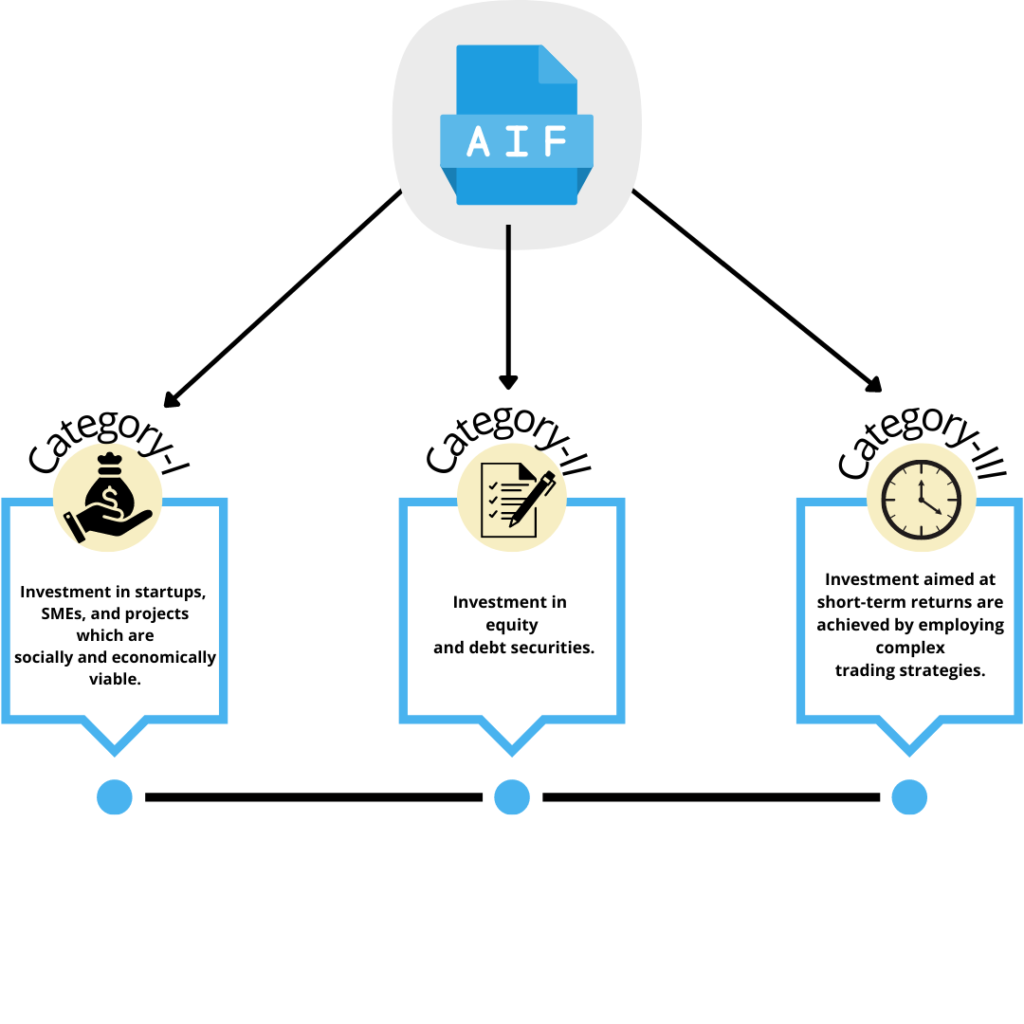
Category I AIF

These are AIFs that invest on start up and early stage venture , small and medium enterprises , infrastructure . AIFs I also Include investment in social and economically desire group. Category I considered to have moderate risk and low regulatory restriction compare to other AIFs categories.

Examples:

  • Venture Capital Funds
  • Angel Funds
  • Infrastructure Funds
  • SME Funds
  • Social Venture Funds

Category II AIF

These are AIFs that do not fall under both categories AIFs I and AIFs II . This category known for moderate risk and uncertainites for investment . These category include private Equity funds , debt funds , and funds invest in real state among India.

Examples:

  • Private Equity Funds
  • Debt Funds
  • Fund of Funds

Category III AIF

Category III Use complex stragies for These are AIFs that use complex trading strategies and leverage to generate high returns for investors, such as hedge funds, among others.

Step-by-Step AIF Registration Process in India

Step 1: Determine the Fund Structure

The first step is decide the legal structure of the fund for investment process.

And determining whether the funds fall in which category either is category I , II, Or III . Choosing the correct category is critical because regulatory requirements differ for each category.

You must:

  • Create the trust, LLP, or company
  • Draft constitutional documents
  • Obtain PAN and other registrations
  • Establish the investment management entity

SEBI reviews the legal structure carefully before granting approval.

Step 2: Select the Appropriate AIF Category

The second step is to determine whether the the fund falls under which is it Category I, Category II, or Category III.

The category affects investment restrictions, compliance requirements, and operational guidelines. Selecting the correct category at the beginning helps avoid regulatory complications later.

Step 3: Appoint the Sponsor and Investment Manager

Every AIF requires a sponsor and an investment manager for the analyising of funds.

The sponsor establishes the fund and contributes the required continuing interest, while the investment manager is responsible for managing investments and making portfolio decisions.

SEBI reviews the qualifications, experience, and regulatory track record of these entities during the registration process.

Step 4: Draft the Private Placement Memorandum (PPM)

The Private Placement Memorandum (PPM) is one of the most important documents for the AIF registration in India.

It contains key information such as:

  • Investment strategy for the investors
  • Risk factors and uncertainty
  • Governance structure
  • Fee structure
  • Investor rights
  • Exit mechanisms

A well-drafted PPM improves transparency and increases the likelihood of regulatory approval.

Step 5: Prepare Documentation

The Applicants must have all the documents which are needed for the investment before filing the application.

Common documents include:

  • Trust Deed or LLP Agreement
  • Certificate of Incorporation
  • PAN card details
  • Bank account details
  • Sponsor information
  • Investment manager details
  • Financial statements
  • Compliance declarations
  • Private Placement Memorandum

Accurate documentation helps prevent delays during SEBI review.

Step 6: Submit the Application to SEBI

This is one of the most important key element of the AIFs registration because application is officially submitted and the review as well as approval will be done SEBI. The application for AIF registration is submitted through SEBI’s online intermediary portal. The document should well prepared for the delay of registration.

The applicant must complete Form A, upload supporting documents, and pay the applicable fees.

Once submitted, SEBI begins its review process.

Step 7: Respond to SEBI Queries

Before the approval the SEBI may seek clarifications regarding the fund structure, investment strategy, governance framework, or the documentation.

Timely and accurate responses are essential for smooth approval.

Step 7: Respond to SEBI Queries

These is the final step SEBI will ask for the document clarification regarding several step for the investment. Respond to SEBI Queries objective is to ensure that the proposed Alternative Investment Fund complies with all regulatory requirements and adequately protects investor interests. In these several Queries may ask :

Asking for the missing documents , clarification regarding the fund structure, Investors protection, Governance and compliance framework concern.

How Long Does AIF Registration Take?

The time taken for AIF registration process depends on the situation of complexity of the application and the quality of documentation that has been submitted.

In most cases:

  • Fund Structuring: 2–4 Weeks
  • Documentation Preparation: 3–6 Weeks
  • SEBI Review: 4–12 Weeks
  • Final Approval: 2–4 Weeks

Most AIF registrations are completed within 2 to 8 months.

Conclusion

AIFs is very important crucial step for every fund manager , venture capital funds ,private equity funds and investment professionals looking to establish a regulated investment platform in India. By selecting the best AIFs category , fund structure , preparing all the documents and analysing the document which is needed for the AIFs registration process. By selecting the appropriate fund structure, preparing robust documentation, drafting a comprehensive PPM, and complying with SEBI regulations, applicants can successfully launch and operate an Alternative Investment Fund.

Frequently Asked Questions (FAQs)

What is a SEBI AIF Registration?

An Alternative Investment Fund that has registered with the Securities and Exchange Board of India (SEBI) is known as a SEBI AIF Registration. AIFs are investment vehicles that invest in assets such as private equity, venture capital, real estate, and debt securities.

What is AIF Registration?

All the registration process are done and approval from the SEBI is most important . In these approval from SEBI to establish and operate an Alternative Investment Fund in India.

Is SEBI Registration Mandatory for AIFs?

Yes, it is very important in every Alternative investment funds, and must be register with SEBI.

Who Can Register an AIF in India?

A Trust, LLP, Company, or Body Corporate can apply for AIF registration subject to SEBI regulations.

How Long Does AIF Registration Take?

It takes almost 2-8 months according to document submission to SEBI. If any document is not missing it will approve soon.

What is a Private Placement Memorandum (PPM)?

A PPM is a legal document that outlines the fund’s investment strategy, risks, fee structure, governance, and investor rights.

What Are the Benefits of AIF Registration?

AIF registration provides regulatory recognition, investor confidence, fundraising opportunities, and a structured framework for managing investments.

Difference Between Category I, II, and III AIFs Explained

How to Build a Multi-AIF Investment Strategy: Allocating Across Categories I, II, and III

There is more than Alternative Investment Funds (AIFs) which have become the most one of the preferred investment vehicles for the high-net-worth individuals (HNIs), family offices, institutional investors, and startups are looking for the well structured capital solutions in India.There are many investors and businesses who are still in doubt to understand the difference between Category I, Category II, and Category III AIFs.

If someone is planning to invest in AIFs, and want to launch an investment fund, or explore emerging AI-driven investment technologies, understanding these categories are very important for making informed financial decisions.

In this guide, we will try to explain everything about Category I, II, and III AIFs in a very simple language — including the structure, benefits, taxation, regulations, examples, and how technology and AI are transforming the AIF ecosystem.

What is an AIF?

There is An Alternative Investment Fund (AIF) is a privately pooled investment vehicle regulated by the Securities and Exchange Board of India (SEBI). The funds used to collect money from the sophisticated investors and invest in assets beyond traditional stocks and bonds.

AIFs generally invest in:

  • Startups company
  • Private equity
  • Venture capital
  • Real estate
  • Infrastructure development
  • Debt instruments
  • Hedge funds

AIFs is regulated by the SEBI (Alternative Investment Funds) under the Regulations, 2012.

Types of AIFs in India

The SEBI is classified in AIFs in three categories

  1. Category I AIF
  2. Category II AIF
  3. Category III AIF

Every category has different investment strategies like risk levels, tax implications, and the regulatory benefits.

Category I AIF Explained

The Category I AIFs invest in those sectors which are considered socially and economically beneficial for India.

These kinds of funds receive more incentives and support from the government because this sector contribute to economic growth as well as innovation.

Key Features of Category I AIFs

  • Invest in the startups in the Newly businesses
  • The promotion of the Entrepreuneurship
  • Have less investment risk
  • Government incentives may apply
  • Long-term investment opportunity

Types of Category I AIFs

Venture Capital Funds (VCFs)

Investing in the startups and the high-growth companies.

SME Funds

These are focused in Medium enterprise

Infrastructure Funds

In these Investment in the infrastructure project for example Roads , energy and logistics.

Social Venture Funds

In these the company which creates social welfare gets Funds

Who Should Invest in Category I AIFs?

Category I AIFs are suitable for:

  • For the Long-term investors
    • Startup-focused investors which can create innovation
  • Investors seeking government-supported sectors
  • High-risk, high-growth investors

Category II AIF Explained

Category II AIFs are the most common type of AIF in India. These kinds of funds don’t receive incentive through the the government and do not have aggresive trading strategies compare to Category III.

They primarily invest in the private companies, debt instruments, and the unlisted businesses.

Features of Category II AIFs

  • There is no leverage expectation for operations.
  • Mature business gets investment
  • From medium to long term investment
    • It is Stable compared to Category III
  • Widely used by private equity firms

Different types of Category II AIFs

Private Equity Funds

Private companies which is established gets Investment

Debt Funds

Invest in debt for securities of companies.

Fund of Funds

Invest in other AIFs.

Real Estate Funds

Invest in commercial and residential projects.

Who Should Invest in Category II AIFs?

Ideal for:

  • High Net worth individual
  • Institutional investors
  • Family offices
  • Investors seeking balanced risk and return

Category III AIF Explained

In Category III AIFs they use high complex trading strategies and may employ leverage to generate short-term investment returns.

These funds are similar to the hedge funds and actively trade across markets.

Features of Category III AIFs

  • Use for leverage and derivatives
  • High risk for investment
  • Short-term opportunities for trading
  • Higher flow of liquidity
  • Suitable for sophisticated investors

Examples of Category III AIFs

  • Hedge Funds : wide range of assets , debt , real estates
  • Quantitative Trading Funds
  • AI-powered Algorithmic Trading Funds
  • Long-short equity funds

Who Should Invest in Category III AIFs?

Suitable for the :

  • Aggressive investors
  • HNIs
  • Institutional traders
  • Investors comfortable with market fluctuations of price

Difference Between Category I, II, and III AIFs

FeatureCategory I AIFCategory II AIFCategory III AIF
Investment Focus onStartups, SMEs, infrastructurePrivate equity, debtTrading & hedge strategies
Government Incentives presenceYesNoNo
Risk LevelModerate to HighModerateVery High
Leverage AllowedLimitedLimitedYes
Investment time periodLong-termMedium to Long-termShort-term to Medium-term
LiquidityLowModerateHigh
Type of investorGrowth investorsBalanced investorsAggressive investors
Examples:Venture capital fundsPE fundsHedge funds

Taxation of AIFs in India

Taxation differs depending on the category of the AIF.

Category I and II AIF Taxation

These are categories who generally enjoy pass-through taxation status, meaning income is taxed in the hands of investors rather than the fund itself.

Category III AIF Taxation

Category III do not receive any pass through status and are taxed at their fund level.

Tax regulations can change frequently, so professional tax consultation is advisable.

According to SEBI regulations:

  • Minimum investment should be 1 crore rupee for the investor.
  • And For the directors/employees/managers of the fund should be 25 lakhs.

These are mainly designed for sophisticated investors.

Benefits of Investing in AIFs

Portfolio Diversification

In AIFs we explore beyond traditional equity and also for the debt markets.

Access to High-Growth Opportunities

Investors can directly participate in startups, private companies, and emerging sectors for the high return.

Fund Management by professional

It is Managed by experienced professionals and investment experts to reduced the risk and uncertainties of your funds.

Potential for Higher Returns

Alternative assets can be generated higher returns compare to conventional investments.

Risks Associated with AIFs

AIFs offer strong growth potential, they also come with high risks:

  • Limited liquidity
  • Market uncertainty
    • Government Regulation
  • High minimum investment
  • Complex structures

Investors should evaluate their risk appetite more carefully before investment in company.

How AI is Transforming the AIF Industry

Artificial Intelligence is changing very fast the way Alternative Investment Funds operate.

Modern AIF firms are using AI for:

  • Portfolio optimization
  • For identifying the risk
  • Detection of funds
  • Predictive analytics
  • Algorithmic trading
  • Investor reporting automation

AI agents can process a huge financial datasets in real-time, helping the fund managers make faster decision and more reliable investment decisions.

Businesses looking to integrate intelligent automation into investment operations can leverage custom AI solutions from Winklix AI Agent Development Services. Their AI-driven systems help enterprises build autonomous AI agents for finance, investment management, and operational automation.

Why Understanding AIF Categories Matters

Choosing the right AIF category depends on several factors:

  • Investment goals
  • Risk tolerance
  • Liquidity requirements
  • Tax planning
  • Investment horizon

A startup-focused investor may prefer Category I, while a stable private equity investor may choose Category II. Aggressive investors looking for high-frequency strategies may opt for Category III.

Understanding these differences helps investors make smarter financial decisions.

Future of AIFs in India

India’s alternative investment market is expected to grow further in future due to significantly aspects:

  • Rising the ecosystem
    • Due to Increased HNI participation
  • The growth of the private capital
  • AI-driven investment management
  • Increase of fintech and wealthtech platforms

As the financial technology is evolving, AI -powered fund management and automation is likely to become more in future of AIFs .

Final Thoughts

Alternative Investment Funds are reshaping India’s investment landscape by offering sophisticated investors access to private markets, startups, and advanced trading opportunities.

The understanding of difference between Category I, II, and III AIFs is very important key aspects before making any investment decisions. Each and every category serves different investor needs, risk profiles, and financial goals.

As AI automate and continue to transform financial services, the future of AIF management will become more increasingly data-driven and intelligent. Businesses and investment firms are adopting AI-powered solutions early will gain a strong competitive advantage in the evolving alternative investment ecosystem.

Frequently Asked Questions (FAQs)

1. What is the main difference between Category I, II, and III AIFs?

Category I focuses on startups and socially beneficial sectors, Category II focuses on private investment and debt investments, while Category III invest in complex trading and hedge fund strategies.

2. Which AIF category is the safest?

The category II AIFs are find safe and considered relatively stable for the investment.Category III is avoided because of leverage trading strategies .

3. Can Category III AIFs use leverage?

Yes, Category III AIFs are allowed to use leverage and derivatives for investment strategies.

4. What is the minimum investment required for AIFs in India?

The minimum investment amount is generally ₹1 Crore per investor.

5. Are AIFs regulated in India?

Yes, AIFs are regulated by the (SEBI)Securities and Exchange Board of India 

6. Which AIF category invests in startups?

The Category I AIFs primary focus on investment in startups, SMEs, and innovative driven businesses.

7. How is AI being used in AIF management?

AI helps in many aspects like prediction analytics, algorithmic trading, investor analytics, portfolio management, and automation of investment operations.

8. Are AIFs better than mutual funds?

AIFs offer access to alternative assets and potentially higher returns, but they also comes with the higher barrier risk and it take larger investments compared to mutual funds.

Global Trends in AIFs: What India Can Learn

Global Trends in AIFs: What India Can Learn

Introduction

One of the most active sectors of the global investment market is Alternative Investment Funds (AIFs). AIFs are changing how investors diversify their portfolios beyond conventional stocks and bonds, from hedge funds in the United States to private equity in Europe and venture capital in Southeast Asia. This industry has grown quickly in India as well, owing to digital initiatives like Online AIF Registration in India, clearer regulations, and more sophisticated investors.

As global markets evolve, India’s AIF ecosystem can draw valuable lessons from international best practices to strengthen its position as a global investment hub.

1. The Global Surge of AIFs

Globally, AIFs have seen exponential growth over the last decade. According to data from Preqin and PwC, the global alternative assets under management (AUM) crossed $13 trillion in 2024, driven by strong institutional participation and technology-enabled fund management. Key global trends include:

  • Digital Fund Registration and Compliance: Many countries now allow seamless online fund registration, ensuring faster onboarding and greater transparency.
  • Diversification of Asset Classes: Global AIFs now invest in new-age sectors such as fintech, green energy, and digital infrastructure.
  • RegTech Integration: Automated compliance and reporting systems are becoming standard across developed markets.

India can benefit from these global models by streamlining its AIF Registration Online in India processes and promoting cross-border collaborations.

2. The Indian AIF Landscape

The Indian AIF industry has grown remarkably since SEBI introduced regulations in 2012. With a growing appetite for alternative investments among high-net-worth individuals (HNIs), family offices, and institutional investors, AIFs are now integral to India’s financial ecosystem.

However, compared to global peers, the domestic ecosystem is still evolving in areas like digital registration, fund transparency, and cross-border fundraising. By embracing Online Alternative Investment Fund Registration in India, SEBI and fund managers can make the process faster, simpler, and more investor-friendly.

  1. Lessons India Can Learn from Global AIF Leaders

a. Streamlined Online Registration

In Luxembourg and Singapore, some digital-first systems allow investors and funds managers to set up funds, online, and complete compliance steps. India registration of Alternative Investment funds is online and is also a good step in this direction.

b. Enhanced Transparency and Investor Protection

To gain investors’ trust, global AIFs tighten their disclosure requirements and use independent audits. For emerging fund managers in India, the credibility deck particularly for emerging fund managers in India.

c. Encouraging Green and Impact Investing

Across the world, focusing on sustainable investing is a growing AIF global trend. India’s regulations could do more to promote this type of investing through tax incentives and AIF compliance.

d. Leveraging Technology

Globally, AI and blockchain technology are used for fund administration and risk management. AIFs in India can use technology for more accurate, rapide, risk analysis for fund management.

4. The Role of AIF Registration Consultants

Setting up an AIF in India requires compliance with SEBI’s extensive regulatory requirements. Engaging an experienced AIF Registration Consultant can simplify the process — from drafting the placement memorandum to securing approval for Online AIF Registration in India. Consultants also ensure compliance with the latest SEBI guidelines and help investors choose the most suitable category of AIF (Category I, II, or III).

5. The Road Ahead

India stands at the cusp of becoming a global AIF powerhouse. The introduction of Online AIF Registration in India and the government’s push for digital governance signal a strong commitment to modernization. By learning from global leaders, encouraging innovation, and strengthening investor protection, India can unlock the next phase of AIF growth.

Conclusion

As the world transitions toward digital and transparent investment ecosystems, India’s AIF sector must keep pace with global innovation. By embracing Online Alternative Investment Fund Registration in India, improving regulatory efficiency, and adopting technology-driven compliance, India can not only attract global investors but also emerge as a key player in the alternative investment domain.

Diversification Strategies Through AIF Investments

Diversification Strategies Through AIF Investments

In the ever-evolving world of finance, investors are constantly looking for ways to reduce risk and maximize returns. Alternative Investment Funds (AIFs) have emerged as a strategic avenue to achieve portfolio diversification beyond traditional stocks and bonds. By investing through AIFs, investors gain access to a wide range of asset classes and investment styles, helping them balance their risk and enhance long-term returns.

Understanding AIFs

Alternative Investment Funds (AIFs) are privately pooled investment vehicles that collect funds from investors to invest in assets beyond conventional equity, debt, or mutual fund instruments. These include hedge funds, private equity, venture capital, real estate, and infrastructure investments.

To operate legally, fund managers must complete Online AIF Registration in India or AIF Registration Online in India, ensuring compliance with the Securities and Exchange Board of India (SEBI) regulations. Professional AIF Registration Consultants assist fund managers throughout the registration and documentation process to ensure seamless compliance.

Why Diversification Matters in AIF Investments

Diversification is the foundation of a sound investment strategy. It minimizes the impact of market volatility by spreading investments across different asset classes. AIFs inherently support diversification through their multi-asset and multi-sector exposure.

Here’s how diversification through AIFs benefits investors:

1. Exposure to Alternative Assets

AIFs provide access to asset classes like private equity, infrastructure, real estate, and hedge funds—areas that are generally unavailable in traditional investment routes. This broader exposure helps investors tap into high-growth sectors while balancing portfolio risk.

2. Risk Mitigation

By investing in a mix of asset categories and strategies, AIFs reduce dependence on the performance of a single market. For instance, when equities underperform, investments in real estate or debt-oriented AIFs can offer stability.

3. Enhanced Returns

Alternative investments often deliver higher returns due to their focus on niche markets, strategic opportunities, and active fund management. Professional fund managers employ complex strategies such as arbitrage, distressed asset investing, and leveraged buyouts to enhance performance.

4. Inflation Hedging

Certain AIF categories, such as real estate or commodity-linked funds, serve as natural hedges against inflation, preserving purchasing power over time.

5. Tailored Investment Opportunities

AIFs offer category-based options—Category I (startups, SMEs, social ventures), Category II (private equity, debt funds), and Category III (hedge funds)—allowing investors to align their portfolios with specific goals, risk tolerance, and return expectations.

AIF Diversification Strategies That Work

To maximize the benefits of diversification, investors can follow these practical strategies through AIF investments:

  • Combine Categories: Mix Category I, II, and III AIFs for a balanced exposure across growth, stability, and liquidity-focused assets.
  • Blend Sectors: Diversify across sectors like real estate, technology, healthcare, and infrastructure to minimize sector-specific risks.
  • Vary Geographical Exposure: Invest in AIFs that target both domestic and international opportunities.
  • Time Diversification: Stagger AIF investments over different market cycles to average entry costs and mitigate timing risk.

Getting Started with AIF Investments

Investing in AIFs requires regulatory registration and due diligence. Businesses or fund managers looking to launch their own AIFs must complete the Alternative Investment Fund Registration in India process with SEBI.

Opting for Online Alternative Investment Fund Registration in India simplifies compliance and accelerates approvals. A professional AIF Registration Consultant can assist in documentation, compliance verification, and submission to SEBI, ensuring a smooth and transparent process.

Conclusion

AIFs represent a powerful tool for achieving diversification in modern portfolios. With their ability to provide access to unique asset classes, reduce risks, and enhance returns, AIFs have become an integral part of sophisticated investment strategies.

Whether you’re an investor seeking higher returns or a fund manager looking to register your AIF, leveraging Online AIF Registration in India through an expert AIF Registration Consultant is the first step toward unlocking the full potential of alternative investments.

SEBI’s Role in Regulating Alternative Investment Funds

Discover SEBI’s role in regulating Alternative Investment Funds (AIFs) in India. Learn about Online AIF Registration in India, SEBI compliance, and how an AIF Registration Consultant can simplify the process.

The financial market in India has witnessed remarkable growth over the past decade, and Alternative Investment Funds (AIFs) have emerged as a popular investment vehicle for high-net-worth individuals and institutional investors. To ensure transparency, investor protection, and accountability, the Securities and Exchange Board of India (SEBI) plays a pivotal role in regulating AIFs. Whether it is Online AIF Registration in India or ongoing compliance, SEBI’s framework ensures that these funds operate within clear legal and financial boundaries.

What Are Alternative Investment Funds?

Alternative Investment Funds refer to privately pooled investment vehicles that collect funds from investors and invest them in accordance with a defined investment policy. These are different from traditional investment avenues like mutual funds and stocks. AIFs are typically classified into three categories:

  • Category I AIFs (venture capital, SME funds, etc.)
  • Category II AIFs (private equity funds, debt funds, etc.)
  • Category III AIFs (hedge funds, etc.)

Each category serves a different purpose and carries its own level of risk and return potential.

SEBI’s Regulatory Framework for AIFs

SEBI introduced the AIF Regulations in 2012 to bring uniformity and structure to this growing investment sector. These regulations focus on:

  1. Registration of AIFs – Every AIF must undergo Alternative Investment Fund Registration in India with SEBI before starting operations. This ensures legitimacy and compliance with the law.
  2. Disclosure Requirements – Fund managers must disclose investment strategies, risks, and performance records to investors.
  3. Investor Protection – SEBI mandates minimum investment amounts and restricts retail participation to safeguard investors with limited risk tolerance.
  4. Compliance & Reporting – Regular reports, audits, and filings are essential for maintaining transparency.

The Importance of Online AIF Registration in India

With digital transformation in the regulatory space, AIF Registration Online in India has become more streamlined and efficient. Now, fund managers and sponsors can complete the Online Alternative Investment Fund Registration in India process through SEBI’s official portals. This has reduced paperwork, accelerated approvals, and improved overall ease of doing business.

Role of AIF Registration Consultants

Navigating the complexities of SEBI’s framework can be challenging for new fund managers and investors. This is where an AIF Registration Consultant plays a vital role. From preparing documentation to liaising with SEBI and ensuring compliance with all legal obligations, consultants simplify the entire registration journey. Their expertise ensures that the fund’s structure and operations align with SEBI’s stringent requirements.

Conclusion

SEBI’s role in regulating Alternative Investment Funds has been crucial in fostering investor confidence and promoting growth in the Indian financial market. By streamlining processes such as Online AIF Registration in India and enforcing transparency, SEBI ensures that AIFs function responsibly and effectively. With the support of experienced AIF Registration Consultants, fund managers can focus on investment strategies while staying fully compliant with the regulatory framework.

Why Investors Are Choosing AIFs Over Traditional Mutual Funds

Why Investors Are Choosing AIFs Over Traditional Mutual Funds

The Indian investment landscape is evolving rapidly. While mutual funds have long been the go-to option for retail investors, a growing number of high-net-worth individuals (HNIs) and institutional investors are now turning to Alternative Investment Funds (AIFs). With the rise of Online AIF Registration in India, the process of setting up and investing in these funds has become much more accessible and transparent.

Unlike traditional mutual funds, AIFs provide investors with exposure to diverse asset classes such as private equity, venture capital, hedge funds, real estate, and structured credit—areas that go beyond the conventional equity and debt markets. This is why investors are increasingly exploring AIF Registration Online in India with the guidance of an experienced AIF Registration Consultant.

Key Reasons Investors Prefer AIFs Over Mutual Funds

1. Wider Range of Investment Opportunities

Mutual funds are largely limited to listed equities, bonds, and hybrid funds. AIFs, however, open the door to alternative investments, including early-stage startups, private companies, infrastructure projects, and even distressed assets.

2. Potential for Higher Returns

While mutual funds are generally designed for broad-based, market-linked returns, AIFs target niche opportunities with potentially higher yields. Investors seeking to maximize long-term gains find this particularly attractive.

3. Customized Risk Management

AIFs allow fund managers to adopt innovative strategies—such as hedging, arbitrage, or structured credit—that mutual funds typically cannot pursue. This flexibility enables more customized risk-reward profiles.

4. Regulatory Confidence

The Securities and Exchange Board of India (SEBI) has introduced clear regulations for AIFs, ensuring transparency and investor protection. Just as compliance is critical for businesses, investors seeking to participate must follow proper Alternative Investment Fund Registration in India.

5. Ease of Registration and Compliance

With Online Alternative Investment Fund Registration in India, fund managers and investors can complete the process digitally, making it quicker and more efficient. The expertise of an AIF Registration Consultant ensures compliance with SEBI norms and helps streamline the process.

The Role of AIF Registration in Growth

The increasing interest in AIFs has also created a demand for professional consultancy services. An AIF Registration Consultant helps navigate the complex documentation, eligibility requirements, and SEBI compliance checks. By making AIF Registration Online in India hassle-free, consultants play a crucial role in the rapid expansion of this investment vehicle.

Conclusion

The shift from mutual funds to AIFs reflects the growing maturity of India’s investor base. With broader investment options, higher return potential, and regulatory clarity, AIFs are quickly becoming the preferred choice for sophisticated investors. Thanks to the availability of Online AIF Registration in India and expert guidance from AIF Registration Consultants, participating in this dynamic segment of the financial market has never been easier.

The Future of AIFs in India: Growth Drivers & Challenges

The Future of AIFs in India: Growth Drivers & Challenges

Alternative Investment Funds (AIFs) have emerged as a strong pillar in India’s financial ecosystem, offering investors diversified opportunities beyond traditional instruments. With increasing interest from high-net-worth individuals (HNIs), family offices, and institutional investors, the future of AIFs in India looks promising. However, while growth drivers are evident, certain challenges must also be addressed for sustained expansion.

Growth Drivers for AIFs in India

1. Regulatory Support & Simplified Processes

The Securities and Exchange Board of India (SEBI) has played a crucial role in streamlining the registration process. Today, Online AIF Registration in India makes it easier for fund managers and promoters to launch funds. This efficiency attracts more players to the sector.

2. Rising Investor Awareness

As investors look for higher returns and portfolio diversification, the demand for AIFs is growing. Thanks to AIF Registration Online in India even emerging fund managers can tap into this trend.

3. Expanding Asset Classes

AIFs now cover a wide spectrum—private equity, real estate, hedge funds, and venture capital—offering tailored investment solutions. The Alternative Investment Fund Registration in India has enabled fund managers to explore innovative strategies.

4. Digital Transformation

With Online Alternative Investment Fund Registration in India technology is reducing paperwork and delays. This digital shift is making AIFs more accessible and transparent for investors.

5. Government & Institutional Push

Government-backed initiatives and increasing institutional participation highlight confidence in AIFs, further boosting sector growth.

Challenges Facing the AIF Industry

1. Regulatory Complexity

Though AIF Registration Consultants simplify the process, compliance with SEBI guidelines remains a challenge for new fund managers.

2. High Minimum Investment Threshold

The ₹1 crore minimum investment limit restricts participation to only HNIs and institutional investors, limiting broader market access.

3. Market Risks & Liquidity Concerns

Since AIFs invest in unlisted or illiquid assets, market volatility can impact returns.

4. Need for Skilled Professionals

While AIF Registration Online in India is accessible, managing funds requires expertise in investment strategies, compliance, and risk management.

The Road Ahead

The future of AIFs in India is bright, driven by regulatory support, increasing investor demand, and digital transformation. However, overcoming challenges such as high entry barriers, compliance complexities, and liquidity risks will be critical. Engaging with an experienced AIF Registration Consultant can help fund managers and promoters navigate the regulatory landscape effectively.

With the right balance of growth strategies and compliance frameworks, AIFs are set to play a defining role in shaping India’s alternative investment landscape.

A Beginner’s Guide to Alternative Investment Funds (AIFs) in India

A Beginner’s Guide to Alternative Investment Funds (AIFs) in India

The Indian investment landscape has evolved rapidly over the past decade, and one of the most prominent developments has been the rise of Alternative Investment Funds (AIFs). For high-net-worth individuals (HNIs) and institutional investors, AIFs present an exciting opportunity to diversify portfolios beyond traditional equity and debt instruments. If you’re new to the concept, this beginner’s guide will walk you through the essentials of AIFs and how to navigate the process of Alternative Investment Fund Registration in India.

What Are Alternative Investment Funds (AIFs)?

An Alternative Investment Fund (AIF) is a privately pooled investment vehicle that collects funds from investors to invest in assets such as private equity, venture capital, real estate, hedge funds, and other structured products. Unlike mutual funds, which are open to retail investors, AIFs are typically designed for sophisticated investors who can handle higher risks for potentially higher returns.

Categories of AIFs in India

SEBI (Securities and Exchange Board of India) has classified AIFs into three categories:

  1. Category I AIFs – These invest in startups, early-stage ventures, social ventures, SMEs, infrastructure, and other sectors that boost economic growth.
  2. Category II AIFs – These include private equity funds, debt funds, and funds that do not fall under Category I or III.
  3. Category III AIFs – These employ complex strategies such as hedge funds and are focused on short-term returns.

Benefits of Investing in AIFs

  • Diversification – Access to a broader range of asset classes.
  • Professional Management – Managed by experienced fund managers.
  • Higher Return Potential – Designed for investors seeking returns beyond traditional instruments.
  • Economic Impact – Investments often support startups, infrastructure, and innovation.

AIF Registration in India – The Process

For fund managers or firms planning to launch an AIF, obtaining SEBI approval is mandatory. The process of AIF Registration Online in India involves:

  1. Application Filing – Submission of Form A to SEBI with required documents.
  2. Due Diligence – SEBI examines the structure, investment strategy, and compliance requirements.
  3. Approval & Certification – Upon successful review, SEBI issues the certificate of Alternative Investment Fund Registration in India.

With digitalization, many professionals and firms now prefer Online Alternative Investment Fund Registration in India for a faster and more transparent process.

Why Choose an AIF Registration Consultant?

Navigating the complexities of SEBI regulations can be challenging. An experienced AIF Registration Consultant can help with:

  • Preparing and submitting the application.
  • Ensuring compliance with SEBI guidelines.
  • Drafting fund documents and investment strategies.
  • Handling queries and communications with SEBI.

This not only saves time but also increases the chances of a smooth approval process.

Conclusion

Alternative Investment Funds in India are opening new avenues for investors and entrepreneurs alike. While they carry a higher risk, they also offer unmatched opportunities for growth and diversification. For fund managers and firms, going through the process of Online AIF Registration in India with the help of an expert AIF Registration Consultant ensures compliance and efficiency.

If you’re considering launching or investing in an AIF, now is the time to explore this exciting investment avenue and make informed decisions for the future.

From NRIs to Startups: Tailoring AIF Investment Strategies for Niche Investor Groups

From NRIs to Startups: Tailoring AIF Investment Strategies for Niche Investor Groups

The Alternative Investment Fund (AIF) industry in India has been witnessing rapid growth, attracting investors who seek diversified opportunities beyond traditional equity and debt. With the flexibility to invest in startups, real estate, infrastructure, and private equity, AIFs are uniquely positioned to serve niche investor groups.

As Online AIF Registration in India becomes more streamlined, the investor base for AIFs is expanding—from Non-Resident Indians (NRIs) looking for regulated exposure to India’s economy, to startups seeking strategic capital. But how can AIFs customize their strategies to meet the needs of these diverse groups?

Understanding AIFs in India

Regulated by the Securities and Exchange Board of India (SEBI), the process of Alternative Investment Fund Registration in India enables fund managers to pool capital from investors for specialized investments. Categories include:

  • Category I AIFs: Venture capital funds, infrastructure funds, and SME funds.
  • Category II AIFs: Private equity funds and debt funds.
  • Category III AIFs: Hedge funds and complex strategies for short-term returns.

Thanks to Online Alternative Investment Fund Registration in India, setting up an AIF is faster and more transparent, making it easier to attract global investors.

Tailoring AIF Strategies for Niche Investors

1. For Non-Resident Indians (NRIs)

  • NRIs look for regulated avenues to invest in India.
  • AIFs can design funds targeting infrastructure, real estate, and long-term private equity opportunities.
  • Category I and II AIFs are especially appealing as they provide stable returns aligned with India’s growth story.

2. For Startups and Entrepreneurs

  • AIFs, especially Category I venture capital funds, provide early-stage financing.
  • Beyond funding, startups gain mentorship and strategic partnerships.
  • Tailored AIF strategies can focus on specific sectors like fintech, healthtech, or green energy.

3. For High-Net-Worth Individuals (HNIs) and Family Offices

  • HNIs prefer AIFs for portfolio diversification and higher yield opportunities.
  • Custom funds can be structured around real estate, distressed assets, or private debt.

4. For Institutional Investors

  • Pension funds, insurance companies, and corporates increasingly look to AIFs for long-term exposure.
  • AIF strategies can align with ESG (Environmental, Social, Governance) themes to attract these investors.

The Role of AIF Registration Consultants

The regulatory process for Alternative Investment Fund Registration in India requires expert handling. An AIF Registration Consultant ensures:

  • Accurate compliance with SEBI requirements.
  • Guidance for fund structuring based on investor categories.
  • Efficient handling of AIF Registration Online in India to reduce delays.

By partnering with consultants, fund managers can focus on building effective strategies tailored to investors, while ensuring smooth regulatory approvals.

Conclusion

India’s AIF ecosystem is uniquely positioned to cater to niche investor groups—from NRIs seeking long-term exposure to startups needing growth capital. With the convenience of Online AIF Registration in India and expert guidance from an AIF Registration Consultant, fund managers can tap into this diverse investor base with confidence.

As Online Alternative Investment Fund Registration in India continues to simplify the process, the future of AIFs lies in their ability to tailor strategies that align with the evolving needs of specialized investor segments.

India’s AIF Ecosystem vs. Global Counterparts: Where Do We Stand?

India’s AIF Ecosystem vs. Global Counterparts: Where Do We Stand?

The Alternative Investment Fund (AIF) industry has emerged as one of the fastest-growing segments in India’s financial sector. With investors seeking diversification beyond traditional avenues like equities and bonds, AIFs have become a preferred choice. At the same time, the global AIF ecosystem — from hedge funds in the US to private equity in Europe — has matured significantly over decades.

So where does India stand compared to its global counterparts? And how does the process of Online AIF Registration in India support this growing ecosystem? Let’s explore.

AIF Ecosystem in India

The Securities and Exchange Board of India (SEBI) regulates the Alternative Investment Fund Registration in India, categorizing them into:

  • Category I AIFs: Venture capital funds, SME funds, infrastructure funds, etc.
  • Category II AIFs: Private equity funds, debt funds, and funds not covered under Category I or III.
  • Category III AIFs: Hedge funds and complex trading strategies.

With the availability of AIF Registration Online in India, fund managers and institutions can now establish AIFs more efficiently, fueling rapid growth in the sector.

India vs. Global AIF Ecosystem

1. Maturity of the Market

  • Global: Markets like the US and Europe have decades of experience with hedge funds, private equity, and venture capital.
  • India: The AIF market is still young but growing at double-digit rates annually.

2. Regulatory Landscape

  • Global: Regulators like the SEC (US) and ESMA (Europe) have stringent yet evolved compliance frameworks.
  • India: SEBI has built a strong but relatively newer regulatory base for Online Alternative Investment Fund Registration in India.

3. Investor Base

  • Global: High-net-worth individuals (HNIs), institutional investors, and pension funds dominate.
  • India: AIFs are attracting more domestic HNIs, family offices, and global investors gradually.

4. Investment Focus

  • Global: Technology, healthcare, and global real estate dominate.
  • India: Infrastructure, fintech, renewable energy, and startups are the hotspots.

Opportunities for India’s AIF Sector

  • Growing Domestic Capital: Rising wealth in India is creating a strong base of investors for AIFs.
  • Ease of Registration: Processes like AIF Registration Online in India simplify market entry.
  • Global Participation: With favorable regulations, India is slowly becoming a preferred hub for foreign investments through AIFs.

Role of AIF Registration Consultants

Navigating the regulatory process for Alternative Investment Fund Registration in India can be complex. Here’s where an AIF Registration Consultant adds value:

  • Ensuring accurate documentation.
  • Guiding fund managers on SEBI compliance.
  • Assisting with Online Alternative Investment Fund Registration in India for faster approvals.

Conclusion

While India’s AIF ecosystem is relatively young compared to global markets, it is evolving at a rapid pace. The rise of Online AIF Registration in India and supportive SEBI regulations are fueling its expansion. With the right strategies and guidance from an AIF Registration Consultant, India’s AIFs are poised to stand shoulder-to-shoulder with global counterparts in the coming years.