Common Documentation Errors in RBI FFMC License Applications

RBI FFMC License

Starting a foreign currency exchange business in India involves more than arranging capital and finding a suitable location. Before you can begin operations, you need to obtain an RBI FFMC License from the Reserve Bank of India (RBI). And while the business idea may be clear, getting the paperwork right can be challenging.

Think about spending days getting your application ready only to get a message asking for more details because there was a mistake, in your financial statement. It’s an annoying moment especially when checking your work carefully could have avoided it. 

This is why understanding FFMC license registration in India before applying matters. Knowing what RBI expects can help you prepare a more accurate application and avoid unnecessary back-and-forth. 

What Documentation Errors Delay FFMC License Approval? 

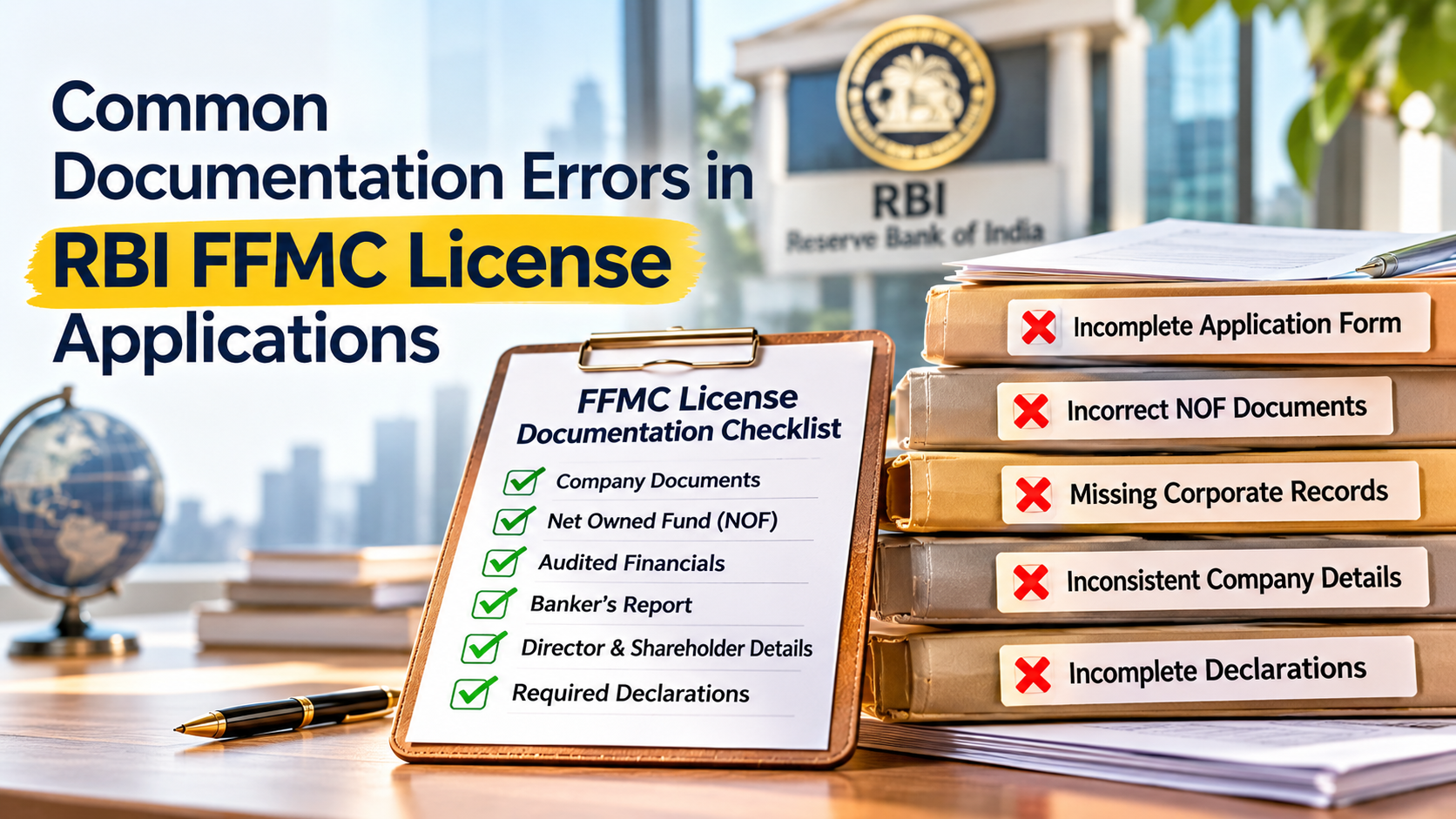
The common documentation errors in an RBI FFMC License application include forms that are not fully filled out corporate records that are not provided mistakes in calculating the Net Owned Fund and details, about the company that do not match each other. Some mistakes applicants should watch for include: 

  • Incorrect company details: Names, addresses, or incorporation information that don’t match official records. 
  • Incomplete financial documents: Missing auditor certificates or supporting statements. 
  • Incorrect NOF calculations: Financial figures that don’t follow RBI’s prescribed method. 
  • Missing declarations: Incomplete information about directors or relevant regulatory matters. 

These mistakes don’t automatically lead to rejection, but they may result in clarification requests and additional verification. 

Understanding the RBI FFMC License Application 

A Full Fledged Money Changer, or FFMC, is a company authorised by RBI to undertake permitted money-changing activities. 

If you’re planning to operate a foreign currency exchange business, you must obtain the appropriate authorisation before beginning regulated operations. 

The FFMC license application is submitted through RBI’s APConnect system to the relevant Regional Office. RBI examines the company’s financial position, corporate background, management information, and suitability for undertaking the proposed activities. 

Incorrect or Incomplete Application Forms 

The application form is the starting point of the approval process. Even small mistakes can create complications when RBI compares the information with supporting documents. 

Mismatched Company Information 

Suppose your company’s registered name appears differently in the application and its Certificate of Incorporation. Although it may seem like a difference it can raise questions, about the accuracy of the records. 

Before submitting verify that the company’s legal name, registered office address, incorporation details and proposed branch information match the documents. 

Missing Incorporation and Corporate Documents 

RBI needs to confirm that the applicant is legally incorporated and permitted to undertake the proposed business. 

The key corporate records include: 

  • Certificate of Incorporation. 
  • Memorandum and Articles of Association. 
  • Board resolution authorising money-changing activities. 

One detail applicants sometimes overlook is whether the company’s constitutional documents permit the proposed business. 

If the relevant provision is missing, an appropriate amendment may be necessary before proceeding. 

Errors in Net Owned Fund Documentation 

Financial eligibility is one of the most important RBI FFMC license requirements. 

Under the applicable RBI framework, companies generally need minimum Net Owned Funds of ₹25 lakh for a single branch and ₹50 lakh for multiple branches. 

However, having that amount in a bank account doesn’t automatically mean the company qualifies. 

Incorrect NOF Calculations 

Net Owned Funds, or NOF, are calculated using RBI’s prescribed method. The calculation considers eligible capital and reserves after specified deductions. 

For example, a company may have substantial paid-up capital but also accumulated losses that reduce its qualifying NOF. 

Understanding the Net Owned Fund requirements for FFMC helps applicants avoid relying on an incorrect calculation. 

Missing Financial Supporting Records 

The financial calculation must be supported by appropriate documents. 

These generally include audited financial statements, a statutory auditor’s NOF certificate, and other financial records required under RBI’s instructions. 

If the figures don’t match across the documents, RBI may request clarification. Having the auditor review the records before submission can help identify such problems. 

Problems With Banker’s Confidential Reports 

A banker’s confidential report is another important document in the application process. It provides relevant information about the applicant’s banking relationship and forms part of RBI’s assessment. 

Applicants sometimes face difficulties because the report is missing, incomplete, or not provided in the prescribed manner. Contacting the banker early can help avoid last-minute delays. 

Incomplete Director and Shareholder Details 

RBI considers relevant information about the people responsible for managing the applicant company. This means director information and applicable ownership disclosures should be accurate and current. 

Errors in Director Information 

Picture a company that names a director just before it files its application. The company still sends records that show the management structure. Such differences may lead to clarification requests. 

Before filing, review the company’s current director details, relevant corporate filings, appointment records, and required declarations. 

Unclear Business Plans and Operational Readiness 

Meeting the requirements is important but the RBI also needs to assess whether the applicant is suitable, for authorisation. 

Companies should have an understanding of the proposed money‑changing activities and the compliance responsibilities involved. 

Missing Operational Information 

For example, if the company wants to work using locations the application needs to show the plans, for those locations clearly when its needed. 

People applying should also know about the ways to identify customers keep records and follow rules before they start working. 

A clear operational plan helps demonstrate that the business has considered its regulatory responsibilities. 

Missing Declarations and Supporting Documents 

Some of the most important records in an FFMC application are declarations rather than financial statements. 

RBI requires relevant information concerning investigations, enforcement proceedings, and criminal cases involving the applicant company or its directors. Applicants should pay attention to: 

  • Required regulatory declarations. 
  • Accurate and current director information. 
  • Undertakings concerning KYC policy implementation. 
  • Supporting documents and authorised signatures. 

These declarations shouldn’t be treated as routine paperwork. Incomplete or inaccurate information can raise concerns during the assessment. 

Inconsistencies Across Submitted Records 

Sometimes, the problem isn’t a missing document. It’s that two documents contain different information. 

For example, the registered office address in the application may not match the company’s latest corporate records. 

Similarly, a board resolution may refer to an activity that isn’t properly supported by the constitutional documents. 

Reviewing all records together helps identify these differences before submission. 

Practical Checklist Before Submitting an FFMC Application 

Before filing an RBI FFMC License application, conduct a final review of the documents. 

Focus on these essential areas: 

  • Corporate records: Verify incorporation documents, constitutional documents, and board resolutions. 
  • Financial records: Review the NOF calculation, auditor’s certificate, and supporting statements. 
  • Banking information: Confirm that the required banker’s confidential report has been arranged. 
  • Regulatory declarations: Check director information and relevant undertakings. 
  • Application accuracy: Compare all details with the supporting records. 

A final review won’t guarantee approval, but it can reduce avoidable documentation problems. 

Steps to Correct Documentation Errors 

Finding an error doesn’t always mean you need to restart the application process. The appropriate correction depends on the nature of the mistake and the application’s status. 

For example, an incorrect NOF calculation should be reviewed with the statutory auditor. If a corporate record contains outdated information, the company may need assistance from its compliance professionals. 

If RBI has already requested clarification, respond through the prescribed process and provide the necessary corrected documents. 

The goal should be to address the actual problem rather than simply change the wording of the application. 

Professional Support for FFMC Registration 

Preparing an FFMC application requires coordination between company management, auditors, bankers, and compliance professionals. For someone applying for the first time, understanding how the documents fit together can be difficult. 

Professional assistance can help applicants look over records, also help them check information. Professional assistance can spot any inconsistencies. Finally professional assistance can help organize the application. Still the company must provide information. The company also must meet all eligibility conditions. 

Frequently Asked Questions:

What is the most common documentation mistake in an FFMC application? 

Incomplete forms, incorrect company information, missing financial documents, and inconsistent records are common problems that can lead to clarification requests. 

Can an FFMC application be corrected after submission? 

Depending on the application’s status and RBI’s instructions, applicants may be able to provide corrected documents or additional information through the prescribed process.

Why is Net Owned Fund verification important?

NOF verification helps establish whether the company meets RBI’s minimum financial eligibility requirements. The calculation must follow the prescribed method and be supported by the statutory auditor’s certificate.

Does RBI check the background of company directors?

Yes. RBI considers relevant director information and declarations when assessing an FFMC application.

Can a consultant help reduce documentation errors?

A consultant can assist with reviewing documents, identifying inconsistencies, and coordinating application preparation. However, RBI alone decides whether to grant authorisation.

Conclusion

Applying for an FFMC licence is not about gathering papers and filling out a form. Every single record, including the documents that show the company was formed the financial reports and the declarations from the directors must be correct. Match up. Even little errors can cause delays especially if more checks are needed. Spending time to check all the papers before sending them in can make everything much simpler. Getting help from a FFMC registration consultant in India can also be very useful. These consultants can help companies understand what is needed get the papers in order and fix any problems before they become issues. The final choice, about giving permission still belongs to RBI.

FFMC License Approval: What Can Go Wrong During the Process?

ffmc license approval

You’ve found a location for your forex business, discussed the investment and started gathering paperwork. Then progress stalls. A document needs clarification, an email hasn’t been answered, or nobody can explain what the application status means. Before treating this as an ordinary delay, check something more fundamental: can your application still proceed under the current rules? 

If you’re researching FFMC license Registration in India, the 2026 regulatory changes are essential context. Older guides describing a straightforward fresh filing route may no longer reflect the position. 

Understanding FFMC License Approval now starts with establishing your application’s status. Only then can you decide whether correcting documents, responding to a query or reviewing another route is appropriate. 

What Are the Common Reasons for Delays? 

Incomplete documents, inconsistent financial information, unanswered requests and unclear ownership details can complicate an application review. However, current applicants must first distinguish a pending transitional application from a fresh proposal. 

Under the 2026 regulations, RBI does not consider fresh FFMC authorisation applications, except those already under process when the regulations commenced. For affected pending applications, additional information already sought had to be supplied within the prescribed transitional window, failing which the applications were deemed rejected. 

So, before asking, “Which document should we upload next?”, establish whether the application remains capable of being processed. That distinction can prevent your team from spending time and money on the wrong next step. 

Check the Current Rules Before Reviewing Your Application 

The Foreign Exchange Management (Authorised Persons) Regulations, 2026 came into force on publication in the Official Gazette on 6 May 2026. 

This matters because a fresh business idea, an application already under process and an existing licence raise different questions. 

Begin by identifying your position: 

  • You planned to apply but had not filed. 
  • You submitted an application before commencement. 
  • RBI had requested additional information. 
  • You already hold an authorisation. 
  • You received a rejection or another decision. 

Don’t group these situations together as “licence pending.” 

FFMC License Approval: Why Your Application Date Matters 

Find the original submission acknowledgement and subsequent correspondence. Check what they establish about the application being under process at commencement. 

The special document deadline was 30 days from commencement, not a rolling 30-day period beginning whenever you review the file today. Prepare a chronology showing submission, requests, responses and decisions. 

An old acknowledgement proves a submission occurred. It should not, by itself, be treated as confirmation that the application remains pending. 

Missing Documents and Incomplete Responses 

For an application that can still proceed, document quality deserves close attention. Sometimes a response looks complete because several attachments were sent. But the reviewer may still lack the information requested. 

Common preparation problems include: 

  • Missing signatures or incomplete pages. 
  • Unreadable scans. 
  • Financial certificates without supporting schedules. 
  • Documents referring to different reporting dates. 
  • A response that overlooks part of a query. 
  • No clear explanation of what has changed. 

These are practical review points, not an official ranking of rejection reasons. 

Answer the Actual Question 

Suppose the request concerns how a financial figure was calculated. Sending the same certificate again may not explain the calculation. 

A useful response should: 

  1. Identify the request. 
  2. Answer it directly. 
  3. Refer to the supporting attachment. 
  4. Explain any correction or difference. 
  5. Identify anything still unresolved. 

    When reviewing FFMC License Documents, compare the file against the applicable requirements and the actual correspondence. A generic checklist can help organise papers. It cannot tell you whether a specific request has been answered. 

    Financial Records That Don’t Match 

    Questions about FFMC License Approval often lead promoters straight to the capital figure. But financial review also involves understanding the records behind that number. 

    Your accountant should compare the relevant statements, certificates and supporting schedules. If they use different dates or calculations, explain the difference before submitting a response. Check for: 

    • Differences between certified figures and underlying accounts. 
    • Unexplained movements in capital. 
    • Missing supporting records. 
    • Shareholding details that conflict with financial documents. 
    • Certificates prepared using outdated information. 

    Imagine a document that shows the position before a capital contribution and imagine another document that shows the position after a capital contribution. Both documents may be accurate. Without an explanation both documents can appear inconsistent. 

    Prepare a short reconciliation rather than expecting the reviewer to reconstruct the sequence. Also distinguish the requirements applicable to a transitional application from those governing renewal. Don’t combine figures or terminology from unrelated checklists. 

    Ownership and Management Information Gaps 

    Your file should make it clear who owns the applicant, who manages it and who is authorised to act for it. 

    When different papers say things problems happen. A director might have changed an ownership chart could be old. A statement might not match details that were shared somewhere else. 

    Review: 

    • Shareholding records. 
    • Director details. 
    • Relevant business interests. 
    • Signing authority. 
    • Changes since the original submission. 
    • Matters requiring professional assessment or disclosure. 

    If something has changed, establish what needs updating and how it should be communicated. 

    Be candid with your advisers about difficult issues. They can assess a known problem; they cannot reliably advise on information they haven’t received. Never rewrite records simply to make them look consistent. Correct inaccuracies through the appropriate process and preserve the history. 

    An Operating Plan That Leaves Questions Unanswered 

    A business plan should explain how the proposed operation would work in practice. “Our location attracts international travellers” may describe an opportunity, but it doesn’t explain how staff will check transactions, maintain records or escalate concerns. 

    Prepare answers to practical questions: 

    • Who will supervise daily operations? 
    • How will staff be trained? 
    • Who will check customer documentation? 
    • How will cash and records be reconciled? 
    • What happens when a transaction needs further review? 
    • Who handles complaints and compliance questions? 

    For authorised businesses, RBI’s money-changing directions include operational and KYC/AML/CFT requirements. Planning should therefore connect procedures to the people responsible for carrying them out. 

    A copied policy is of limited use if your team cannot explain how it will follow it. 

    Missed Communications and Unclear Responsibility 

    Sometimes the immediate problem is coordination. The consultant expects finance to provide a certificate. Finance believes it has already sent it. The director assumes the response was submitted. Meanwhile, nobody has checked the final communication. 

    To manage FFMC License Approval correspondence, assign one internal owner who can track the whole file. 

    Maintain a register showing: 

    • The communication date. 
    • What was requested. 
    • The applicable deadline. 
    • The person preparing each item. 
    • Who must review or sign it. 
    • When the response was sent. 
    • Evidence of submission. 

    Keep the filed version separate from working drafts. 

    During follow-up calls make sure to take notes with dates and confirm details through the right channel. A conversation might clear up confusion. Your written records should clearly show what was actually submitted or decided. 

    How to Review a Stalled Application 

    If the status is unclear, organise a file review before commissioning another set of documents. 

    Start with four questions: 

    • What application or authorisation are we reviewing? 
    • Which rules apply to its current position? 
    • What is the latest official communication? 
    • What evidence supports the next proposed action? 

    Then create a short issue list. Separate missing records from substantive eligibility questions and unresolved status questions. A useful adviser should explain the distinction between correcting a live application and attempting to revive one that is no longer pending. 

    For a fresh business proposal, discuss the currently available framework. AD authorisation categories have their own eligibility conditions. The Forex Correspondent model is an agency arrangement with an authorised principal, rather than an independent FFMC licence. Neither should be presented as an automatic substitute. 

    Frequently Asked Questions

    Can I Submit a Fresh FFMC Application Now?

    Fresh FFMC authorisation applications are not being considered under the 2026 regulations. The exception concerns applications already under process at commencement, subject to the applicable conditions.

    Does an Acknowledgement Mean My Application Is Still Pending?

    Not necessarily. Review subsequent correspondence, compliance with the transitional requirements and any decision communicated by RBI.

    Can Missing Documents Always Be Submitted Later?

    No. The answer depends on the application’s status and applicable deadlines. Don’t assume a late document automatically restores a rejected application.

    Can I Begin Money-Changing Activity While Waiting?

    An application is not an authorisation. RBI’s directions state that money-changing business requires valid authorisation.

    Can a Consultant Guarantee Approval?

    No. Avoid promises that document preparation alone will secure approval. Regulatory eligibility and the application’s legal status must be assessed first.

    Conclusion 

    The first step, towards understanding FFMC License Approval is to confirm where your business stands under the framework. Rebuild the filing history look over communications and compare the records with the issues that were actually raised. Before you spend more on an FFMC license application find out whether it can proceed and what action is appropriate.  That gives your team a clearer basis for its next decision. 

    How Does the FFMC License Application Process Work in India?

    ffmc license application process

    You’re planning a foreign-exchange business. You’ve researched locations, spoken to an accountant and found several guides explaining how to apply for an FFMC licence. Most make it sound like a straightforward sequence: incorporate, arrange funds, submit documents and wait. Before following those instructions, check whether they reflect the current rules.  If you’re researching FFMC Registration in India, the FFMC License Application Process now needs an important qualification. Under the regulations effective from 6 May 2026, RBI does not consider fresh FFMC applications, except those already under process when the regulations took effect. 

    Your first task is therefore to establish which route applies. This guide explains how to approach that assessment and organise the work that follows. 

    Why Do FFMC License Applications Face Delays in India? 

    For an eligible pending application, progress can depend on complete records, consistent financial information and timely responses to RBI’s questions. But a new proposal faces a more fundamental issue: fresh FFMC applications are no longer considered under the May 2026 framework. An unavailable route should not be described as a processing delay. 

    That distinction matters when someone tells you the application is “taking time.” Ask whether it is pending, awaiting information or unsuitable for the requested route.  Those situations require different responses. 

    Understand the Current Position Before Preparing an Application 

    Older checklists may accurately describe the previous framework. They should not be treated as instructions for a fresh application today. 

    RBI’s May 2026 circular confirms that the authorisation framework was reviewed and the relevant directions amended following the new regulations. 

    When reading about the FFMC License Application Process, separate: 

    • An existing authorised FFMC. 
    • An application covered by transitional provisions. 
    • A completely new business proposal. 

    Checklists may not fit all situations. Find out what category you fall into and why your adviser wants to take the next step by asking them to clarify the legal basis. Don’t pay any application fees or sign up to premises until you have done so. 

    Step 1: Identify Your Regulatory Position 

    Begin with a short factual summary. 

    Does the company already hold an authorisation? Was an application under process when the new regulations commenced? Or are you starting without an earlier filing? 

    Record the dates and supporting references. Avoid relying on memory or a consultant’s verbal update. 

    Existing Operators and Transitional Applicants 

    The regulations distinguish existing authorisations and transitional applications from fresh proposals. For covered pending applications where further information had been sought, they imposed a specific 30-day submission condition from commencement, with deemed rejection for non-compliance. That historical window should not be presented as open now. 

    If you have an older file, establish what happened within the relevant period. A past acknowledgement does not, by itself, confirm that the application remains pending. 

    Step 2: Review Your Application Records and Correspondence 

    For a business with an existing file, reconstruct the history before sending another response. 

    Collect: 

    • The application and acknowledgement. 
    • Documents originally submitted. 
    • Requests for clarification. 
    • Replies and supporting attachments. 
    • Submission confirmations. 
    • Any decision or status communication. 

    Arrange these chronologically. Then prepare a one-page summary showing what was requested, what was supplied and what remains unresolved. 

    Suppose the company changed directors after an earlier submission. Your adviser needs to see both the original position and the later change. Sending only the latest list can leave the file difficult to understand. 

    A reliable FFMC License Application Process review begins with the record, not with assumptions about what RBI probably received. 

    Step 3: Organise the Relevant Documents 

    The appropriate document set depends on the route and the actual request. Don’t present a generic checklist as a universal filing requirement. 

    For preparation, a company file may bring together: 

    • Incorporation and constitutional records. 
    • Ownership and management information. 
    • Relevant financial statements. 
    • Banking information. 
    • Existing authorisations. 
    • Business and operating plans. 
    • Applicable correspondence and declarations. 

    Ask your adviser to explain why each item is needed. If a record is unavailable, identify that early rather than leaving an unexplained gap. 

    Keep Financial Information Consistent 

    Your financial statements, accountant’s assessment and application information should reconcile. 

    Check whether different documents describe the same financial position and reporting date. Clarify the applicable regulatory measure rather than treating paid-up capital, net worth and available cash as interchangeable. 

    Also separate regulatory eligibility from business affordability. Meeting a relevant financial condition does not automatically cover rent, salaries, technology, security and working liquidity. 

    A credible plan should explain both. 

    Step 4: Respond Carefully to Requests for Information 

    A clarification request needs a focused answer. Re-sending the original bundle without explaining the issue can create more confusion. 

    Use a practical response method: 

    1. Read the complete communication. 
    2. Record the applicable deadline. 
    3. Assign each point to a responsible person. 
    4. Check the original submission. 
    5. Answer in the same sequence as the request. 
    6. Label supporting documents clearly. 
    7. Retain proof of submission. 

      Keep the explanation direct. If the question concerns ownership, answer that question before describing the wider business. 

      For FFMC license application documents, consistency matters across the complete response. Updating one form while leaving an attachment unchanged can create a fresh discrepancy.  Have one person check the final bundle before submission. 

      Step 5: Assess the Available Route for a New Business 

      If you are a new entrant, don’t try to recreate an unavailable fresh FFMC filing from an old guide. 

      The current regulations provide other authorisation categories and a Forex Correspondent scheme involving appointment by eligible Authorised Dealers. These are distinct arrangements, not automatic substitutes available to every proposed counter. 

      Describe your intended services precisely: 

      • Who are the customers? 
      • What transactions will they request? 
      • What activities do you want to undertake? 
      • Will the business operate under its own authorisation or another arrangement? 
      • What support would a proposed principal provide? 

      When talking about a money changer license in India ask for an evaluation of the process and what is allowed. The service label, by itself does not decide if someone is eligible. 

      Step 6: Prepare for Operations and Continuing Compliance 

      A viable route still needs an operating plan. 

      Money-changing business requires the appropriate authorisation or valid arrangement. RBI’s current directions also address transaction records, exchange-rate and licence displays, audit and applicable KYC requirements. 

      Turn those responsibilities into tasks your staff can follow: 

      • Who verifies customer information? 
      • Who checks incomplete records? 
      • Who approves an escalation? 
      • How are daily balances reconciled? 
      • Who maintains reporting information? 
      • How is access to sensitive records controlled? 

      Run a sample transaction internally. If every unfamiliar situation requires an improvised call to the owner, the procedures need more work. 

      The FFMC License Application Process should never be discussed as though paperwork alone creates a functioning compliance system. Operational preparation needs its own time, budget and ownership. 

      Set a Realistic Budget and Timeline 

      Start with an assessment, then commit to larger expenses. 

      Avoid signing a long lease or announcing an opening date based only on a general promise that approval will arrive soon. Ask what the estimate assumes and what could change it. 

      Your budget should distinguish: 

      • Professional assessment. 
      • Document preparation. 
      • Applicable filing or onboarding work. 
      • Premises and equipment. 
      • Staff and training. 
      • Continuing accounting and compliance. 
      • Working liquidity. 

      Get the engagement scope in writing. Does it include responses to questions? Which work requires a separate quote? What happens if the proposed route is unavailable? 

      For the FFMC License Application Process, a meaningful update should identify the stage, outstanding action and responsible person. “Under process” is not enough to plan a business launch. 

      Frequently Asked Questions

      Can a new company apply for a fresh FFMC licence now?

      The May 2026 framework stops consideration of fresh FFMC applications, except those already under process at commencement. New proposals need assessment under the available framework.

      Does an old acknowledgement prove my application is still pending?

      No. Review subsequent requests, responses and decisions, including the transitional conditions. The full application history matters.

      Can a consultant guarantee approval?

      No. Ask for an evidence-based assessment, clearly defined work and realistic assumptions. A professional engagement is not a guarantee of a regulatory outcome.

      Are all online document checklists still suitable?

      No. Check their date, legal basis and intended applicant category. Older material may describe a route that no longer applies to a new proposal.

      Can I begin exchanging currency while the paperwork is pending?

      Do not assume pending paperwork permits transactions. Confirm that the required authorisation or valid arrangement is in place before undertaking money-changing business.

      Conclusion 

      The FFMC License Application Process begins by confirming the route. Existing operators, transitional applicants and new entrants require assessments. Organise the records answer questions accurately and plan operations with the paperwork. Before committing to a counter ensure that the proposed business is built on an available arrangement and a workable compliance plan.

      FFMC Registration in India Queries that Applicants Face and How to Respond?

      FFMC registration in India

      You have collected the company documents organized the records and handed in the application. Then a message comes in asking for details. For businesses pursuing FFMC registration in India, the useful question is not simply, “How quickly can we reply?” It is, “What does the reviewing authority need to establish, and which records answer that?” A clear response starts there. 

      It can seem upsetting especially when you are already thinking about the store talking to suppliers and getting ready for the opening day. A question is not, on its own, a no. It is a need that should be seen and responded to correctly. 

      Why Does RBI Raise Queries on FFMC Applications? 

      The Reserve Bank of India might ask questions if an application needs information, extra papers or some checking before they can decide if it meets the rules for being eligible and getting a license. The questions could be about money records, company papers, details about the people, in charge official statements or what the business plans to do. The precise reason depends on the communication received. There is no single explanation that fits every application. 

      RBI’s requirements cover corporate documents, financial evidence, declarations and other licensing matters. The examples below explain where clarification may be needed; they are not an official ranking of query reasons. 

      If you need support with FFMC registration in India, share the complete query alongside the application. A short summary can leave out wording that changes what the response needs to address. 

      What Can Lead to Questions During Application Review? 

      An application consists of several connected records. Each document may look reasonable on its own, yet leave questions when read alongside the others. 

      Financial Records and Net Owned Funds 

      Net Owned Funds, or NOF, should not be confused with a bank balance or the amount founders intend to invest. 

      RBI lists minimum NOF of ₹25 lakh for a single-branch FFMC and ₹50 lakh for multiple branches. The prescribed calculation and supporting financial records matter. 

      A financial clarification could concern: 

      • Differences between statements and certificates. 
      • An unclear calculation. 
      • Losses or relevant deductions. 
      • Changes since the financial statements were prepared. 
      • Supporting evidence for capital introduced. 

      For example, saying “the company has sufficient funds” does not explain why two submitted documents show different figures. 

      Where a calculation needs correction, involve the responsible financial professional rather than editing a certified document yourself. 

      Company Documents and Business Activities 

      The company’s records should support the activity it proposes to undertake. 

      RBI’s documentation requirements include incorporation records, constitutional documents containing the relevant money-changing provision and a certified board resolution. 

      Review whether: 

      • The company name is consistent. 
      • Relevant amendments are properly documented. 
      • The business description matches the application. 
      • Authorised signatories are correctly identified. 
      • Resolutions relate to the proposed activity. 

      Also describe the intended service accurately. An FFMC licence should not be treated as permission for every forex, payment or remittance activity. 

      Director Information and Declarations 

      Names, appointments and declarations should tell a consistent story. 

      Potential points requiring explanation include: 

      • Different name spellings. 
      • Changes in directors. 
      • Missing signatures. 
      • Incomplete associated-business information. 
      • Disclosures that need further explanation. 

      Answer accurately. If a legal proceeding exists, obtain advice on the applicable disclosure and eligibility implications. Do not sign an inaccurate declaration because somebody calls it “standard wording.” 

      A response should explain the facts, identify the supporting records and address the actual requirement. 

      Compliance and Operational Readiness 

      A declaration about future compliance is not the same as a functioning process. 

      RBI’s requirements address a KYC, AML and CFT policy framework before commencement. Its directions also address premises-related evidence following approval and before business begins.  

      Keep the required stages separate. Do not assume every operational document belongs at the same point in the application. 

      When clarification is requested, explain: 

      • Who will handle the relevant responsibility. 
      • Which process will apply. 
      • What preparation is complete. 
      • What remains to be completed. 
      • Which records support the explanation. 

      Avoid presenting a generic policy as proof that staff and systems are already ready. 

      How to Prepare a Clear Response 

      The strongest reply is usually easy to follow. It answers the question directly, then points to evidence. You do not need to make it sound complicated. 

      Break the Communication Into Individual Questions 

      Before drafting, read the whole communication and create a response checklist. For each point, record: 

      • The clarification requested. 
      • Who will prepare the answer. 
      • Which documents are needed. 
      • Whether another document needs updating. 
      • The response deadline. 

      This helps prevent a common problem: answering the easiest questions and overlooking the one that requires coordination. 

      If the communication is unclear, seek clarification through the appropriate channel. Guessing may produce a polished response to the wrong question. 

      Explain the Answer and Attach the Evidence 

      A useful response follows this pattern: 

      1. Identify the query. 
      2. Give the direct answer. 
      3. Explain any discrepancy. 
      4. Refer to the supporting attachment. 
      5. Identify any corrected document. 

      For example: 

      “The difference arose because the earlier statement preceded the capital contribution. The updated financial records and supporting certificate are attached as Annexures A and B.” That is an illustrative structure, not wording to copy unless it matches the facts. 

      Clear FFMC application queries responses should make verification straightforward. Avoid sending a large attachment bundle without explaining what each item proves. 

      Check the Whole Application Again 

      A correction can affect than one document. If the proposed branch plan changes review the related assumptions and statements. If a director changes check the particulars and declarations. 

      For FFMC registration in India consistency across the application matters more than producing a standalone letter. Keep a record of what changed why it changed and who approved it. 

      Mistakes That Can Create Queries 

      Some replies introduce new uncertainty instead of resolving the original issue. Watch for these habits: 

      • Sending documents, without an explanation: The reviewer should not have to guess their relevance. 
      • Using versions: Clearly identify the current document. 
      • Making statements: Explain how the records support the answer. 
      • Changing facts without acknowledging the change: Address differences openly. 
      • Replying in fragments: Coordinate a complete response where required. 
      • Promising guaranteed approval: A complete reply does not predetermine the decision. 

      Also check the submission route. 

      RBI introduced APConnect for FFMC licensing and related requests, directing eligible fresh applicants to that system. Follow the current official instructions and the channel specified for your matter. Do not assume an NBFC application guide applies to an FFMC licence application. 

      How an FFMC Registration Consultant Can Help 

      An FFMC registration consultant can help organise the response and identify gaps that need financial, corporate or legal input. 

      Useful support may include: 

      • Reading the query against the submitted application. 
      • Separating documentary gaps from substantive issues. 
      • Coordinating with the company’s professionals. 
      • Preparing a point-by-point reply. 
      • Checking attachment references. 
      • Tracking submission and follow-up. 

      Ask who is responsible for each part. Financial certifications should come from the appropriate professional, while directors remain responsible for accurate declarations they sign. 

      A consultant supporting FFMC registration in India should explain what can be corrected and what may affect eligibility. They should also be clear that RBI makes the licensing decision. 

      Preparing Before Submission 

      You cannot guarantee a query-free review. You can make the application easier to assess. 

      Before filing: 

      • Compare names and addresses across records. 
      • Verify financial calculations and dates. 
      • Check signatures and authorisations. 
      • Review the proposed activity description. 
      • Confirm which documents apply to your circumstances. 
      • Maintain one controlled set of final records. 

      Separate regulatory capital from your setup budget. Office expenses, staffing, security and working arrangements need planning too. 

      Finally, resist the pressure to launch because you have spent money preparing. An application or query response is not a substitute for the necessary authorisation. 

      Frequently Asked Questions

      Does a Query Mean RBI Will Reject the Application?

      No. A query requests clarification or further information. The eventual outcome depends on the facts, requirements and assessment.

      Should We Resubmit Every Document?

      Follow the communication’s instructions. Provide the requested material and any related updates needed for consistency, with a clear index.

      What If We Cannot Respond by the Deadline?

      Raise the issue promptly through the appropriate channel, explain the reason and request additional time where available. Do not assume an extension has been granted.

      Can a New Company Provide Three Years of Accounts?

      RBI refers to previous audited accounts wherever applicable. Explain the company’s age and provide the records and certifications applicable to its situation.

      Will a Correct Reply Guarantee Approval?

      No. Resolving a query does not remove substantive eligibility concerns or guarantee a favourable decision.

      Conclusion

      FFMC registration in India requires a consistent, evidence-backed application. If queries arrive, slow down enough to understand each point before drafting. Give direct answers, explain differences and attach the records that support your position. Careful coordination between management and the relevant professionals can reduce avoidable back-and-forth and help you understand what still needs attention before the business moves forward.

      FFMC License Requirements in India: Know this Before Applying

      FFMC Licence Requirements in India

      Thinking about starting a foreign currency exchange business in India? You might have seen how often international travellers need to swap money before they leave or after they arrive. It seems like a business idea, especially in cities, with busy airports, popular tourist spots and a lot of international business activity. But there’s something important to know before opening a currency exchange counter. You can’t just start buying and selling currency just because you have set up a company or have rented an office.  First you need to undersatnd the FFMC License requirements.

      FFMC Registration in India needs permission, from the Reserve Bank of India (RBI). To get a Fledged Money Changer (FFMC) licence a business usually has to be registered under the Companies Act meet the required net owned funds have proper space and daily operations and meet the RBIs rules for being eligible. 

      Imagine you are thinking about starting a money exchange business to a famous tourist spot. You have found a place talked to some possible customers and already started thinking about how your office will look. Everything seems ready. But when you look into the legal requirements, you discover that you need RBI authorisation before carrying out money-changing activities. 

      That’s why understanding the licensing process early matters. It helps you plan your investment, arrange the necessary documents, and avoid spending money on a business that isn’t yet authorised to operate.  Here’s what you should know before applying. 

      What Is an FFMC Licence in India? 

      FFMC stands for Full Fledged Money Changer. 

      An FFMC is an entity that has been given permission by the Reserve Bank of India to do foreign exchange money-changing work. This permission is given under the Foreign Exchange Management Act, 1999 which is also known as FEMA. 

      In words an authorised FFMC can buy foreign currency from customers who are allowed to do so. It can also sell exchange for approved purposes as long as it follows the rules set by the RBI. 

      For example a person who comes back from a trip abroad may have some foreign currency left. They can go to an FFMC and exchange that money back, into rupees. 

      An FFMC provides permitted currency exchange services in accordance with the applicable regulations. 

      Is an FFMC the Same as a Bank? 

      No. Banks may be authorised to provide a wider range of foreign exchange services. 

      An FFMC operates within the specific activities permitted under its RBI authorisation. 

      Having an FFMC licence does not automatically give a business the right to offer every foreign exchange service. For example services, like remittances or other activities may need separate authorisation. 

      Before you apply check carefully that the services you want to provide are covered under the FFMC framework. 

      Who Can Apply for FFMC Registration in India? 

      Not every individual or business is eligible to apply directly. The RBI has laid down conditions for companies seeking authorisation as Full Fledged Money Changers. 

      1. The Applicant Must Be a Registered Company 

      Under the RBI’s FFMC licensing framework, the applicant must be a company registered under the Companies Act. 

      This means an individual cannot simply obtain an FFMC licence in their personal name and start operating a currency exchange business. 

      If you’re currently running a sole proprietorship or partnership, you’ll need to consider the appropriate company structure before applying. 

      Your company’s constitutional documents should also permit the proposed money-changing business. 

      2. The Company Must Meet the Net Owned Funds Requirement 

      This is one of the most important financial conditions. 

      RBI’s established FFMC licensing framework specifies the following minimum net owned funds (NOF): 

      • ₹25 lakh for a single-branch FFMC 
      • ₹50 lakh for an FFMC proposing more than one branch 

      Net owned funds aren’t simply the amount of money available in your company’s bank account. 

      They’re calculated according to the applicable regulatory definition, taking account of eligible owned funds and prescribed deductions. 

      For example, if you plan to open currency exchange counters in multiple locations, the financial requirement is different from that for a single-branch operation. 

      You should confirm the latest applicable NOF requirements with RBI before committing capital or filing an application. 

      3. Directors and Management Must Meet Suitability Requirements 

      RBI also considers the background of the applicant company and its management. 

      The application involves checks relating to the suitability of directors and the company, including relevant regulatory and enforcement concerns. A business should be ready to provide accurate information about its directors, ownership, and management. If there are past regulatory issues, these shouldn’t be hidden. 

      Providing incomplete or misleading information can create serious problems during the application process. 

      Documents Required for an FFMC Licence in India 

      Getting the paperwork ready can take time, especially if your company is newly incorporated. 

      The exact requirements should be checked against RBI’s current application instructions, but applicants generally need documents covering the company’s identity, financial position, management, and proposed business operations. 

      Company Registration Documents 

      These establish that your business is legally incorporated. 

      Common documents include: 

      • Certificate of Incorporation 
      • Memorandum of Association 
      • Articles of Association 
      • Corporate identification details 
      • Registered office information 

      The company’s objects should support the proposed foreign exchange business. 

      Financial Documents 

      RBI needs to assess whether the applicant meets the required financial conditions. 

      Depending on the applicable instructions, documents may include: 

      • Audited financial statements 
      • A certificate from the statutory auditor regarding net owned funds 
      • Relevant financial declarations 
      • Supporting information about the company’s financial position 

      The NOF certificate is particularly important because it supports the company’s claim that it meets the minimum financial requirement. 

      Management and Operational Documents 

      Applicants may also need to provide: 

      • Details of directors and key management personnel 
      • Relevant declarations and undertakings 
      • Information about proposed business premises 
      • Details of the planned money-changing activities 
      • Board resolutions and other corporate approvals, where required 
      • Additional information requested by RBI 

      Don’t assume that having a Certificate of Incorporation and PAN is enough. 

      RBI needs to understand both the company and how it intends to conduct the regulated business. 

      FFMC Registration Process in India: Step by Step 

      Once your company meets the basic conditions, the next stage is preparing and submitting the licence application. 

      The process involves regulatory review, so it isn’t the same as applying for an ordinary business registration. 

      Step 1: Incorporate the Company 

      If you haven’t already established a company, this comes first. Choose a suitable company structure and ensure its constitutional documents permit the proposed money-changing activities. It’s worth checking this before preparing the RBI application. 

      Step 2: Arrange the Required Capital 

      Next, make sure your company meets the applicable net owned funds requirement. If you’re planning more than one branch, account for the higher financial threshold. 

      You’ll also need to consider expenses beyond the regulatory capital requirement, such as office rent, staffing, technology, security, and compliance arrangements. 

      Step 3: Prepare the Application Documents 

      Collect the company records, financial documents, management details, and supporting declarations required under the applicable RBI instructions. Check that the information is consistent. 

      For example, the proposed business locations, company details, and financial information should match across the application and supporting documents. 

      Step 4: Submit the Application to RBI 

      The application must be submitted through the prescribed RBI process to the appropriate office or channel specified in the current instructions. 

      The RBI reviews the application and may request further clarification or additional documents. Submitting an application doesn’t mean the business is authorised to start operations. 

      Step 5: Complete RBI’s Review and Approval Requirements 

      RBI assesses whether the applicant meets the relevant licensing conditions. This may involve examining the company’s financial position, management suitability, and proposed operational arrangements. 

      If the application is approved, the company must comply with the conditions attached to its authorisation. 

      Step 6: Begin Operations Only After Authorisation 

      Once the required authorisation is in place and applicable operational conditions have been satisfied, the company can begin its permitted money-changing activities. 

      Starting operations before obtaining the necessary approval can expose the business to regulatory action. 

      What Compliance Rules Must an FFMC Follow? 

      Getting an FFMC license in India is only the beginning. Because foreign currency exchange is a regulated activity, must follow the FFMC license requirements. 

      Customer Identification and KYC 

      FFMCs must comply with applicable Know Your Customer (KYC) and anti-money laundering requirements. 

      This includes carrying out appropriate customer identification and verification for relevant transactions. 

      The business should have procedures for identifying customers, maintaining records, and handling transactions that require additional scrutiny. 

      Transaction Records and Reporting 

      An FFMC needs to maintain the prescribed records of foreign exchange transactions. Applicable reporting requirements must also be followed. 

      These records help demonstrate that the business is operating within its authorised activities. 

      Internal Controls and Staff Training 

      Currency exchange businesses handle money and sensitive customer information. 

      Staff should understand the relevant RBI instructions, customer verification procedures, transaction limits, and reporting responsibilities. Internal checks can help reduce errors and identify suspicious or unusual activity. 

      Operating Within the Permitted Scope 

      An FFMC must not assume that its authorisation covers every type of foreign exchange transaction. 

      The company should follow the specific activities, limits, and conditions permitted under the applicable RBI framework. 

      How Much Does FFMC Registration Cost in India? 

      This is often one of the first questions business owners ask. The total cost of setting up an FFMC depends on more than the amount required to meet the NOF condition. 

      You’ll also need to budget for the practical cost of establishing and running the business. 

      These expenses may include: 

      • Company incorporation and documentation 
      • Professional assistance 
      • Office premises and equipment 
      • Security arrangements 
      • Staff recruitment and training 
      • Accounting and compliance systems 
      • Technology and transaction recordkeeping 

      The minimum net owned funds requirement shouldn’t be confused with an application fee or a payment made to RBI. 

      It’s a financial eligibility condition that the company must satisfy. 

      Before preparing a budget, confirm the current regulatory requirements and obtain estimates for the services and infrastructure you’ll need. 

      Common Mistakes Businesses Make During FFMC Registration 

      Applying for an FFMC licence involves several details, and overlooking even one can delay your plans. 

      Starting Without Checking Eligibility 

      Some applicants spend money on premises and equipment before confirming whether their company meets the licensing requirements. It’s better to review eligibility first. 

      Confusing Capital With Net Owned Funds 

      Having ₹25 lakh or ₹50 lakh in a bank account doesn’t automatically mean the company satisfies the NOF requirement. The amount must be calculated using the applicable regulatory definition. 

      Submitting Incomplete Documents 

      Missing declarations, inconsistent company information, or unsupported financial claims can lead to further questions. Review your documents carefully before submission. 

      Assuming Approval Is Guaranteed 

      Even if your company appears to meet the basic eligibility conditions, RBI still has to assess the application. Meeting the minimum requirements doesn’t guarantee that a licence will be granted. 

      Ignoring Compliance Planning 

      Don’t wait until after approval to think about KYC, recordkeeping, staff training, and internal controls. These are essential parts of running a regulated money-changing business. 

      Should You Hire an FFMC Registration Consultant? 

      If you’re unfamiliar with RBI licensing, the process can feel confusing. 

      There are financial conditions to check, company documents to prepare, and regulatory requirements to understand. 

      An experienced FFMC registration consultant can help you review eligibility, identify missing documents, and organise the application. 

      Professional assistance may also be useful when you’re deciding how many branches to establish or preparing your operational arrangements. 

      If you’re planning to start a currency exchange business, you can explore BIAT Consultant’s FFMC registration services to understand the professional support available. 

      Keep in mind that a consultant can assist with preparation and compliance, but the decision to grant authorisation rests with RBI. 

      Frequently Asked Questions

      What are the requirements for FFMC registration in India? 

      The applicant generally needs to be a company incorporated under the Companies Act, meet the prescribed net owned funds requirement, have suitable management and operational arrangements, and satisfy RBI’s licensing conditions. 

      How much capital is required for an FFMC licence in India?

      Under RBI’s established framework, the minimum net owned funds requirement is ₹25 lakh for a single branch and ₹50 lakh for more than one branch. Applicants should verify the current requirements before applying.

      Can an individual apply for an FFMC licence? 

      An individual cannot obtain an FFMC licence directly in their personal capacity under the company-based licensing framework. The applicant must be an eligible company. 

      How long does FFMC registration take in India? 

      The timeline depends on the completeness of the application, RBI’s review, and whether additional information or clarification is required. Applicants shouldn’t assume a guaranteed approval date.

      Conclusion

      Starting a foreign currency exchange business can be an interesting opportunity, particularly in places where international travel and tourism create regular demand for money-changing services. But it’s a regulated business, and getting the licence right is essential. Before meeting a FFMC Consultant in India, check whether your company meets the eligibility conditions, understand the net owned funds requirement, and prepare the necessary documents. 

      You should also think about the practical side of running the business, including customer verification, transaction records, staff training, and ongoing compliance. A well-prepared application won’t guarantee RBI approval, but it can help you avoid unnecessary mistakes and delays. And if you’re unsure about the requirements, getting professional guidance before submitting the application may save you time and effort later.

      FFMC Registration Cost in India: Fees and Capital Requirements

      FFMC registration in India

      How much does FFMC registration cost in India? The biggest financial requirement is the capital your company must have before applying for an RBI licence. For a single-branch Full Fledged Money Changer (FFMC), the minimum Net Owned Fund requirement is ₹25 lakh. For multiple branches, it increases to ₹50 lakh. 

      If you’re planning FFMC Registration in India, there’s one important thing to understand. This amount isn’t a registration fee paid to the Reserve Bank of India (RBI). It’s the minimum financial strength your company must maintain to qualify for the licence. 

      Starting a foreign currency exchange business involves more than getting permission from the RBI. You’ll also need to consider office expenses, documentation, professional assistance and ongoing compliance costs. 

      So, how much money should you actually plan for? Let’s break down the expenses and requirements. 

      What Is an FFMC License in India? 

      An FFMC, or Full Fledged Money Changer, is a company authorised by the RBI to carry out permitted foreign currency exchange activities. 

      For example, someone returning from an international trip may have unused foreign currency. An authorised money changer can purchase that currency under the applicable RBI rules. 

      Similarly, an FFMC may sell foreign exchange for permitted purposes, subject to regulatory conditions. 

      However, an FFMC licence in India doesn’t allow a company to provide every type of foreign exchange or international payment service. Its activities are limited to what the RBI permits. 

      That’s why understanding the licence and its requirements matters before investing in the business. 

      What Is the Total Cost of FFMC Registration in India? 

      There’s no single fixed amount that covers every expense involved in starting an FFMC business. 

      The overall cost depends on whether you’re starting a new company, how many branches you want and what professional services you need. 

      Here are the main expenses to consider: 

      • Minimum Net Owned Funds: ₹25 lakh for one branch or ₹50 lakh for multiple branches. 
      • Company incorporation: Expenses involved in registering a company, if you haven’t already formed one.
      • Documentation: Costs of preparing financial statements, certificates and supporting records.
      • Professional fees: Charges for assistance with the application and regulatory requirements.
      • Office setup: Rent, furniture, computers, security arrangements and other equipment.
      • Compliance expenses: Costs of maintaining records and meeting RBI requirements. 
      • Working capital: Funds needed for employees, daily operations and foreign currency inventory. 

      These costs shouldn’t be confused with government registration fees. 

      For example, an existing company with a suitable office may spend less on setting up operations than a newly incorporated business. 

      The important thing is to calculate the total investment rather than focusing only on the minimum capital requirement. 

      Minimum Capital Requirements for an FFMC License 

      One of the first things the RBI considers is whether your company has sufficient Net Owned Funds, commonly called NOF. 

      How Much Capital Is Required for a Single Branch? 

      A company planning to operate one FFMC branch must have a minimum NOF of ₹25 lakh. 

      This isn’t money you automatically deposit with the RBI. It represents the company’s qualifying financial resources. 

      Meeting this requirement is necessary, but it doesn’t guarantee approval. 

      What If You Want Multiple Branches? 

      For a company planning to operate more than one branch, the minimum NOF requirement is ₹50 lakh. 

      Suppose you want to open a currency exchange office in Delhi and later expand into Mumbai or Bengaluru. You should consider the higher capital requirement while planning your expansion. 

      Opening additional branches is also subject to applicable RBI conditions. 

      What Are Net Owned Funds? 

      Net Owned Funds aren’t simply the amount of cash available in your bank account. 

      They’re calculated based on the company’s financial position under RBI rules. 

      The calculation generally considers: 

      • Paid-up equity capital. 
      • Eligible free reserves. 
      • Accumulated losses. 
      • Intangible assets. 
      • Certain investments and other applicable deductions. 

      For example, a company may have ₹30 lakh in capital and reserves but still fail to meet the ₹25 lakh requirement if losses and deductions reduce its qualifying NOF. 

      That’s why getting the calculation reviewed before applying is a sensible step. 

      Is There an RBI Government Fee for FFMC Registration? 

      Many websites mention different amounts for FFMC licensing. This can be confusing, especially when you’re trying to prepare a budget. 

      The reason is that some quotations combine consultancy charges, documentation expenses and other services. 

      There isn’t one universal registration package price that covers everything. 

      Before paying a consultant, ask for a breakdown of: 

      • Any applicable official charges. 
      • Professional consultancy fees. 
      • Documentation and certification costs. 
      • Company incorporation expenses, if required. 
      • Additional charges for follow-up assistance. 

      Don’t assume that every amount quoted as an FFMC registration fee is payable to the RBI. 

      It’s always better to confirm the applicable requirements and charges before submitting your application. 

      What Documents Are Required for an FFMC License? 

      Preparing your documents carefully can help prevent unnecessary delays. 

      The documents generally include: 

      • Certificate of Incorporation. 
      • Memorandum and Articles of Association permitting money-changing activities. 
      • Latest audited financial statements. 
      • Auditor’s certificate confirming Net Owned Funds. 
      • Previous three years’ audited financial statements, wherever applicable. 
      • Confidential report from the company’s banker. 
      • Board resolution approving the proposed business. 
      • Details of associated financial-sector companies. 
      • Required regulatory and legal declarations. 
      • Declaration regarding the proposed KYC, AML and CFT compliance framework. 

      The exact documents should be confirmed against the applicable RBI requirements. 

      Can Documentation Increase Registration Costs? 

      Yes, particularly if your company’s existing records need updating. 

      For instance, if your Memorandum of Association doesn’t permit money-changing activities, you may need to amend it. 

      Similarly, preparing financial certificates or correcting incomplete records may involve professional charges. 

      Reviewing these documents early can help you avoid repeated corrections. 

      How to Apply for FFMC Registration in India 

      The application process involves several steps, and each one deserves attention. 

      Step 1: Check Your Company’s Eligibility 

      Make sure your company meets the applicable NOF requirement and other RBI eligibility conditions. 

      The company’s management and directors must also satisfy relevant suitability requirements. 

      Step 2: Prepare the Required Documents 

      Collect incorporation records, audited financial statements, the NOF certificate and other supporting documents.  Check everything before submission. 

      Step 3: Submit the Application 

      The application must be submitted through the RBI’s prescribed process, including APConnect where applicable.  Follow the current filing instructions issued by the RBI. 

      Step 4: RBI Reviews the Application 

      The RBI may examine: 

      • The company’s financial position. 
      • Background and suitability of directors. 
      • Proposed business activities. 
      • Regulatory declarations. 
      • Supporting documents and compliance arrangements. 

      Additional information may be requested during the review. 

      Step 5: Complete the Approval Requirements 

      If the application is approved, the company must satisfy any applicable conditions before starting money-changing operations. 

      Submitting an application alone doesn’t authorise a company to conduct foreign exchange business. 

      What Other Expenses Should You Consider? 

      Many entrepreneurs arrange the required capital but underestimate what it costs to operate the business.  Apart from licensing-related expenses, you’ll need to budget for everyday operations. 

      Office and Infrastructure 

      Your office may require furniture, computers, security equipment and reliable internet connectivity.  Rent and security deposits will depend on the location. 

      Employees and Training 

      Staff members must understand customer verification, transaction documentation and applicable regulatory requirements. 

      Employee salaries and training expenses should be part of your budget. 

      Technology and Compliance 

      You’ll need suitable systems to maintain transaction records, customer information and regulatory reports. 

      Ongoing compliance may also involve accounting, audits and internal controls. 

      Working Capital 

      You’ll need sufficient liquidity to manage operating expenses and foreign currency inventory. 

      The minimum NOF requirement shouldn’t be confused with the total working capital needed to run the business. 

      How Can an FFMC Registration Consultant Help? 

      Applying for an RBI-regulated licence can feel complicated, especially if you’re unfamiliar with financial documentation and regulatory procedures. 

      An FFMC registration consultant can help you understand the requirements and prepare your application properly. 

      Depending on the services offered, assistance may include: 

      • Reviewing company eligibility. 
      • Checking capital requirements. 
      • Helping prepare application documents. 
      • Coordinating financial certificates. 
      • Assisting with application submission. 
      • Helping respond to RBI queries. 
      • Explaining compliance obligations. 

      However, a consultant cannot guarantee approval. The final decision rests with the RBI. 

      Before hiring someone, ask what’s included in their fees and whether additional assistance will cost extra.  A clear quotation can help you avoid unexpected expenses. 

      Common Mistakes That Can Increase FFMC Registration Costs 

      Some expenses are unavoidable, but others happen because applicants begin without understanding the requirements. 

      Confusing Capital With Government Fees 

      The ₹25 lakh and ₹50 lakh amounts are NOF requirements, not government application fees. 

      Treating them as registration charges can lead to incorrect financial planning. 

      Applying Without Checking Eligibility 

      A company may have sufficient funds in its bank account but still fail to meet the required NOF after applicable deductions. Check the calculation before applying. 

      Ignoring Ongoing Compliance Costs 

      Getting the licence is only the beginning.  Customer verification, reporting, record-keeping, and internal controls involve continuing responsibilities and expenses. 

      Planning Multiple Branches Too Early 

      Expansion involves additional capital and regulatory requirements. 

      It’s better to consider these costs before committing to new premises. 

      Frequently Asked Questions

      1. How Much Does FFMC Registration Cost in India? 

      The total expense depends on documentation, professional assistance, office setup and business operations. The minimum NOF requirement is ₹25 lakh for one branch and ₹50 lakh for multiple branches. These are capital requirements, not registration fees.

      2. Is ₹25 Lakh Paid to the RBI? 

      No. ₹25 lakh represents the minimum Net Owned Funds required for a single-branch FFMC. It isn’t a licence fee paid to the RBI.

      3. Can an Individual Apply for an FFMC License? 

      No. An FFMC licence is issued to an eligible incorporated company that meets the applicable RBI requirements. 

      4. Is Hiring an FFMC Registration Consultant Necessary?

      Not necessarily. However, professional assistance can be useful for preparing documents, understanding eligibility requirements and handling application-related queries.

      5. Does Meeting the Capital Requirement Guarantee Approval? 

      No. The RBI also reviews the company’s suitability, documents, management and other regulatory requirements. 

      6. Are There Expenses After Receiving the License? 

      Yes. Businesses need to budget for employees, office operations, technology, compliance, audits, and working capital.

      Conclusion 

      Starting an FFMC business requires more than arranging the minimum capital to get some with that you can hire an FFMC registration consultant. You also need to think about documentation, professional assistance, office expenses, and the cost of meeting regulatory requirements once operations begin. 

      Before applying, check your company’s financial eligibility and prepare a realistic budget. Understanding the expenses early can help you avoid unnecessary costs and make better decisions about starting your foreign currency exchange business.

      AI and Data Analytics in the FFMC Industry: Smarter Compliance and Risk Monitoring

      AI and Data Analytics in the FFMC Industry: Smarter Compliance and Risk Monitoring

      The foreign exchange ecosystem in India is evolving rapidly, and Full Fledged Money Changers (FFMCs) are under increasing regulatory and operational pressure. With strict RBI norms governing the full fledged Money Changer license, businesses must ensure transparency, compliance, and robust risk management. This is where Artificial Intelligence (AI) and Data Analytics are transforming the FFMC industry.

      The Growing Compliance Challenge for FFMCs

      Entities holding an FFMC License in India must comply with multiple regulations, including KYC, AML, FEMA, and RBI reporting requirements. Manual compliance processes often lead to delays, human errors, and higher operational costs. As full fledged Money Changers scale their operations, the complexity of monitoring transactions and identifying risks increases significantly.

      How AI Enhances Compliance Monitoring

      AI-powered systems can automate and strengthen compliance frameworks for FFMCs. Advanced algorithms analyze large volumes of transaction data in real time to detect anomalies, suspicious patterns, and non-compliant activities.

      For businesses operating under an FFMC, full fledge money changer license in India, AI tools help:

      • Automate KYC and customer verification
      • Identify high-risk transactions instantly
      • Generate accurate compliance reports for regulators

      This significantly reduces manual intervention and improves regulatory confidence.

      Data Analytics for Smarter Risk Management

      Data analytics enables FFMCs to move from reactive to proactive risk management. By leveraging historical data, analytics platforms can predict potential compliance risks, customer behavior trends, and exposure to foreign exchange volatility.

      FFMCs holding FFMCs lincese in India can use data insights to:

      • Monitor transaction trends across branches
      • Assess customer risk profiles
      • Optimize foreign currency inventory management

      This data-driven approach supports sustainable growth while maintaining compliance.

      AI in Fraud Detection and AML Controls

      AI models are highly effective in identifying complex fraud patterns that traditional systems may miss. For FFMCs, this means stronger AML controls and faster detection of suspicious activities, ensuring adherence to RBI guidelines.

      By integrating AI with digital platforms offering FFMCs license online application and management services, businesses can also streamline internal audits and compliance reviews.

      Future of FFMC Operations in India

      As regulatory scrutiny intensifies, AI and data analytics will become essential tools rather than optional upgrades. FFMCs that invest in intelligent compliance systems will not only safeguard their full fledged Money Changer license but also gain a competitive edge through efficiency, accuracy, and trust.

      Conclusion

      AI and data analytics are redefining how full fledged Money Changers operate in India. From smarter compliance monitoring to advanced risk management, these technologies empower FFMCs to stay compliant, reduce operational risks, and scale confidently. For businesses seeking long-term success under an FFMC License in India, embracing digital intelligence is the way forward.

      How FFMC Licensing Increases Business Credibility with Banks and Partners

      How FFMC Licensing Increases Business Credibility with Banks and Partners

      In India’s tightly regulated foreign exchange ecosystem, trust and compliance are the foundation of every successful transaction. For businesses dealing in foreign currency exchange, credibility is not optional—it is essential. This is where obtaining a Full Fledged Money Changer license plays a decisive role. An FFMC License in India, issued by the Reserve Bank of India (RBI), does much more than grant legal permission to operate; it significantly enhances a company’s reputation with banks, financial institutions, and strategic partners.

      This blog explores how full fledged Money Changers benefit from licensing and why FFMC approval is a powerful credibility booster in today’s competitive financial landscape.

      Understanding FFMC Licensing in India

      A full fledge money changer license in India allows eligible entities to undertake foreign exchange transactions such as buying and selling foreign currency, traveler’s cheques, and prepaid forex cards. Governed under FEMA and regulated by the RBI, FFMCs are expected to meet strict norms related to capital adequacy, compliance, KYC, AML, and reporting.

      The FFMC License in India serves as official recognition that a business meets RBI’s regulatory and financial standards, making it a trusted participant in the forex market.

      Why Credibility Matters in the Forex Business

      Foreign exchange transactions involve high-value funds, cross-border movement of money, and exposure to compliance risks. Banks and partners are cautious about whom they work with, as any regulatory lapse can have serious legal and reputational consequences.

      Without proper licensing, businesses often face:

      • Difficulty opening or maintaining bank accounts
      • Limited access to forex settlement channels
      • Hesitation from partners to collaborate
      • Increased scrutiny from regulators

      Holding a valid FFMCs license in India directly addresses these concerns.

      How FFMC Licensing Builds Trust with Banks

      1. RBI Recognition Enhances Institutional Confidence

      Banks prefer working with entities that are directly regulated by the RBI. An FFMC license demonstrates that your business has undergone detailed scrutiny, including background checks, financial assessment, and operational review. This RBI endorsement reassures banks that the entity is compliant, transparent, and low-risk.

      As a result, licensed full fledged Money Changers find it easier to:

      • Open current accounts
      • Access forex settlement services
      • Obtain faster approvals for transactions

      2. Easier Access to Banking Facilities

      Banks are legally obligated to ensure that their clients comply with FEMA and RBI norms. When a business holds an FFMC License in India, banks can confidently extend services such as:

      • Nostro/Vostro arrangements
      • Cash management services
      • Foreign currency accounts
      • Payment gateway integrations

      Unlicensed or informally operating entities often face repeated rejections or account freezes due to compliance concerns.

      3. Reduced Due Diligence Burden

      Licensed FFMCs already meet RBI’s KYC and AML requirements. This reduces the additional due diligence banks need to conduct, speeding up onboarding and strengthening long-term relationships. In contrast, non-licensed entities are subject to ongoing scrutiny, audits, and restrictions.

      Strengthening Partnerships Through FFMC Licensing

      1. Increased Confidence Among Business Partners

      Strategic partners—such as travel companies, fintech platforms, exporters, and remittance service providers—prefer to collaborate with entities holding a valid FFMCs lincese in India. Licensing assures them that the business operates within legal boundaries and follows standardized procedures.

      This credibility opens doors to:

      • White-label forex partnerships
      • Franchise and sub-agent models
      • Cross-border payment collaborations

      2. Competitive Advantage in the Market

      In a crowded forex market, having an RBI-approved FFMC license differentiates your business. Partners are more likely to choose licensed full fledged Money Changers over unregulated competitors because the risk of regulatory non-compliance is significantly lower.

      This advantage often translates into higher transaction volumes and stronger commercial terms.

      3. Long-Term Business Sustainability

      Partnerships thrive on stability. An FFMC license signals that the business is built for long-term operations, not short-term gains. This assurance encourages partners to invest time, resources, and technology into collaborative growth.

      Role of Online FFMC Licensing in Building Credibility

      With regulatory processes becoming more digitized, businesses can now apply for FFMCs license online through professional consultants. Online licensing ensures:

      • Faster documentation and submission
      • Better compliance tracking
      • Reduced procedural errors

      Opting for FFMCs license online not only simplifies the application process but also reflects a business’s commitment to transparency and modern governance—qualities highly valued by banks and partners alike.

      Compliance as a Continuous Credibility Factor

      Obtaining the license is only the beginning. RBI expects FFMCs to maintain ongoing compliance through:

      • Periodic reporting
      • Regular audits
      • Adherence to updated KYC and AML norms

      Businesses that remain compliant retain their credibility and avoid penalties, suspension, or cancellation of their FFMC License in India.

      Conclusion

      In the foreign exchange industry, credibility is built on regulation, transparency, and trust. A Full Fledged Money Changer license is more than a legal requirement—it is a strategic asset that strengthens relationships with banks and business partners. From easier access to banking services to improved partnership opportunities, FFMC licensing lays a solid foundation for sustainable growth.

      For businesses aiming to scale responsibly and build long-term trust in the forex market, securing an FFMC, full fledge money changer license in India—whether through traditional or FFMCs license online channels—is a decisive step toward success.

      Legal Implications of Non-Compliance for FFMC License Holders

      Legal Implications of Non-Compliance for FFMC License Holders

      Operating as a foreign exchange service provider in India comes with significant regulatory responsibilities. Entities holding a full fledged Money Changer license are governed by strict guidelines issued by the Reserve Bank of India (RBI) under the Foreign Exchange Management Act (FEMA), 1999. While the FFMC License in India enables businesses to legally deal in foreign currency, non-compliance can lead to severe legal, financial, and reputational consequences.

      This blog explores the key legal implications of non-compliance for full fledged Money Changers and why strict adherence to RBI norms is critical.

      Understanding FFMC Regulatory Framework in India

      A full fledge money changer license in India allows authorized entities to undertake foreign exchange transactions such as buying and selling foreign currency notes, coins, and traveler’s cheques. RBI regulations mandate compliance in areas such as:

      • Know Your Customer (KYC) and Anti-Money Laundering (AML)
      • Transaction reporting
      • Record maintenance
      • Periodic audits and inspections
      • Net Owned Fund (NOF) requirements

      Failure to comply with these obligations exposes FFMCs to serious legal action.

      Key Areas of Non-Compliance by FFMCs

      Some of the most common compliance failures related to FFMCs lincese in India include:

      • Inadequate KYC documentation
      • Failure to report high-value or suspicious transactions
      • Unauthorized currency exchange activities
      • Non-maintenance of statutory registers and records
      • Delay or failure in filing regulatory returns
      • Breach of RBI operational guidelines

      Even minor lapses can attract scrutiny during RBI inspections.

      Legal Consequences of Non-Compliance

      1. Monetary Penalties under FEMA

      Under FEMA provisions, RBI has the authority to impose heavy monetary penalties on FFMCs found violating regulations. In some cases, penalties can extend to several lakhs or even crores, depending on the severity of the breach.

      2. Suspension or Cancellation of FFMC License

      Repeated or serious violations can lead to suspension or outright cancellation of the FFMC License in India, effectively shutting down the business. Once cancelled, obtaining a fresh FFMCs license online becomes extremely difficult.

      3. Criminal Liability

      Non-compliance related to money laundering, terror financing, or fraudulent transactions may attract criminal proceedings against directors, compliance officers, and key management personnel of full fledged Money Changers.

      4. Enhanced Regulatory Scrutiny

      Non-compliant FFMCs are often placed under enhanced RBI monitoring, leading to frequent audits, inspections, and reporting obligations—impacting operational efficiency.

      5. Reputational Damage

      Loss of credibility among customers, banks, and regulators is a long-term consequence. For FFMCs, trust is a critical business asset, and regulatory action can severely damage brand reputation.

      Impact on Business Operations

      Legal action due to non-compliance doesn’t just result in penalties—it disrupts business continuity. Bank accounts may be frozen, foreign exchange operations restricted, and expansion plans delayed. For businesses that obtained their FFMCs license online, maintaining digital compliance records becomes even more important to withstand regulatory audits.

      How FFMC License Holders Can Ensure Compliance

      To avoid legal complications, FFMCs should:

      • Implement robust digital KYC and AML systems
      • Conduct regular internal and statutory audits
      • Train staff on RBI and FEMA regulations
      • Maintain updated transaction records
      • Seek professional compliance and legal advisory support

      Proactive compliance not only protects the full fledged Money Changer license but also strengthens long-term business sustainability.

      Conclusion

      Holding an FFMC License in India comes with immense responsibility. Non-compliance can trigger penalties, license cancellation, and even criminal prosecution. For full fledged Money Changers, staying aligned with RBI norms is not optional—it is essential for survival and growth.

      If you are applying for or already operating under FFMCs lincese in India, investing in compliance management is the smartest way to safeguard your business and maintain regulatory trust.

      Digital KYC and Automation: How Technology Is Simplifying FFMC Operations

      Digital KYC and Automation: How Technology Is Simplifying FFMC Operations

      The foreign exchange industry in India is undergoing a rapid digital transformation. With increasing regulatory oversight and customer expectations for faster services, Full Fledged Money Changers (FFMCs) are embracing digital KYC and automation to streamline their operations. Technology is no longer optional—it has become a key driver of compliance, efficiency, and growth for businesses holding a full fledged money changer license in India.

      This blog explores how digital KYC and automation are simplifying FFMC operations and reshaping the future of licensed money-changing businesses.

      Understanding FFMCs and Their Regulatory Environment

      A Full Fledged Money Changer license allows entities to undertake foreign exchange transactions such as currency exchange, outward remittances, and forex services for travelers. Issued by the Reserve Bank of India (RBI), the FFMC License in India comes with strict compliance requirements related to KYC, AML, reporting, and record maintenance.

      Traditionally, full fledged Money Changers relied heavily on manual documentation and verification processes. However, these legacy systems often led to delays, errors, and higher operational costs—making digital solutions a necessity rather than a luxury.

      The Role of Digital KYC in FFMC Operations

      Digital Know Your Customer (KYC) systems have revolutionized how FFMCs onboard customers and verify identities. Instead of physical paperwork, digital KYC enables real-time verification using Aadhaar-based authentication, PAN validation, passport checks, and face recognition technologies.

      Key Benefits of Digital KYC for FFMCs

      • Faster customer onboarding with minimal documentation
      • Improved compliance with RBI and AML guidelines
      • Reduced risk of fraud and identity theft
      • Accurate digital recordkeeping for audits and inspections

      For businesses operating under FFMCs license in India, digital KYC ensures regulatory adherence while improving customer experience.

      Automation: The Backbone of Modern FFMCs

      Automation goes beyond KYC. It touches every operational aspect of FFMCs—from transaction processing to reporting and compliance management.

      How Automation Simplifies FFMC Operations

      1. Transaction Management
        Automated systems process forex transactions in real time, reducing manual intervention and calculation errors.
      2. Regulatory Reporting
        Automation enables seamless generation and submission of RBI reports, CTRs, and STRs, ensuring timely compliance for full fledged Money Changers.
      3. Customer Data Management
        Centralized dashboards allow FFMCs to securely store and retrieve customer data whenever required.
      4. Audit Readiness
        Digital logs and automated documentation help businesses remain audit-ready at all times.

      With automation, FFMCs can scale operations without proportionally increasing administrative overhead.

      Digital Transformation and FFMC License Online Applications

      Technology has also simplified the licensing process itself. Today, applicants can apply for an FFMCs license online, reducing paperwork and processing time. Automated compliance checks and digital document submission make it easier for businesses to obtain and maintain a full fledged money changer license in India.

      This digital shift has significantly lowered entry barriers for new forex businesses while improving transparency and regulatory control.

      Compliance and Risk Management Made Smarter

      One of the biggest challenges for FFMCs is maintaining ongoing compliance. Automated compliance tools continuously monitor transactions, flag suspicious activities, and ensure adherence to RBI norms. For entities holding an FFMC, full fledge money changer license in India, this means reduced compliance risk and greater operational confidence.

      The Future of FFMC Operations in India

      As digital adoption accelerates, FFMCs that fail to modernize risk falling behind. RBI’s push toward digitization, coupled with customer demand for quick and secure services, makes digital KYC and automation indispensable.

      Businesses leveraging technology can expect:

      • Lower operational costs
      • Better customer trust
      • Faster service delivery
      • Stronger regulatory compliance

      Conclusion

      Digital KYC and automation are transforming how Full Fledged Money Changers operate in India. From customer onboarding to compliance management, technology is simplifying processes, reducing risks, and enabling scalable growth. Whether you are applying for an FFMC License in India or managing an existing operation, adopting digital solutions is the key to staying competitive in the evolving forex ecosystem.

      For FFMCs looking to grow sustainably, embracing automation is not just an upgrade—it’s a strategic necessity.