
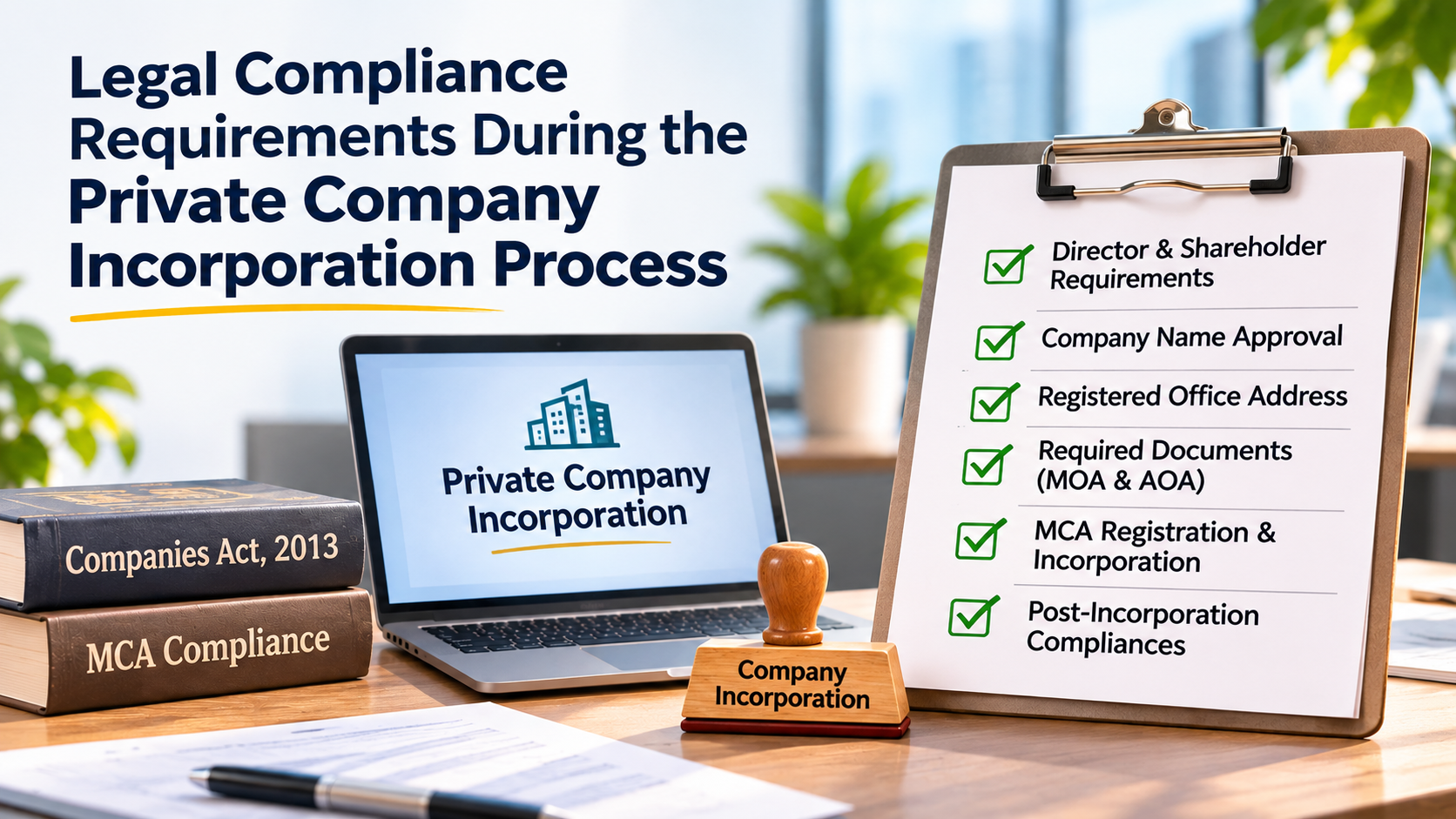
Legal Compliance Requirements During the Private Company Incorporation Process

Private Company Incorporation Process

Starting a business can feel exciting. You have an idea you have thought about how a business could work and you’re ready to make a business real. Maybe you are planning to launch a startup, with a friend. Maybe you have been running a small business and now want to register a business as a company. Whatever your situation there is one step that you cannot overlook: making sure a business is legally registered. The Private Company Incorporation Process in India requires you to register your business according to the Companies Act 2013. You also need to finish all the steps with the Ministry of Corporate Affairs which is called MCA. If you want to register your business knowing about the private limited company registration can help you get the right papers ready and stay away, from usual errors. 

For first-time entrepreneurs, company registration feels confusing. First-time entrepreneurs face forms to complete documents to arrange and legal requirements to understand. When first-time entrepreneurs know what is needed company registration becomes much easier to follow. 

What Are the Legal Compliance Requirements for Private Company Incorporation? 

To register a limited company, in India you usually need at least two directors. You also need two shareholders. The company must have an approved name. There must be a registered office address. There are incorporation documents that are required. You also need to meet the applicable conditions under the Companies Act, 2013. 

Here’s what you’ll usually need: 

  • At least two directors and two shareholders. 
  • Digital Signature Certificates for relevant applicants. 
  • Director Identification Numbers for proposed directors. 
  • An approved company name. 
  • Memorandum of Association (MOA). 
  • Articles of Association (AOA). 
  • Registered office details and supporting documents. 
  • Required declarations and incorporation forms. 

At least one director must also meet the prescribed residency requirement in India. The exact paperwork may differ depending on who is starting the company and what type of business it plans to operate. 

Understanding the Private Company Incorporation Process in India 

When you register a private limited company, you’re creating a separate legal entity. In simple terms, the company becomes legally distinct from the people who own it. It can enter into contracts, own property and carry out business activities in its own name. 

Let’s say you and your friend want to start a digital marketing agency. You both invest money, find clients and begin offering services. Instead of running everything under your individual names, you decide to form a private limited company. 

Once registered, the company can enter into agreements and manage its business operations as a separate legal entity. Another advantage is limited liability. Generally, shareholders are liable only for any unpaid amount on their shares, although legal exceptions can apply. However, registration also means taking responsibility for ongoing company compliance. 

Key Legal Requirements for Company Incorporation 

Before you begin filling out forms, it’s worth checking whether your proposed company meets the basic requirements. 

1. Directors and Shareholders 

A private limited company generally needs at least two directors and two shareholders. 

The same two people can act as both directors and shareholders, provided they meet the legal conditions. 

A private company can generally have up to 200 members, subject to statutory exclusions. You should also make sure the proposed directors have the required identification details and meet the applicable eligibility conditions. 

2. Choosing and Approving Your Company Name 

Choosing a name is often one of the fun things, about starting a business. Just because you like a name doesn’t mean that name will be accepted. 

Your proposed name must follow MCA naming rules. It shouldn’t be identical or too similar to an existing company name or otherwise violate applicable restrictions. 

For example, imagine you’ve chosen a name for your clothing brand, only to discover that another registered company already uses something very similar. Your application could face objections, which means you may need to choose another name. 

Checking availability early can save time. 

3. Registered Office Address 

Every company needs a registered office where official notices and communications can be received. Depending on the circumstances, you may need: 

  • Address proof. 
  • A recent utility bill. 
  • Ownership or occupancy documents. 
  • A no-objection certificate from the property owner, where applicable. 

The registered office must be established and verified within the applicable legal timelines. 

Documents Required for Private Limited Company Incorporation 

Documentation is where many applicants run into difficulties. Sometimes it’s a spelling difference, between two papers. Times the address doesn’t match, or a needed declaration is not there. 

These might seem like small issues, but they can lead to queries or resubmission requests. During the Private Company Incorporation Process, you may need: 

  • PAN and identity proof of Indian directors and subscribers. 
  • Address proof of directors and shareholders. 
  • Passport and prescribed documents for foreign applicants. 
  • Registered office documents. 
  • Required declarations and consents. 
  • Memorandum and Articles of Association. 

The documents depend on the applicants and the proposed company structure. It’s useful to review the company registration requirements before submitting your application. 

Step-by-Step Private Company Incorporation Process 

Once your documents are ready, the next step is submitting the incorporation application through the MCA portal. 

Step 1: Arrange Digital Signatures 

Digital Signature Certificates allow relevant applicants and professionals to sign incorporation forms electronically. Make sure the required signatures are available before filing. 

Step 2: Apply for Company Name Approval 

You can request name reservation through the applicable MCA process, including SPICe+ Part A. The proposed name is checked against the relevant rules. 

Step 3: Prepare the MOA and AOA 

The Memorandum of Association explains the company’s objectives and other fundamental details. 

The Articles of Association describe how the company will be managed internally. Both documents should reflect the company’s proposed structure and activities. 

Step 4: Submit the Incorporation Application 

The application is generally filed through SPICe+ and the relevant linked forms. These may include e-MOA, e-AOA and AGILE-PRO-S, depending on the applicable requirements. 

Step 5: Receive the Certificate of Incorporation 

Once the Registrar of Companies approves the application, the company receives its Certificate of Incorporation and Corporate Identity Number (CIN). PAN and TAN are generally allotted through the integrated process. Your company is now incorporated, but some important compliance steps still remain. 

Common Mistakes That Can Delay Company Registration 

Even when you’ve prepared everything, small documentation errors can slow down the application. Some common mistakes include: 

  • Using different names or addresses across documents. 
  • Applying for a company name without checking restrictions. 
  • Providing incomplete registered office details. 
  • Entering incorrect business activity information. 
  • Making mistakes in the MOA or AOA. 
  • Forgetting required declarations or attachments. 

For example, if the registered office address in your application does not match the supporting documents you may receive a request, for clarification. Reviewing the application carefully before submission can help avoid unnecessary delays. 

Important Compliance Requirements After Incorporation 

Receiving your incorporation certificate is an important moment. Your business now has a legal identity. But company registration isn’t the end of your compliance responsibilities. There are several requirements you may need to complete after incorporation. 

Appointment of the First Auditor 

For a company other than a government company, the Board generally needs to appoint the first auditor within 30 days of registration. 

If the Board doesn’t make the appointment, the statutory procedure for appointment by members applies. 

Commencement of Business Declaration 

Companies that are incorporated with share capital usually need to file Form INC‑20A within one hundred and eighty days of incorporation before starting business or using borrowing powers subject, to the provisions. 

Other Ongoing Compliance Requirements 

Depending on your company and business activities, you may also need to: 

  • Open and maintain a company bank account. 
  • Issue share certificates within the prescribed timeline. 
  • Maintain statutory registers and accounting records. 
  • File annual financial statements and returns. 
  • Hold required board meetings. 
  • Obtain GST registration or industry-specific licences where applicable. 

These responsibilities are easier to manage when you plan for them from the beginning. 

Why Legal Compliance Matters From the Beginning 

The Private Company Incorporation Process isn’t just about getting a registration certificate. It’s about building a proper legal foundation for your business. 

Imagine your startup grows quickly, and an investor becomes interested in funding it. Before investing they might want to look at your incorporation papers, information about who owns the company and records, about following the rules. 

If key papers are not there or the records are not kept the way you may have to do more work before the investment can continue. Keeping everything organised from the start can make future business decisions easier. 

Frequently Asked Questions 

1. How Many Directors Are Required for a Private Limited Company? 

A private limited company generally needs at least two directors. At least one must satisfy the prescribed Indian residency requirement. 

2. Can Two People Start a Private Limited Company? 

Yes. Two eligible individuals can generally act as both directors and shareholders, provided the legal requirements are met. 

3. Is a Registered Office Mandatory? 

Yes. A company must have a registered office that’s able to receive official communications and meet the required establishment and verification rules. 

4. How Long Does Company Incorporation Take?

The time it takes depends on how ready the documenters getting the name approved making sure the application is correct and the Registrar of Companies processing it.

5. Is GST Registration Required After Incorporation?

Not always. GST registration is needed based on the business activities the amount of turnover that applies and other legal rules.

Conclusion

Creating a limited company can be an exciting journey; however, it is important to make sure all legal rules are followed. When starting your limited company, you will have to choose your directors get papers ready and fulfill some rules after you register. Understanding what is needed can help avoid mistakes. Will help keep your business papers organized. If you want to register your company then using private company registration services in India can help you learn about the papers and rules you need.


Private Limited Company Compliance: How to Prepare for Your First Financial Year

private limited company compliance

You’ve received your certificate of incorporation. The company finally has a name, the founders are excited, and there’s probably a long list of things you want to do next. You might be looking for your first customer, setting up a bank account or planning your launch. Somewhere on that list is another question: what does the company need to take care of after registration? If you’ve recently completed Private Limited Company Registration in India, now is a good time to put a few basic systems in place. Private Limited Company Compliance becomes much easier when you know what needs to be done, who is responsible and where the records are kept. You don’t need to memorise every filing date today. You do need a plan for finding the right information when it’s time to act. 

What Are the Key Compliance Requirements for a Private Limited Company’s First Financial Year? 

In its financial year a private limited company usually has to hold its first board meeting. It also needs to appoint an auditor. The company must keep accounting records and company records. It should get ready for its annual general meeting. It also has to file with the ROC on time. These steps are important to stay on track, with the law. 

If a company has share capital that company must also meet the commencement declaration requirements. In my experience a company also faces obligations, such as GST, TDS, payroll and sector‑specific registrations and the need, for these duties depends on what the business does. 

Start by gathering: 

  • Your certificate of incorporation. 
  • Memorandum and articles of association. 
  • Details of directors and shareholders. 
  • Registered office documents. 
  • Subscriber payment and bank records. 
  • MCA login and filing information. 

Once these are in one place, it becomes much easier to work with your accountant or company secretary on the next steps. 

First, Understand When Your Financial Year Ends 

It’s tempting to think every new company has a full twelve months before it needs to prepare its first accounts. That isn’t always the case. 

A company’s financial year generally ends on 31 March. But if it is incorporated on or after 1 January, its first financial year ordinarily ends on 31 March of the following year. Certain approved exceptions may apply. 

Here’s Why the Incorporation Date Matters 

Let’s say two businesses register a few months apart: 

  • Company A is incorporated on 1 December 2026. Its first financial year would ordinarily end on 31 March 2027. 
  • Company B is incorporated on 1 February 2027. Its first financial year would ordinarily end on 31 March 2028. 

That difference affects the first audit, AGM and annual filing schedule. 

So before copying deadlines from another founder’s checklist, check your own incorporation date. Ask your adviser to confirm the relevant dates and add them to a shared calendar. 

Private Limited Company Compliance Starts After Incorporation 

Once the company is registered, the next few weeks are about getting the basics right. Manage the company bank account keep company money separate, from personal money and keep records of the subscribers share payments. This may seem like an administrative task but these records will be useful when the company prepares its declaration and accounts. 

For a company that has share capital a director needs to submit the start declaration, in Form INC-20A within 180 days after the company is set up. The correct declaration needs to be submitted before the company starts doing business or uses the power to borrow money. 

Your early Post-incorporation compliance in India checklist should also include: 

  • Confirming registered office details. 
  • Recording the initial shareholding. 
  • Arranging share certificates within the applicable period. 
  • Maintaining statutory registers and company records. 
  • Keeping board resolutions and minutes. 
  • Checking whether your business needs additional registrations. 

You don’t have to handle every detail alone. But someone on the team should know what is pending and who is following it up. 

Hold Your First Board Meeting and Appoint an Auditor 

In the early days, founders often make decisions over calls, messages and quick meetings. That’s understandable. But some company decisions also need formal approval and records. 

The first board meeting must normally take place within 30 days of incorporation. In a private company the board usually appoints the first auditor within 30 days of registration. If the board fails to make that appointment the Act gives a process for the members to appoint the auditor. 

The first meeting is a good opportunity to discuss: 

  • The company bank account and authorised signatories. 
  • Appointment of the first auditor. 
  • Subscriber payments and shareholding. 
  • Accounting arrangements. 
  • Registered office and statutory records. 
  • Directors’ relevant disclosures. 

Keep the meeting notice, attendance details, resolutions and minutes together. You don’t want to search through several inboxes when an auditor asks for them months later. 

Who Should Keep Track of These Tasks? 

Even if there are only two founders, divide the responsibility. 

One person might coordinate with the accountant. Another might maintain the corporate documents. A director may be responsible for reviewing and approving filings. The arrangement can be simple. The important part is that everyone knows who is doing what. 

Keep Your Accounts Up to Date 

Picture this: it’s the end of the financial year. Your invoices are in one inbox, a founder has paid business expenses from a personal account, and nobody is quite sure whether all the receipts were saved. 

Sound like something that could happen during a busy launch? 

A little organisation each month can save a lot of effort later. Set up a routine for: 

  • Recording income and expenses. 
  • Saving invoices, receipts and payment confirmations. 
  • Reconciling the company bank account. 
  • Recording founder loans and reimbursements. 
  • Tracking vendor payments. 
  • Reviewing applicable taxes and registrations. 

You don’t need a complicated system on day one. You need one that your team will actually use. 

Also, remember that a company-law audit and an income-tax audit are separate matters. Your adviser can assess the company’s tax return and whether a tax audit applies for the relevant year. 

GST, TDS, payroll and other obligations depend on your business activities and circumstances. Review them when the business begins hiring, invoicing or entering new markets, rather than waiting until year-end. 

Plan for Your First AGM and Annual Filings 

Your first annual general meeting, or AGM, is a chance for shareholders to consider the company’s financial statements and other relevant matters. For an ordinary private limited company, the first AGM is generally held within nine months from the end of its first financial year. If it is held within that period, another AGM is not required in the incorporation year. 

The meeting date may feel far away when you first incorporate, but the preparation starts earlier. Your accountant needs time to organise the records. The auditor needs time to review the accounts. Directors then need to consider the documents before the AGM. Work backwards from the expected meeting date so nobody has to rush at the last minute. 

What Happens After the AGM? 

A Private limited company annual filing generally involves two separate submissions to the Registrar of Companies: 

  • Financial statements: Usually filed in the applicable AOC-4 form within 30 days of the AGM. 
  • Annual return: Usually filed within 60 days of the AGM, using MGT-7 or, where eligible, MGT-7A. 

Eligible small companies use MGT-7A under the applicable rules. If an AGM is not held, separate filing and explanation requirements still apply. 

Keep the filed forms, payment receipts and acknowledgements together. They’ll be easier to find when a bank, investor or adviser asks for them. 

Build a Private Limited Company Compliance Calendar 

A compliance calendar doesn’t need to be complicated. A shared spreadsheet can be enough if someone updates it and the team checks it. 

Add the important dates and tasks: 

  • First board meeting. 
  • First auditor appointment. 
  • Subscriber payments and INC-20A. 
  • Share certificates and statutory records. 
  • Regular board meetings. 
  • Accounting and bank reconciliation. 
  • Applicable tax and employment filings. 
  • First financial year-end. 
  • Audit preparation and first AGM. 
  • ROC annual filings. 

For each task, record who is responsible, what documents are needed and when the work should begin. A deadline is only the final date. Your accountant may need information well before then, and your directors may need time to review it. 

Some filings also depend on events. If you change a director, move the registered office or alter the share capital, ask your adviser whether the change needs to be recorded or filed. If you need help coordinating these tasks, discuss the scope of Legal Compliance Services in India and agree on who will monitor deadlines and provide the documents. 

Common Mistakes to Avoid in the First Year 

Most founders don’t miss a task because they don’t care. They miss it because there are ten other things happening at the same time. 

A few common gaps are: 

  • Mixing personal and company expenses. Reimbursements become harder to track. 
  • Saving invoices in different places. Records take longer to collect. 
  • Waiting until year-end to update accounts. Small errors are harder to remember. 
  • Assuming no revenue means no obligations. The company may still need to maintain records and file. 
  • Forgetting changes made during the year. Some events need separate action. 
  • Leaving responsibility unclear. A task may remain open because everyone assumes it’s handled. 

Try a short review at the end of each month. Ask: have we recorded this month’s transactions, saved the documents and informed our adviser about any important changes? It’s a small habit, but it can make Private Limited Company Compliance feel much less overwhelming. 

Frequently Asked Questions

Does a company with no sales still need to file?

Don’t assume that zero revenue removes all company-law or tax obligations. The applicable requirements depend on the company’s status and circumstances. Check them even if the business has not started trading.

Is the first financial year always twelve months?

No. It depends on the incorporation date and applicable rules. A company incorporated on or after 1 January ordinarily has its first financial year ending on 31 March of the following year.

Do we need a full-time employee to manage compliance?

Not always. Many early‑stage companies work together inside the firm with help, from a company secretary, an accountant or another adviser. Be sure that responsibilities, deadlines and how you share information are all clear.

What should we do if we miss a deadline?

First, identify exactly what is outstanding and gather the relevant records. Then seek advice on the applicable filing, fees and possible consequences. It’s better to understand the position promptly than leave it until year-end.

When should we start preparing for the first audit?

Start keeping records from the company’s first transaction. Before the financial year ends, ask your auditor what documents they will need and when. That gives you time to find missing invoices or clarify entries.

Conclusion

Your first year will be busy. Private Limited Company Compliance does not have to become a pile of last‑minute paperwork. Confirm your year‑end take care of the early appointments and declarations and keep your records updated as you go. A clear calendar and a little communication, with your advisers can give you time to focus on growing the business. 

First Customer or Incorporation? Timing Private Limited Company Registration in India

private limited company registration in India

You have a business idea, a rough website and someone who might become your first customer. Then a familiar question interrupts the excitement: “Should I register the company first?” It’s a reasonable question. Private Limited Company Registration in India can help you establish an entity for ownership, contracts and investment. But incorporation also brings responsibilities, even while you’re still figuring out whether customers want what you’re building. 

So, which should come first? The answer depends less on reaching a particular sales figure and more on what you’re about to do. Interviewing potential customers is one thing. Signing a substantial contract, taking investment or launching a regulated activity is another. 

Should You Register a Private Limited Company Before Getting Your First Customer? 

Not always. You can often research demand before incorporating. However, consider incorporating before commitments that should belong to the company, such as equity investment, significant customer contracts or shared founder ownership. Paid activity still needs an appropriate legal and tax setup, and incorporation alone does not replace required licences. The useful question is: What will our next business decision require? 

If you’re still testing the problem, incorporation may not be the immediate priority. If someone is ready to sign, pay or invest, you need to look more closely at the structure behind that transaction. 

Separate Testing an Idea From Running a Business 

“Starting a business” can describe very different situations. You might be exploring an idea after work, or you might already be supplying products every week. 

Those situations deserve different decisions. 

Customer Research Can Come First 

You can learn plenty without immediately setting up a company: 

  • Interview potential customers. 
  • Ask how they currently solve the problem. 
  • Develop an early prototype. 
  • Test your pricing assumptions. 
  • Collect expressions of interest. 
  • Explore suppliers and delivery costs. 

For example, a founder planning a booking platform could speak to salon owners before commissioning the full product. 

That research may reveal that the real problem is missed appointments rather than booking itself. Discovering this early is valuable. 

Even during research, take confidentiality, personal information and ownership of commissioned work seriously. “We’re only testing” doesn’t answer every legal question. 

Paid Work Needs More Care 

A paid pilot changes the conversation. Who is supplying the service?, Who receives payment?, Who handles a refund? What happens if the customer claims the work caused a loss? 

Before accepting money, clarify: 

  • The contracting person or entity. 
  • Scope, pricing and payment terms. 
  • Relevant tax and invoicing requirements. 
  • Applicable licences or registrations. 
  • Ownership of deliverables. 
  • Responsibility for complaints. 

You may have options besides a private limited company. Compare them against your actual activities rather than assuming every first sale requires the same structure. 

When Private Limited Company Registration in India Makes Sense 

Incorporation becomes more useful when you have a clear reason for the company to exist. 

Perhaps a customer wants to contract with an incorporated supplier. Perhaps two founders need a formal ownership arrangement. Or perhaps investors expect to subscribe for shares. 

Look for concrete triggers: 

  • You’re preparing to raise equity. 
  • Multiple founders are committing time or money. 
  • A substantial contract is approaching. 
  • You’re building valuable intellectual property. 
  • Hiring and recurring operations are beginning. 
  • Customer onboarding requires company documents. 

The company becomes a separate corporate body upon incorporation under the Companies Act. That distinction matters when deciding who should own assets and enter contracts. 

Co-Founders, Investment and Larger Contracts 

Suppose you and a friend are building software. One develops the product; the other funds expenses and finds customers. 

At first, a verbal understanding may feel sufficient. But what happens if one person leaves after six months? 

Discuss: 

  • Share ownership and contributions. 
  • Roles and decision-making. 
  • Founder departures. 
  • Ownership of existing work. 
  • Funding responsibilities. 

Incorporation helps establish the vehicle. Carefully prepared agreements help explain how you’ll work together. 

What Can Go Wrong If You Register Too Early? 

Registering early isn’t automatically a mistake. Registering without a plan can create avoidable work. 

You may still be uncertain about: 

  • The business activity. 
  • Your co-founder. 
  • The ownership split. 
  • Available funding. 
  • Whether you want to pursue the idea. 

Meanwhile, the company needs attention. Recordkeeping and compliance don’t become irrelevant simply because sales haven’t started. 

Ask for an annual operating and compliance estimate before deciding. A low incorporation quote tells you little about the following year. 

Startup incorporation timing should reflect your readiness to maintain the company as well as your enthusiasm for launching it. Think of incorporation as taking on a working system. Someone needs to keep it running. 

What Can Go Wrong If You Wait Too Long? 

Waiting can also create complications. Imagine signing a customer contract personally and then incorporating a month later. The customer’s agreement was with you. You shouldn’t assume the new company automatically replaces you. 

Similarly, software, designs or other assets created before incorporation need careful ownership review. Delays can leave you sorting out: 

  • Contracts signed by individual founders. 
  • Business payments mixed with personal spending. 
  • Informal promises about equity. 
  • Unclear ownership of commissioned work. 
  • Customer onboarding held up by missing documents. 

Transfers or replacement arrangements may be possible, but they require attention. 

That’s why Private Limited Company Registration in India should be considered before the transaction that needs the company—not on the evening before the customer expects to sign. 

Make These Decisions Before You Apply 

The application should reflect decisions you’ve already discussed. Start with: 

  • Ownership: Who will hold shares, and why? 
  • Directors: Who will manage the company’s affairs? 
  • Business activities: What will the company actually do? 
  • Registered office: Which suitable address and documents will you use? 
  • Funding: Who will contribute money? 
  • Name: What alternatives do you have if the preferred name is unavailable? 

Also discuss what each founder brings: cash, existing work, equipment, relationships or time. Don’t treat these as interchangeable without agreement. A founder contributing savings may have different expectations from someone contributing evenings and weekends. 

Once these choices are clear, the incorporation process becomes easier to coordinate. MCA’s SPICe+ framework provides the integrated incorporation route and linked services. 

Remember What Happens After Incorporation 

Receiving the certificate is a milestone. It isn’t the end of the setup. Plan for banking, subscriber contributions, accounting, statutory records and applicable registrations. Allocate responsibility for each task. 

For a newly incorporated company with share capital, Section 10A imposes conditions before commencing business or exercising borrowing powers. These include a director’s declaration, filed within 180 days, that subscribers have paid for their agreed shares, together with registered-office verification requirements. The deadline is not permission to begin business before satisfying the conditions. 

Your post-incorporation checklist should include: 

  • Opening and organising the company bank account. 
  • Recording contributions and expenses correctly. 
  • Completing applicable commencement requirements. 
  • Arranging accounting and compliance support. 
  • Reviewing licences and tax registrations. 
  • Putting customer and team agreements in place. 

Company-law filing and audit obligations can apply even without revenue. Confirm your calendar early. 

A Practical Checklist for Choosing Your Timing 

Still deciding when to register a company in India? Review the next three to six months rather than trying to predict the entire business journey. 

Ask yourself: 

  • Are customers showing meaningful demand? 
  • Is a contract or investment discussion becoming concrete? 
  • Have founders agreed on ownership? 
  • Do we understand the relevant regulatory requirements? 
  • Can we fund setup and ongoing administration? 
  • Who will coordinate the paperwork? 
  • Would another structure fit our present needs better? 

Then identify the earliest event that requires the chosen structure. Work backwards from that event, allowing time for documents, application queries, banking and post-incorporation steps. 

If you’re still doing interviews, keep learning. If a buyer is preparing a purchase order, resolve the setup questions now. Your timing should follow evidence and commitments, rather than pressure to look established. 

Frequently Asked Questions

Can I get customers before incorporating?

You can research demand and build relationships beforehand. Accepting paid work requires closer assessment of your operating structure, contracts, taxes and any activity-specific permissions.

Does Private Limited Company Registration in India protect my brand name?

Company-name approval and trademark protection serve different purposes. Don’t assume incorporation alone gives you the brand protection your business needs.

Should I incorporate just because an investor sounds interested?

First clarify how serious the discussion is, the proposed investment route and what structure the investor expects. Informal interest alone shouldn’t determine your decision.

Can a new company take over contracts I signed personally?

Possibly, through appropriate arrangements. Review the contract and necessary consents; don’t assume incorporation automatically transfers it.

What if I incorporate and the idea doesn’t work?

You still need to address the company’s obligations and assess the appropriate closure or other available route. Leaving it unattended can create further problems.

Conclusion 

The best moment for Private Limited Company Registration in India depends on your commitments. Study the market demand to make a smart decision then get the Private Limited Company Registration ready, before any contracts, investments or ownership deals call for it. 

Talk about the responsibilities of Private Limited Company Registration carefully as you discuss its benefits. A useful structure should support the business you’re building—and be something your team is ready to manage.

Is a Private Limited Company the Right Choice for Your Startup?

private limited company registration in India

You have started working on your business idea. Maybe a few customers have already paid you. A friend wants to join as a co-founder. An investor has asked for your company details, about your business idea. Then someone says, “You should register a private limited company”. Private Limited Company Registration in India, may make sense when you want shared ownership, it also allows, outside investment.

It sounds like the next step. Is it the right one for your business—or just the structure that everyone around you keeps suggesting? 

Private Limited Company Registration in India creates a business that exists separately from its founders. Private Limited Company Registration in India brings costs and responsibilities that continue after incorporation. 

Should You Register Your Startup as a Private Limited Company? 

Choosing a limited company can be a good fit, for your startup. A private limited company lets you bring in equity investors share ownership among the founders and give the business its legal identity. If you are still experimenting with a small self-funded idea a different structure may be easier to start with. 

There is no prize for choosing the most complicated structure early. 

A tech company getting ready to seek funding has requirements, than a freelance designer who works with three regular customers. Both need records and fair agreements but the way they handle ownership and money plans can be very different. 

Before proceeding with private limited company registration, ask: 

  • Will anyone else own part of the business? 
  • Do we expect outside investors? 
  • What risks does our work involve? 
  • Can we manage recurring compliance costs? 
  • How will we take money out of the business? 

Startup India also identifies funding, liability, taxation, compliance and exit plans as factors in choosing an entity. 

What Does a Private Limited Company Actually Mean? 

A company has its legal identity, separate from the people who own it. It can own property enter into contracts and accept responsibilities all, in its name. This means the business can keep operating even if the shareholders or directors change long as the proper legal rules are followed. 

In a company limited by shares, shareholders’ liability is generally limited to the unpaid amount on their shares. However, personal guarantees, fraud, statutory defaults and other circumstances can create separate exposure. 

It also helps to understand two roles: 

  • Shareholders own shares in the company. 
  • Directors manage its affairs and carry legal responsibilities. 

You can be both. But owning half the shares does not automatically settle who approves spending, signs contracts or makes hiring decisions. Those arrangements still need discussion and documentation. 

When Private Limited Company Registration in India Makes Sense 

You Expect to Raise Equity Funding 

Suppose you and your co-founder are building an app. You can fund the first version yourselves, but expansion will probably need investors. 

A company structure often fits that plan because ownership can be represented through shares. 

It provides a framework for: 

  • Bringing in equity investors. 
  • Recording founder ownership. 
  • Structuring employee equity incentives. 
  • Negotiating investor rights. 
  • Preparing for later funding rounds. 

The details must still follow applicable law and proper documentation. 

Also, incorporation does not make a startup investment-ready overnight. Investors may ask who owns the code, whether the founder agreements are signed and how earlier funding was recorded. Get those basics organised alongside the company paperwork. 

You Want Clear Ownership and Continuity 

What happens if a co-founder leaves after a year? 

A company offers mechanisms for dealing with ownership changes. However, the outcome depends on the law, articles and relevant agreements—not simply the fact that shares exist. 

Discuss uncomfortable possibilities early: 

  • A founder stops working full-time. 
  • Someone wants to sell their stake. 
  • The founders disagree about funding. 
  • One person wants to close the business. 

These conversations are easier before a disagreement starts. 

Also, check that important assets belong to the intended entity. Software or designs created before incorporation do not automatically transfer to the company just because it has been formed. 

When Another Structure May Suit You Better 

Sometimes you need room to test the business before taking on a company’s ongoing obligations. 

For example, a solo consultant may want to validate demand and understand income before deciding on a longer-term structure. 

Alternatives worth assessing include: 

  • Sole proprietorship: For individually owned businesses, with personal liability implications. 
  • LLP: For suitable businesses seeking limited liability with partnership-based arrangements. 
  • OPC: Where a company structure with one member fits the circumstances. 

Each option has its own legal, tax and compliance implications. 

Ask yourself whether you need a company for a practical reason. Is it investment, ownership, risk or a customer requirement? “It sounds more professional” should not be the whole answer. 

Basic Requirements Before You Incorporate 

For a standard private company, plan for: 

  • At least two members. 
  • At least two directors. 
  • A registered office in India. 
  • Suitable constitutional documents. 
  • Required identification, declarations and digital signatures. 

The same individuals can be both members and directors. 

At least one director must meet the prescribed India-stay requirement—generally 182 days during the financial year, applied proportionately for a newly incorporated company. 

Avoid appointing someone casually because you need another name on the application. Directors have responsibilities even when they are not involved in daily work. 

Before Private Limited Company Registration in India, agree on ownership, contributions and decision-making. Do not leave the share split for a hurried conversation on filing day. 

Understanding Private Limited Company Registration Fees 

You may find incorporation packages with very different prices. Before choosing the cheapest, check what each one includes. 

Private limited company registration fees may involve: 

  • Applicable government charges. 
  • State stamp duty. 
  • Name-reservation charges where relevant. 
  • Digital signatures. 
  • Professional assistance. 
  • Additional documentation for complex arrangements. 

MCA’s published SPICe+ guidance provides a zero-filing-fee concession for qualifying incorporations with authorised capital up to ₹15 lakh. However, stamp duty and other applicable charges can remain. 

Ask for an itemised quotation. 

Does it cover resubmissions? What happens after incorporation? Are accounting and annual compliance separate? 

Also, keep authorised capital, paid-up capital and service fees distinct. Money subscribed as share capital is not the same as a fee paid to your adviser. 

The Private Limited Company Registration Process 

The private limited company registration process becomes easier to follow when you break it into stages. 

  1. Decide the structure. Confirm founders, directors, ownership and activities. 
  2. Assess the name. Review company-name availability and relevant trademark concerns. 
  3. Prepare documents. Collect identity, address and registered-office records. 
  4. Arrange digital signatures. Obtain the required signing credentials. 
  5. Prepare SPICe+ and linked filings. Complete the incorporation particulars and constitutional documents.
  6. Submit and respond. Address clarification or resubmission requirements. 
  7. Review the result. Check the approved details and plan the next obligations. 

    During Private Limited Company Registration in India, take time to read the memorandum and articles. 

    The memorandum covers the company’s objects and other foundational matters. The articles govern internal arrangements. 

    These documents should reflect the business you intend to run. They deserve more attention than a quick “looks fine” over email. 

    What Happens After Incorporation? 

    Receiving the certificate feels good. You finally have the company name and formal documents. 

    But keep a second checklist ready, because incorporation creates work rather than finishing it. 

    Relevant next steps may include: 

    • Funding subscribed shares. 
    • Completing banking arrangements. 
    • Appointing the first auditor. 
    • Maintaining statutory records. 
    • Recording board decisions. 
    • Issuing share certificates as required. 
    • Setting up bookkeeping. 
    • Assessing tax and sector-specific registrations. 

    For companies covered by the commencement-of-business requirement, the relevant declaration must be filed within 180 days. Applicable conditions must be met before commencing business or exercising borrowing powers; the deadline does not mean you can ignore those conditions meanwhile. 

    Budget for recurring accounting, statutory audit and filings. Low revenue does not automatically remove company-law obligations. 

    Company incorporation also does not automatically provide trademark protection, startup recognition or permission for regulated activities. 

    Questions to Ask Before Making Your Decision 

    Before committing to Private Limited Company Registration in India, sit down with your co-founder and adviser. 

    Work through these questions: 

    • Are we likely to seek equity investment? 
    • Have we agreed on ownership? 
    • Who will maintain records and track deadlines? 
    • Can we afford the recurring costs? 
    • Does our activity need separate permission? 
    • How will founders receive money from the company? 
    • What happens if someone leaves? 

    Compare the total first-year cost, not just the incorporation quote. 

    A useful adviser should explain why the structure fits your plans. You should leave the conversation understanding the recommendation—not simply agreeing because the paperwork sounds difficult. 

    Frequently Asked Questions

    Can a Solo Founder Register a Standard Private Company?

    A standard private company requires at least two members. A sole founder can assess an OPC or another suitable structure instead. 

    Does Company-Name Approval Protect My Brand?

    Do not treat it as trademark clearance or registration. Assess brand protection separately before investing heavily in packaging, advertising or design. 

    Will Incorporation Automatically Give Us Tax Benefits?

    No. Tax treatment and incentives depend on applicable law, eligibility and any required approvals. Incorporation alone does not guarantee startup benefits. 

    Can We Use a Home Address? 

    It may be possible with appropriate documentation, subject to applicable property, local and other restrictions. Check the circumstances before using the address.

    What If We Stop Working on the Business?

    The company may still have compliance responsibilities. Stopping operations does not automatically close it. Review the appropriate closure process rather than leaving filings unattended. 

    Conclusion 

    A private limited company, in India can be a choice if you want to share ownership bring in investors and grow your business. Before you begin the private limited company registration process think carefully about the costs. Also think about the duties that go along with this kind of company. Think about how the people who started the company will work and make choices. Spend some time looking at business setups.

    Annual Compliance Cost of a Private Limited Company in India

    Annual Compliance Cost of a Private Limited Company in India

    For a private limited company in India, a good starting budget of ₹25,000 to ₹60,000 per year is needed for annual compliance costs. Things like bookkeeping, GST and TDS work, difficult audits, government charges, and filings that happen at times can make the total go over ₹1 lakh. These are estimates from professionals. They are not the prices set by the government. They are also not a promise of a package, with all costs included. 

    Published provider estimates vary substantially in scope. Treat the range as a starting point for obtaining itemised quotations rather than a minimum amount every company must pay. 

    What does annual compliance cost of a private limited company include? 

    Annual compliance cost is the money you spend on keeping company records preparing accounts arranging audits that are required and finishing any filings that must be done. 

    It usually has several parts: 

    • Professional fees: Charges for accounting, audit, tax work and company-secretarial support. 
    • Government fees: Amounts payable for applicable statutory filings. 
    • Recurring operational compliance: GST, TDS and payroll-related work where applicable. 
    • Event-based work: Additional filings triggered by changes to directors, share capital or the registered office. 
    • Support costs: Accounting software, digital signature renewal and document management. 

    Keep these expenses separate from corporate income tax, GST payable and other tax liabilities. Paying an accountant to file a return is different from paying the tax shown in that return. 

    Company incorporation is another separate expense. A registration package does not automatically cover the following year’s compliance. 

    How much should a startup budget for annual compliance? 

    Start with your activity level and the services you actually need. 

    What should a straightforward company expect? 

    For a company with clean books, limited transactions and straightforward ownership, use ₹25,000–₹60,000 as an initial professional-service budget to test against quotations. 

    Check whether that amount covers: 

    • Preparation of annual accounts. 
    • Statutory audit. 
    • Annual ROC filings. 
    • Company income-tax return preparation. 
    • Routine company-secretarial documentation. 

    Do not assume these services are all included merely because a provider uses the phrase “annual compliance.” 

    Why can the annual cost exceed ₹1 lakh? 

    An increase in costs can be seen when the company needs: 

    • Monthly bookkeeping across several bank accounts. 
    • Regular GST or TDS return preparation. 
    • Payroll and employee-related compliance. 
    • Inventory accounting or transaction reconciliation. 
    • Foreign-investment or cross-border support. 
    • Tax audit, transfer-pricing work or specialised reporting, where applicable. 
    • Correction of past records and overdue filings. 

    An advertised package may be reasonably priced for its stated scope while covering only part of your company’s needs. 

    Action: Request separate prices for core annual compliance, recurring accounting and tax work, and additional filings. 

    Which core obligations should a private limited company plan for? 

    For an ordinary active private limited company, the baseline includes maintaining accounts, statutory audit, corporate records and applicable annual filings. Low turnover alone does not remove company-law audit requirements.  

    What accounting and statutory audit work is involved? 

    Bookkeeping means recording transactions and reconciling them with invoices, bank statements and other evidence. 

    Statutory audit is the independent examination of financial statements under applicable company law. It is different from maintaining the books. 

    Budget for: 

    • Recording income and expenses. 
    • Bank and payment reconciliation. 
    • Reviewing receivables and payables. 
    • Preparing financial statements. 
    • Supporting the auditor’s questions and evidence requests. 
    • Finalising the audit report and relevant documentation. 

    Audit fees depend on the work involved, including transaction complexity and the condition of the records. Turnover is one factor, not the only factor. 

    Action: Confirm whether your quote includes bookkeeping, accounts preparation and statutory audit as distinct services. 

    What are AOC-4 and MGT-7 or MGT-7A? 

    These filings serve different purposes: 

    • AOC-4: Filing financial statements and required accompanying documents, using the applicable form or variant. 
    • MGT-7: The annual return for companies outside the OPC and small-company categories. 
    • MGT-7A: The abridged annual return for OPCs and eligible small companies.  

    An annual return reports corporate information; it does not replace the financial-statements filing. 

    For an ordinary company, financial statements are generally filed within 30 days of the AGM, and the annual return within 60 days of the AGM, subject to applicable provisions, exceptions and extensions.  

    Action: Ask your company secretary to identify the correct forms and calculate your actual deadlines. Avoid using the same calendar date for every company. 

    Does a company need an income-tax return if it has no profit? 

    Yes. The Income Tax Department states that companies must file a return irrespective of whether they report profit or loss.  

    Your professional-service scope should address: 

    • Return preparation and filing. 
    • Reconciliation of income and tax information. 
    • Review of deductions and tax adjustments. 
    • Treatment of losses. 
    • Applicable audit reports or other tax filings. 

    For FY 2025–26, the department identifies ITR-6 for companies other than those claiming exemption under section 11. Confirm the forms and law applicable to the reporting period rather than carrying old instructions into every future year.  

    Action: Ask whether your fee includes only uploading the return or also preparing the tax computation and resolving reconciliation differences. 

    Which additional costs depend on your business? 

    Not every company needs every compliance service. Applicability should be assessed before pricing the package. 

    When should you budget for GST, TDS and payroll work? 

    Ask your adviser which obligations apply based on registration, transactions, payments, employees and relevant thresholds. 

    Potential services include: 

    • GST return preparation and reconciliation. 
    • TDS calculation, deposit support and return preparation. 
    • Payroll processing. 
    • Applicable professional-tax, EPF or ESI work. 
    • Tax audit or specialised tax reporting. 

    Statutory audit and tax audit are different requirements. A company-law audit does not mean a separate income-tax audit is automatically required in every case.  

    Action: Request an applicability checklist. Each service should be marked required, not applicable or subject to review. 

    Which filings should not automatically be treated as annual? 

    Some costs arise only when a condition is met or an event occurs: 

    • ADT-1: Relevant auditor-appointment filing; do not assume a fresh filing is required every year. 
    • DPT-3: Consider where deposit or specified non-deposit reporting applies. 
    • MSME Form I: Consider where the applicable supplier-payment reporting conditions are met. 
    • Director KYC: Check the director’s current compliance cycle. 
    • Director changes: Review filings triggered by appointment or resignation. 
    • Share transactions: Review filings arising from allotment or changes in capital. 
    • Registered-office changes: Assess the applicable process and filing requirements. 

    One important update: ICAI’s January 2026 announcement explains that routine annual director KYC was replaced by a three-year cycle effective 31 March 2026. Do not automatically budget it as an annual filing without checking the director’s circumstances.  

    Does small-company status reduce compliance costs? 

    It can reduce parts of the workload, but it does not mean “no audit” or “no annual filing.” 

    The prescribed small-company financial thresholds increased from 1 December 2025 to: 

    • Paid-up share capital not exceeding ₹10 crore. 
    • Turnover not exceeding ₹100 crore, assessed under the applicable definition.  

    Both conditions and statutory exclusions must be considered. Holding companies, subsidiary companies, section 8 companies and companies governed by a special Act are excluded from the definition.  

    Paid-up capital is not the same as authorised capital. The figure relevant to small-company classification should not be confused with the capital basis used for filing fees. 

    Action: Ask your adviser to confirm your classification for the relevant year and explain which simplifications actually apply. 

    How are government filing fees different from professional charges? 

    A government filing fee is payable under prescribed rules. A professional charge pays for preparing, reviewing, certifying and submitting the documents. 

    For standard ROC document filings, the prescribed fee schedule uses nominal share-capital categories. The exact payable amount depends on the form, company and applicable rules.  

    When reviewing a quotation, ask: 

    • Are government fees included or billed separately? 
    • Which forms are covered? 
    • Are applicable taxes on professional services additional? 
    • Are certification and document preparation included? 
    • Are corrections or resubmissions chargeable? 
    • Does the quote exclude additional fees for delay? 

    Avoid treating a quoted “ROC filing cost” as the government fee alone. 

    Action: Ask for separate subtotals for professional charges, government charges and taxes. 

    How can you calculate an annual compliance budget? 

    Use this planning formula: 

    Annual compliance budget = professional services + government fees + recurring accounting and tax work + event-based work + support costs. 

    Avoid counting a service twice if it is already part of the annual package. 

    What would a hypothetical startup budget look like? 

    Assume a small services company receives these quotations: 

    • Core annual package, including statutory audit and accounts preparation: ₹30,000. 
    • Monthly bookkeeping: ₹2,000 × 12 = ₹24,000. 
    • Applicable GST and TDS support: ₹12,000 a year. 
    • Estimated government fees and digital-signature-related expenses: ₹2,000. 

    The illustrative budget is ₹68,000, before any applicable tax on professional services and unexpected event-based work. 

    These are assumed figures showing the calculation, not verified market rates for each service. Actual government charges and digital signature needs must be checked. 

    If bookkeeping or tax support is already included in the ₹30,000 package, remove the corresponding separate amount. 

    Action: Turn each quotation into an annual total. Monthly prices can appear small while materially changing the full-year budget. 

    How much can late filing add to the cost? 

    Delays can create additional filing fees and separate legal exposure. 

    The Companies Act’s section 403 framework provides for additional fees of at least ₹100 per day for delayed filings under sections 92 and 137, with amounts prescribed under the rules. Do not apply the same calculation to every MCA form.  

    For illustration, where the applicable charge is ₹100 per day per form: 

    • One form delayed by 30 days adds ₹3,000. 
    • Two forms each delayed by 30 days add ₹6,000. 

    That illustration excludes normal fees, professional charges and any separately imposed statutory penalties. Payment of an additional filing fee does not automatically remove other liability. 

    Action: Track document preparation and sign-off dates before the statutory deadline. Last-minute filing is harder when accounts or signatures are incomplete. 

    How can you reduce costs without missing obligations? 

    Reduce repeated work and prevent avoidable corrections. 

    Useful steps include: 

    • Reconcile bank transactions every month. 
    • Keep invoices and expense evidence organised. 
    • Separate personal and company transactions. 
    • Give your adviser complete information on time. 
    • Review applicability before buying unnecessary services. 
    • Compare providers on the same scope. 
    • Keep filing acknowledgements and final documents. 
    • Review the package when transactions, staffing or ownership change. 

    Assign clear responsibility: 

    • The founder supplies business information and approvals. 
    • The accountant maintains records and reconciliations. 
    • The auditor performs the independent audit. 
    • The company-secretarial adviser manages applicable corporate filings. 

    Outsourcing helps with execution, but directors should still monitor completion. 

    What should you ask before choosing an annual compliance package? 

    Request written answers to these questions: 

    • Does the price include statutory audit? 
    • Is bookkeeping included, and what transaction limit applies? 
    • Are annual financial statements and the income-tax return included? 
    • Which ROC filings and supporting documents are covered? 
    • Are government fees and applicable taxes on professional services additional? 
    • Is GST or TDS support included? 
    • What counts as an event-based extra? 
    • Are past-year corrections or notice responses excluded? 
    • Who will perform the audit and certify applicable forms? 
    • Will you receive copies of all submissions and acknowledgements? 

    A clearly defined package is easier to compare and budget than a broad “all-inclusive” promise. 

    FAQs about annual compliance costs: 

    Does a zero-turnover company still have compliance expenses? 

    Yes. Zero turnover does not automatically cancel accounting, audit or filing obligations for an ordinary active company. The work may be simpler, but it still needs to be assessed and completed. 

    Is statutory audit mandatory for a small private limited company? 

    For an ordinary active private limited company compliance, low turnover or small-company status alone does not remove the statutory audit requirement. Do not confuse this with income-tax audit thresholds. 

    Is ₹25,000 enough for the entire year? 

    It may cover a defined package for a straightforward company. It may exclude bookkeeping, GST, TDS, government fees, taxes, additional filings or backlog work. Check the written scope before relying on the amount. 

    Are annual compliance fees fixed by the government? 

    Government filing charges are prescribed. Professional fees vary with scope, complexity and the service provider. There is no single government-fixed all-inclusive compliance package price. 

    Does an annual package include GST and TDS returns? 

    Only if the quotation says so. Confirm filing frequency, transaction limits and reconciliation support. 

    Can a company stop filing because it has stopped trading? 

    Stopping operations does not automatically end the company’s legal obligations. Ask about continuing compliance, formal dormant status or closure, as appropriate, rather than simply abandoning filings. 

    Is director KYC still an annual expense? 

    Do not assume so. The routine framework moved to a three-year cycle from 31 March 2026. Confirm the director’s filing history, changes and applicable requirements. 

    What is the best way to compare two quotations? 

    Compare the same deliverables and annual total. Separate professional fees, government charges, taxes and exclusions, and identify any duplicated services. 

    Conclusion 

    The annual compliance cost of a private limited company depends on its activity, records, and applicable obligations. Use 25,000 rupees to 60,000 rupees as a starting point for a basic package. Then figure out the services the company needs. 

    Before finalising your budget: 

    • Confirm your company classification and applicable filings. 
    • Separate professional fees from government charges and taxes. 
    • Check whether audit, bookkeeping, GST and TDS work are included. 
    • Allow for event-based work and support costs. 
    • Keep your records up, to date and track which filings have been completed. 

    An itemised annual quotation gives you a reliable budget. It helps avoid missed responsibilities, duplicate charges and last-minute surprises. 

    How Much Does Company Registration in Mumbai Cost?

    How Much Does Company Registration in Mumbai Cost?

    Mumbai, India’s financial capital, is home to thousands of startups, SMEs, and multinational corporations. If you’re planning to launch a business here, company registration in Mumbai is your first crucial step. But how much does it actually cost to register a company, especially a private limited company?

    In this blog, we’ll break down the costs associated with pvt ltd company registration in Mumbai, including both government fees and professional charges. We’ll also guide you through the process of private limited company registration online in Mumbai, helping you make a smart and informed decision.

    Why Choose a Private Limited Company in Mumbai?

    Before getting into the costs, it’s worth understanding why entrepreneurs and investors often prefer the private limited company registration in Mumbai over other business structures.

    A private limited company offers limited liability protection, which means your personal assets are not at risk. It is recognized as a separate legal entity, making it easier to secure funding and build business credibility. The structure also allows for perpetual succession, meaning the company remains unaffected by ownership changes. In Mumbai’s competitive market, these advantages are key to long-term business success.

    Cost Breakdown: Pvt Ltd Company Registration in Mumbai

    Here’s what typically goes into the cost of company registration in Mumbai:

    Digital Signature Certificate (DSC)
    Cost: ₹1,000 – ₹2,000 per director
    This is required for digitally signing documents submitted to the Ministry of Corporate Affairs (MCA).

    Director Identification Number (DIN)
    Cost: Included in the SPICe+ form
    This is a mandatory identification number for all directors and is now included in the main incorporation form.

    Name Reservation via RUN or SPICe+
    Cost: ₹1,000
    This step is optional but recommended to check and reserve your company name in advance.

    Stamp Duty and Filing Fees
    Cost: ₹1,500 – ₹5,000
    This varies depending on the authorized share capital and state-specific rules in Maharashtra.

    Professional Fees
    Cost: ₹3,000 – ₹10,000+
    These are fees paid to professionals such as Chartered Accountants or Company Secretaries for document preparation, filing, and compliance support.

    Government Fees Based on Authorized Capital
    Cost: ₹1,500 – ₹3,000 for capital up to ₹10 lakh
    Higher authorized capital will attract proportionally higher government charges.

    Estimated Total Cost

    The total cost for pvt ltd company registration in Mumbai typically ranges from ₹11,500 to ₹21,000 or more, depending on the number of directors, capital, and whether you choose professional help. Though optional, professional assistance ensures the process is completed accurately and without delays.

    Company Registration Online Mumbai – Is It Worth It?

    Absolutely. The Ministry of Corporate Affairs (MCA) allows company registration online Mumbai via the SPICe+ portal. This means you can complete the private limited company registration online in Mumbai without ever visiting a government office.

    The online process is fast, paperless, and accessible from anywhere. You can also connect with professionals who offer end-to-end registration services to simplify your journey even further.

    Final Thoughts

    Choosing private limited company registration in Mumbai offers legal credibility, financial flexibility, and long-term growth potential. While the costs may vary, the benefits of this business structure make it well worth the investment. If you’re ready to build your brand in one of India’s most dynamic business hubs, starting with private limited company registration online in Mumbai is the smartest first step.

    Cost Breakdown of Private Limited Company Registration in Pune

    Cost Breakdown of Private Limited Company Registration in Pune

    Starting a business in Pune—a city known for its booming tech scene, vibrant startup ecosystem, and strategic location—is a smart move for many entrepreneurs. One of the most preferred legal structures for businesses in India is the Private Limited Company (Pvt Ltd). However, before diving into the incorporation process, it’s crucial to understand the cost breakdown of private limited company registration in Pune.

    In this blog, we’ll break down the expenses involved and explain why so many business owners choose pvt ltd company registration in Pune.

    Top Reasons to Register a Private Limited Company in Pune

    Before we dive into the costs, let’s take a quick look at why entrepreneurs prefer to register a private limited company in Pune:

    1. Legal Recognition & Limited Liability: Shareholders enjoy limited liability, meaning personal assets are protected.
    2. Startup Hub: Pune is home to top tech parks and incubators, making it ideal for startups and SMEs.
    3. Ease of Fundraising: Investors prefer Pvt Ltd companies due to their legal structure and compliance standards.
    4. Perpetual Succession: The company continues to exist even if shareholders change.
    5. Professional Image: Registering a company boosts brand image and credibility.

    These are some of the top reasons to register a private limited company in Pune, especially if you’re looking to attract partners or investors.

    Cost Breakdown: Pvt Ltd Company Registration in Pune

    Here’s a detailed look at the typical costs involved in company registration in Pune:

    1. Digital Signature Certificate (DSC)

    • Cost: ₹1,000 – ₹2,000 per director
    • Required for signing electronic documents during the registration process.

    2. Director Identification Number (DIN)

    • Cost: Included in the SPICe+ form (no separate cost as of recent updates)
    • A unique identification number for each director.

    3. Name Approval via RUN (Reserve Unique Name)

    • Cost: ₹1,000
    • Optional if applying directly through SPICe+ form. Still used by many for checking name availability.

    4. Stamp Duty

    • Cost: ₹500 – ₹1,500 (varies based on authorized capital and state regulations)
    • Applicable on the Memorandum of Association (MOA) and Articles of Association (AOA).

    5. Professional Fees

    • Cost: ₹3,000 – ₹10,000+
    • Paid to Chartered Accountants or Company Secretaries who handle documentation, filing, and compliance.

    6. Government Fees (based on Authorised Capital)

    • Cost:
      • ₹1,000 – ₹5,000 for capital up to ₹10 lakh
      • Additional charges may apply for higher capital
    • Paid to the Ministry of Corporate Affairs (MCA).

    Total Estimated Cost for Pvt Ltd Company Registration in Pune

    ItemEstimated Cost (INR)
    Digital Signature (DSC)₹2,000 (for 2 directors)
    DIN (Director ID)₹0
    Name Approval₹1,000
    Stamp Duty₹1,000
    Govt. Filing Fees₹2,000 – ₹5,000
    Professional Fees₹5,000 – ₹10,000
    Total₹11,000 – ₹19,000+

    Tip: You can save time and streamline the process with private limited company registration online in Pune through MCA’s SPICe+ portal or by hiring a professional agency.

    Private Limited Company Registration Online in Pune: Is It Worth It?

    Absolutely! With digitization, company registration online Pune has become hassle-free and efficient. All documentation, from DSC to incorporation certificate, can be managed online. This not only reduces paperwork but also speeds up the registration process.

    Conclusion

    While the cost of pvt ltd company registration in Pune may vary depending on capital, number of directors, and professional help, it remains one of the most secure and reputable ways to start a business in India. From limited liability protection to scalability, the advantages outweigh the initial costs.

    If you’re ready to make your mark in Pune’s business ecosystem, consider starting with a private limited company registration online in Pune today!

    Why Delhi is the Best Place to Register Your Private Limited Company

    Why Delhi is the Best Place to Register Your Private Limited Company

    In India, setting up a private limited company is one of the most preferred choices for startups and entrepreneurs due to its credibility, limited liability, and ease of fundraising. When it comes to choosing the best location for company registration, Delhi stands out as a top choice. From access to resources to a business-friendly environment, company registration in Delhi offers numerous advantages that make it a smart move for emerging businesses.

    1. Strategic Location and Business Ecosystem

    Delhi, the capital city of India, serves as a commercial hub for various industries including tech, finance, manufacturing, and consulting. It provides unparalleled connectivity and access to major cities, government agencies, and potential clients. With such a dynamic business ecosystem, private limited company registration in Delhi offers companies the advantage of growing their network and scaling faster.

    2. Access to Skilled Professionals

    One of the key benefits of pvt ltd company registration in Delhi is the easy availability of skilled professionals – be it accountants, legal advisors, marketing experts, or IT specialists. This ensures smoother operations and easier compliance with regulatory requirements.

    3. Supportive Government Initiatives

    Delhi offers various government schemes and startup incentives, especially for registered entities. When you go for company registration in Delhi, you position your business to leverage these opportunities and establish credibility among investors and clients alike.

    4. Ease of Doing Business with Online Registration

    Thanks to digitization, entrepreneurs can now complete the entire process of private limited company registration online in Delhi. From name approval to getting the Certificate of Incorporation, every step is streamlined and efficient. Company registration online Delhi not only saves time but also reduces costs associated with traditional paperwork and legal hassles.

    5. Professional Services and Legal Support

    Delhi is home to a large number of company secretaries, chartered accountants, and legal firms that specialize in pvt ltd company registration in Delhi. Their expertise ensures compliance with the Companies Act, 2013, and minimizes the risk of errors during registration.

    6. Competitive Edge and Brand Value

    A private limited company registration in Delhi lends a brand image that exudes professionalism and trust. Being headquartered in the capital adds to your company’s credibility and visibility, making it easier to attract clients, partners, and investors.

    Final Thoughts

    Choosing Delhi for your private limited company registration is more than just a strategic decision—it’s a smart investment in your business’s future. With robust infrastructure, a strong talent pool, digital registration facilities, and government support, Delhi offers everything a growing business needs. Whether you’re a solo entrepreneur or a startup team, company registration in Delhi sets the foundation for long-term success.In India, setting up a private limited company is one of the most preferred choices for startups and entrepreneurs due to its credibility, limited liability, and ease of fundraising. When it comes to choosing the best location for company registration, Delhi stands out as a top choice. From access to resources to a business-friendly environment, company registration in Delhi offers numerous advantages that make it a smart move for emerging businesses.

    1. Strategic Location and Business Ecosystem

    Delhi, the capital city of India, serves as a commercial hub for various industries including tech, finance, manufacturing, and consulting. It provides unparalleled connectivity and access to major cities, government agencies, and potential clients. With such a dynamic business ecosystem, private limited company registration in Delhi offers companies the advantage of growing their network and scaling faster.

    2. Access to Skilled Professionals

    One of the key benefits of pvt ltd company registration in Delhi is the easy availability of skilled professionals – be it accountants, legal advisors, marketing experts, or IT specialists. This ensures smoother operations and easier compliance with regulatory requirements.

    3. Supportive Government Initiatives

    Delhi offers various government schemes and startup incentives, especially for registered entities. When you go for company registration in Delhi, you position your business to leverage these opportunities and establish credibility among investors and clients alike.

    4. Ease of Doing Business with Online Registration

    Thanks to digitization, entrepreneurs can now complete the entire process of private limited company registration online in Delhi. From name approval to getting the Certificate of Incorporation, every step is streamlined and efficient. Company registration online Delhi not only saves time but also reduces costs associated with traditional paperwork and legal hassles.

    5. Professional Services and Legal Support

    Delhi is home to a large number of company secretaries, chartered accountants, and legal firms that specialize in pvt ltd company registration in Delhi. Their expertise ensures compliance with the Companies Act, 2013, and minimizes the risk of errors during registration.

    6. Competitive Edge and Brand Value

    A private limited company registration in Delhi lends a brand image that exudes professionalism and trust. Being headquartered in the capital adds to your company’s credibility and visibility, making it easier to attract clients, partners, and investors.

    Final Thoughts

    Choosing Delhi for your private limited company registration is more than just a strategic decision—it’s a smart investment in your business’s future. With robust infrastructure, a strong talent pool, digital registration facilities, and government support, Delhi offers everything a growing business needs. Whether you’re a solo entrepreneur or a startup team, company registration in Delhi sets the foundation for long-term success.

    The Importance of Having a Strong Cybersecurity Strategy for Private Limited Companies

    The Importance of Having a Strong Cybersecurity Strategy for Private Limited Companies

    In today’s digital-first business environment, cybersecurity is no longer a luxury—it’s a necessity. For private limited companies, especially those operating in India’s fast-paced and highly connected economy, safeguarding sensitive data and IT infrastructure is critical to long-term sustainability and brand reputation.

    This blog explores why cybersecurity should be a top priority for Pvt Ltd companies and how it aligns with the broader framework of business protection, starting from the very first step—Private Limited Company Registration in India.

    Why Cybersecurity Matters for Pvt Ltd Companies

    Private limited companies often store and manage vast amounts of sensitive data, including customer details, financial records, and proprietary business information. A single breach can lead to significant financial losses, legal consequences, and irreparable reputational damage.

    Key Risks Include:

    • Data theft from cloud storage or internal servers
    • Phishing attacks targeting employees or executives
    • Ransomware that can paralyze business operations
    • Non-compliance with data protection regulations

    With the increasing shift towards Company registration online in India, digital vulnerabilities begin even before a business starts operations. That’s why implementing a robust cybersecurity framework should be integral from the moment you register a company in India.

    From Registration to Protection: A Strategic Approach

    Many entrepreneurs begin their journey with Pvt Ltd Company Registration in India, often focusing on structure, tax benefits, and compliance. However, cybersecurity is often overlooked in the early stages of business formation.

    Whether you’re learning how to register a company in India or exploring how to register a startup company in India, cybersecurity planning must go hand-in-hand with foundational legal and operational strategies.

    Company Registration and Cybersecurity: A Dual Priority

    When you register a company in India, you provide sensitive data to government portals and third-party service providers. Ensuring secure communication, encrypted storage, and multi-factor authentication can reduce risks at this stage.

    Moreover, as Company registration online in India becomes more popular, it’s important to choose secure platforms and reliable partners who prioritize data security. A compromised registration process can jeopardize your startup before it even launches.

    Cybersecurity Best Practices for Private Limited Companies

    To help your Pvt Ltd company build digital resilience, consider implementing the following:

    1. Data Encryption: Encrypt all sensitive files and communications.
    2. Firewall & Antivirus Software: Use robust endpoint protection solutions.
    3. Access Control: Limit data access based on roles and responsibilities.
    4. Employee Training: Educate staff on recognizing phishing attempts and safe browsing practices.
    5. Regular Audits: Conduct cybersecurity audits to identify vulnerabilities.
    6. Incident Response Plan: Prepare a strategy to act quickly in case of a breach.

    The Role of Cybersecurity in Business Growth

    India’s startup ecosystem is booming, with thousands of entrepreneurs researching how to register a startup company in India each year. But growth brings exposure—and exposure without protection leads to risk.

    Investors, partners, and clients increasingly evaluate a company’s cybersecurity posture before engaging. A strong cybersecurity strategy enhances trust, improves compliance with global standards, and positions your brand as a reliable market player.

    Conclusion

    Securing your digital infrastructure is as important as choosing the right business structure. From Private Limited Company Registration in India to expansion into global markets, cybersecurity must be woven into your company’s DNA.

    Whether you’re in the early stages of Company Registration in India or scaling your operations, don’t wait for a breach to take cybersecurity seriously. Protect your business, your data, and your future.

    Ready to start your entrepreneurial journey?
    Learn how to register a company in India securely and efficiently. Opt for company registration online in India with trusted professionals who understand both compliance and cybersecurity.

    Top Benefits of Company Registration in India for Startups

    Top Benefits of Company Registration in India for Startups

    Starting a new business is an exciting journey filled with innovation, ambition, and opportunity. However, one of the most crucial steps in building a successful venture is company registration in India. Whether you’re a solo entrepreneur or launching with co-founders, registering your business provides a solid legal foundation and opens the door to numerous benefits.

    In this blog, we’ll explore the top advantages of company registration in India, especially for startups, and why online company registration is the smarter, faster way to get started.

    1. Legal Recognition and Credibility

    Registering your startup as a legal entity gives it official recognition under Indian law. This boosts the credibility of your business among customers, investors, banks, and suppliers. A registered company is perceived as more trustworthy and professional compared to an unregistered business.

    Whether it’s a private limited, LLP, or OPC, company registration in India strengthens your brand’s legitimacy in the eyes of stakeholders.

    2. Limited Liability Protection

    One of the most important benefits of registering a company is limited liability. This means that the personal assets of the founders or directors are protected from any debts or legal liabilities of the company. In case of financial losses or legal disputes, your personal property remains safe.

    This protection is only available through formal company registration India, especially for private limited and LLP structures.

    3. Easy Access to Funding and Investment

    Investors prefer to fund registered companies because of the structured ownership, transparent governance, and regulatory compliance. Most venture capitalists, angel investors, and banks require company registration in India as a prerequisite before providing funding.

    A registered company can also issue shares to raise capital — a critical advantage for startups looking to grow quickly.

    4. Perpetual Succession

    Once registered, a company becomes a separate legal entity. This ensures perpetual succession, meaning the company continues to exist even if founders or directors leave or pass away. This legal continuity is crucial for long-term stability and planning.

    5. Online Company Registration is Fast and Convenient

    Gone are the days of standing in long queues or dealing with tons of paperwork. Thanks to digitalization, online company registration has made the process simpler and faster. You can complete company registration in India online from anywhere, with minimal hassle.

    The MCA (Ministry of Corporate Affairs) portal allows entrepreneurs to file all forms, upload documents, and track status seamlessly.

    6. Tax Benefits and Incentives

    Startups registered under the Startup India initiative enjoy several tax benefits, including a 3-year tax holiday, exemption from capital gains, and more. These incentives are available only after formal company registration online India and DPIIT recognition.

    7. Ability to Open a Business Bank Account

    A registered company can open a dedicated business bank account in the company’s name, which adds a layer of professionalism and helps keep finances organized. Most banks require a Certificate of Incorporation and PAN, both of which are provided after company registration in India online.

    8. Brand Protection and Intellectual Property

    A registered company name is legally protected and cannot be used by other entities. This is essential for building a unique brand identity. Additionally, a registered company can apply for trademarks and other IP protections, ensuring that your innovations are safeguarded.

    Conclusion

    In today’s competitive startup ecosystem, formalizing your business through company registration in India is not just a legal requirement — it’s a strategic advantage. From limited liability and funding access to online convenience and tax benefits, n the reasons are clear.

    If you’re ready to take the next step, explore the option of company registration online India and give your startup the foundation it deserves.

    Need help with company registration India? Reach out to a professional service provider to get started with hassle-free, online company registration today.