
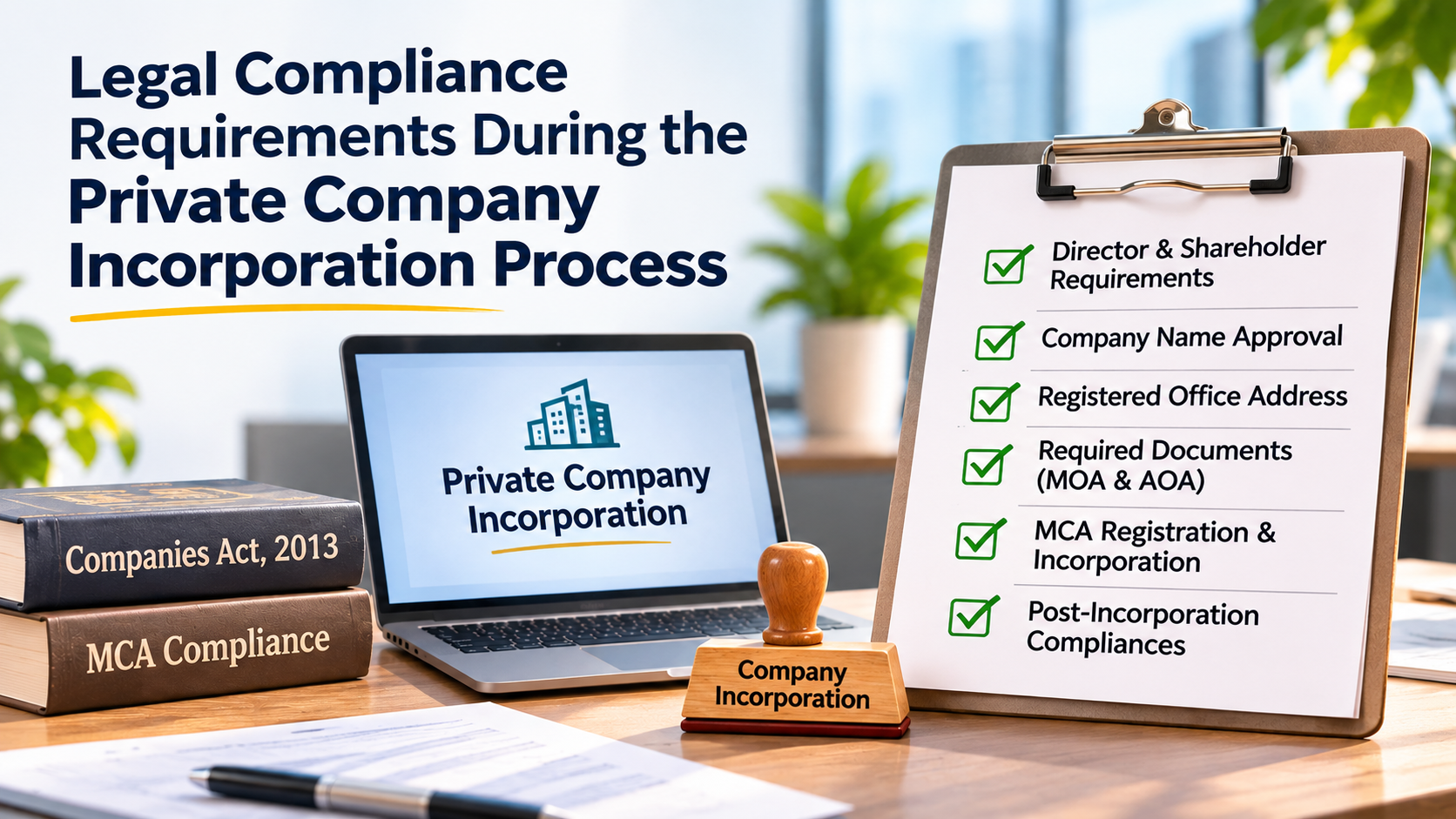
Legal Compliance Requirements During the Private Company Incorporation Process

Private Company Incorporation Process

Starting a business can feel exciting. You have an idea you have thought about how a business could work and you’re ready to make a business real. Maybe you are planning to launch a startup, with a friend. Maybe you have been running a small business and now want to register a business as a company. Whatever your situation there is one step that you cannot overlook: making sure a business is legally registered. The Private Company Incorporation Process in India requires you to register your business according to the Companies Act 2013. You also need to finish all the steps with the Ministry of Corporate Affairs which is called MCA. If you want to register your business knowing about the private limited company registration can help you get the right papers ready and stay away, from usual errors. 

For first-time entrepreneurs, company registration feels confusing. First-time entrepreneurs face forms to complete documents to arrange and legal requirements to understand. When first-time entrepreneurs know what is needed company registration becomes much easier to follow. 

What Are the Legal Compliance Requirements for Private Company Incorporation? 

To register a limited company, in India you usually need at least two directors. You also need two shareholders. The company must have an approved name. There must be a registered office address. There are incorporation documents that are required. You also need to meet the applicable conditions under the Companies Act, 2013. 

Here’s what you’ll usually need: 

  • At least two directors and two shareholders. 
  • Digital Signature Certificates for relevant applicants. 
  • Director Identification Numbers for proposed directors. 
  • An approved company name. 
  • Memorandum of Association (MOA). 
  • Articles of Association (AOA). 
  • Registered office details and supporting documents. 
  • Required declarations and incorporation forms. 

At least one director must also meet the prescribed residency requirement in India. The exact paperwork may differ depending on who is starting the company and what type of business it plans to operate. 

Understanding the Private Company Incorporation Process in India 

When you register a private limited company, you’re creating a separate legal entity. In simple terms, the company becomes legally distinct from the people who own it. It can enter into contracts, own property and carry out business activities in its own name. 

Let’s say you and your friend want to start a digital marketing agency. You both invest money, find clients and begin offering services. Instead of running everything under your individual names, you decide to form a private limited company. 

Once registered, the company can enter into agreements and manage its business operations as a separate legal entity. Another advantage is limited liability. Generally, shareholders are liable only for any unpaid amount on their shares, although legal exceptions can apply. However, registration also means taking responsibility for ongoing company compliance. 

Key Legal Requirements for Company Incorporation 

Before you begin filling out forms, it’s worth checking whether your proposed company meets the basic requirements. 

1. Directors and Shareholders 

A private limited company generally needs at least two directors and two shareholders. 

The same two people can act as both directors and shareholders, provided they meet the legal conditions. 

A private company can generally have up to 200 members, subject to statutory exclusions. You should also make sure the proposed directors have the required identification details and meet the applicable eligibility conditions. 

2. Choosing and Approving Your Company Name 

Choosing a name is often one of the fun things, about starting a business. Just because you like a name doesn’t mean that name will be accepted. 

Your proposed name must follow MCA naming rules. It shouldn’t be identical or too similar to an existing company name or otherwise violate applicable restrictions. 

For example, imagine you’ve chosen a name for your clothing brand, only to discover that another registered company already uses something very similar. Your application could face objections, which means you may need to choose another name. 

Checking availability early can save time. 

3. Registered Office Address 

Every company needs a registered office where official notices and communications can be received. Depending on the circumstances, you may need: 

  • Address proof. 
  • A recent utility bill. 
  • Ownership or occupancy documents. 
  • A no-objection certificate from the property owner, where applicable. 

The registered office must be established and verified within the applicable legal timelines. 

Documents Required for Private Limited Company Incorporation 

Documentation is where many applicants run into difficulties. Sometimes it’s a spelling difference, between two papers. Times the address doesn’t match, or a needed declaration is not there. 

These might seem like small issues, but they can lead to queries or resubmission requests. During the Private Company Incorporation Process, you may need: 

  • PAN and identity proof of Indian directors and subscribers. 
  • Address proof of directors and shareholders. 
  • Passport and prescribed documents for foreign applicants. 
  • Registered office documents. 
  • Required declarations and consents. 
  • Memorandum and Articles of Association. 

The documents depend on the applicants and the proposed company structure. It’s useful to review the company registration requirements before submitting your application. 

Step-by-Step Private Company Incorporation Process 

Once your documents are ready, the next step is submitting the incorporation application through the MCA portal. 

Step 1: Arrange Digital Signatures 

Digital Signature Certificates allow relevant applicants and professionals to sign incorporation forms electronically. Make sure the required signatures are available before filing. 

Step 2: Apply for Company Name Approval 

You can request name reservation through the applicable MCA process, including SPICe+ Part A. The proposed name is checked against the relevant rules. 

Step 3: Prepare the MOA and AOA 

The Memorandum of Association explains the company’s objectives and other fundamental details. 

The Articles of Association describe how the company will be managed internally. Both documents should reflect the company’s proposed structure and activities. 

Step 4: Submit the Incorporation Application 

The application is generally filed through SPICe+ and the relevant linked forms. These may include e-MOA, e-AOA and AGILE-PRO-S, depending on the applicable requirements. 

Step 5: Receive the Certificate of Incorporation 

Once the Registrar of Companies approves the application, the company receives its Certificate of Incorporation and Corporate Identity Number (CIN). PAN and TAN are generally allotted through the integrated process. Your company is now incorporated, but some important compliance steps still remain. 

Common Mistakes That Can Delay Company Registration 

Even when you’ve prepared everything, small documentation errors can slow down the application. Some common mistakes include: 

  • Using different names or addresses across documents. 
  • Applying for a company name without checking restrictions. 
  • Providing incomplete registered office details. 
  • Entering incorrect business activity information. 
  • Making mistakes in the MOA or AOA. 
  • Forgetting required declarations or attachments. 

For example, if the registered office address in your application does not match the supporting documents you may receive a request, for clarification. Reviewing the application carefully before submission can help avoid unnecessary delays. 

Important Compliance Requirements After Incorporation 

Receiving your incorporation certificate is an important moment. Your business now has a legal identity. But company registration isn’t the end of your compliance responsibilities. There are several requirements you may need to complete after incorporation. 

Appointment of the First Auditor 

For a company other than a government company, the Board generally needs to appoint the first auditor within 30 days of registration. 

If the Board doesn’t make the appointment, the statutory procedure for appointment by members applies. 

Commencement of Business Declaration 

Companies that are incorporated with share capital usually need to file Form INC‑20A within one hundred and eighty days of incorporation before starting business or using borrowing powers subject, to the provisions. 

Other Ongoing Compliance Requirements 

Depending on your company and business activities, you may also need to: 

  • Open and maintain a company bank account. 
  • Issue share certificates within the prescribed timeline. 
  • Maintain statutory registers and accounting records. 
  • File annual financial statements and returns. 
  • Hold required board meetings. 
  • Obtain GST registration or industry-specific licences where applicable. 

These responsibilities are easier to manage when you plan for them from the beginning. 

Why Legal Compliance Matters From the Beginning 

The Private Company Incorporation Process isn’t just about getting a registration certificate. It’s about building a proper legal foundation for your business. 

Imagine your startup grows quickly, and an investor becomes interested in funding it. Before investing they might want to look at your incorporation papers, information about who owns the company and records, about following the rules. 

If key papers are not there or the records are not kept the way you may have to do more work before the investment can continue. Keeping everything organised from the start can make future business decisions easier. 

Frequently Asked Questions 

1. How Many Directors Are Required for a Private Limited Company? 

A private limited company generally needs at least two directors. At least one must satisfy the prescribed Indian residency requirement. 

2. Can Two People Start a Private Limited Company? 

Yes. Two eligible individuals can generally act as both directors and shareholders, provided the legal requirements are met. 

3. Is a Registered Office Mandatory? 

Yes. A company must have a registered office that’s able to receive official communications and meet the required establishment and verification rules. 

4. How Long Does Company Incorporation Take?

The time it takes depends on how ready the documenters getting the name approved making sure the application is correct and the Registrar of Companies processing it.

5. Is GST Registration Required After Incorporation?

Not always. GST registration is needed based on the business activities the amount of turnover that applies and other legal rules.

Conclusion

Creating a limited company can be an exciting journey; however, it is important to make sure all legal rules are followed. When starting your limited company, you will have to choose your directors get papers ready and fulfill some rules after you register. Understanding what is needed can help avoid mistakes. Will help keep your business papers organized. If you want to register your company then using private company registration services in India can help you learn about the papers and rules you need.


Private Limited Company Compliance: How to Prepare for Your First Financial Year

private limited company compliance

You’ve received your certificate of incorporation. The company finally has a name, the founders are excited, and there’s probably a long list of things you want to do next. You might be looking for your first customer, setting up a bank account or planning your launch. Somewhere on that list is another question: what does the company need to take care of after registration? If you’ve recently completed Private Limited Company Registration in India, now is a good time to put a few basic systems in place. Private Limited Company Compliance becomes much easier when you know what needs to be done, who is responsible and where the records are kept. You don’t need to memorise every filing date today. You do need a plan for finding the right information when it’s time to act. 

What Are the Key Compliance Requirements for a Private Limited Company’s First Financial Year? 

In its financial year a private limited company usually has to hold its first board meeting. It also needs to appoint an auditor. The company must keep accounting records and company records. It should get ready for its annual general meeting. It also has to file with the ROC on time. These steps are important to stay on track, with the law. 

If a company has share capital that company must also meet the commencement declaration requirements. In my experience a company also faces obligations, such as GST, TDS, payroll and sector‑specific registrations and the need, for these duties depends on what the business does. 

Start by gathering: 

  • Your certificate of incorporation. 
  • Memorandum and articles of association. 
  • Details of directors and shareholders. 
  • Registered office documents. 
  • Subscriber payment and bank records. 
  • MCA login and filing information. 

Once these are in one place, it becomes much easier to work with your accountant or company secretary on the next steps. 

First, Understand When Your Financial Year Ends 

It’s tempting to think every new company has a full twelve months before it needs to prepare its first accounts. That isn’t always the case. 

A company’s financial year generally ends on 31 March. But if it is incorporated on or after 1 January, its first financial year ordinarily ends on 31 March of the following year. Certain approved exceptions may apply. 

Here’s Why the Incorporation Date Matters 

Let’s say two businesses register a few months apart: 

  • Company A is incorporated on 1 December 2026. Its first financial year would ordinarily end on 31 March 2027. 
  • Company B is incorporated on 1 February 2027. Its first financial year would ordinarily end on 31 March 2028. 

That difference affects the first audit, AGM and annual filing schedule. 

So before copying deadlines from another founder’s checklist, check your own incorporation date. Ask your adviser to confirm the relevant dates and add them to a shared calendar. 

Private Limited Company Compliance Starts After Incorporation 

Once the company is registered, the next few weeks are about getting the basics right. Manage the company bank account keep company money separate, from personal money and keep records of the subscribers share payments. This may seem like an administrative task but these records will be useful when the company prepares its declaration and accounts. 

For a company that has share capital a director needs to submit the start declaration, in Form INC-20A within 180 days after the company is set up. The correct declaration needs to be submitted before the company starts doing business or uses the power to borrow money. 

Your early Post-incorporation compliance in India checklist should also include: 

  • Confirming registered office details. 
  • Recording the initial shareholding. 
  • Arranging share certificates within the applicable period. 
  • Maintaining statutory registers and company records. 
  • Keeping board resolutions and minutes. 
  • Checking whether your business needs additional registrations. 

You don’t have to handle every detail alone. But someone on the team should know what is pending and who is following it up. 

Hold Your First Board Meeting and Appoint an Auditor 

In the early days, founders often make decisions over calls, messages and quick meetings. That’s understandable. But some company decisions also need formal approval and records. 

The first board meeting must normally take place within 30 days of incorporation. In a private company the board usually appoints the first auditor within 30 days of registration. If the board fails to make that appointment the Act gives a process for the members to appoint the auditor. 

The first meeting is a good opportunity to discuss: 

  • The company bank account and authorised signatories. 
  • Appointment of the first auditor. 
  • Subscriber payments and shareholding. 
  • Accounting arrangements. 
  • Registered office and statutory records. 
  • Directors’ relevant disclosures. 

Keep the meeting notice, attendance details, resolutions and minutes together. You don’t want to search through several inboxes when an auditor asks for them months later. 

Who Should Keep Track of These Tasks? 

Even if there are only two founders, divide the responsibility. 

One person might coordinate with the accountant. Another might maintain the corporate documents. A director may be responsible for reviewing and approving filings. The arrangement can be simple. The important part is that everyone knows who is doing what. 

Keep Your Accounts Up to Date 

Picture this: it’s the end of the financial year. Your invoices are in one inbox, a founder has paid business expenses from a personal account, and nobody is quite sure whether all the receipts were saved. 

Sound like something that could happen during a busy launch? 

A little organisation each month can save a lot of effort later. Set up a routine for: 

  • Recording income and expenses. 
  • Saving invoices, receipts and payment confirmations. 
  • Reconciling the company bank account. 
  • Recording founder loans and reimbursements. 
  • Tracking vendor payments. 
  • Reviewing applicable taxes and registrations. 

You don’t need a complicated system on day one. You need one that your team will actually use. 

Also, remember that a company-law audit and an income-tax audit are separate matters. Your adviser can assess the company’s tax return and whether a tax audit applies for the relevant year. 

GST, TDS, payroll and other obligations depend on your business activities and circumstances. Review them when the business begins hiring, invoicing or entering new markets, rather than waiting until year-end. 

Plan for Your First AGM and Annual Filings 

Your first annual general meeting, or AGM, is a chance for shareholders to consider the company’s financial statements and other relevant matters. For an ordinary private limited company, the first AGM is generally held within nine months from the end of its first financial year. If it is held within that period, another AGM is not required in the incorporation year. 

The meeting date may feel far away when you first incorporate, but the preparation starts earlier. Your accountant needs time to organise the records. The auditor needs time to review the accounts. Directors then need to consider the documents before the AGM. Work backwards from the expected meeting date so nobody has to rush at the last minute. 

What Happens After the AGM? 

A Private limited company annual filing generally involves two separate submissions to the Registrar of Companies: 

  • Financial statements: Usually filed in the applicable AOC-4 form within 30 days of the AGM. 
  • Annual return: Usually filed within 60 days of the AGM, using MGT-7 or, where eligible, MGT-7A. 

Eligible small companies use MGT-7A under the applicable rules. If an AGM is not held, separate filing and explanation requirements still apply. 

Keep the filed forms, payment receipts and acknowledgements together. They’ll be easier to find when a bank, investor or adviser asks for them. 

Build a Private Limited Company Compliance Calendar 

A compliance calendar doesn’t need to be complicated. A shared spreadsheet can be enough if someone updates it and the team checks it. 

Add the important dates and tasks: 

  • First board meeting. 
  • First auditor appointment. 
  • Subscriber payments and INC-20A. 
  • Share certificates and statutory records. 
  • Regular board meetings. 
  • Accounting and bank reconciliation. 
  • Applicable tax and employment filings. 
  • First financial year-end. 
  • Audit preparation and first AGM. 
  • ROC annual filings. 

For each task, record who is responsible, what documents are needed and when the work should begin. A deadline is only the final date. Your accountant may need information well before then, and your directors may need time to review it. 

Some filings also depend on events. If you change a director, move the registered office or alter the share capital, ask your adviser whether the change needs to be recorded or filed. If you need help coordinating these tasks, discuss the scope of Legal Compliance Services in India and agree on who will monitor deadlines and provide the documents. 

Common Mistakes to Avoid in the First Year 

Most founders don’t miss a task because they don’t care. They miss it because there are ten other things happening at the same time. 

A few common gaps are: 

  • Mixing personal and company expenses. Reimbursements become harder to track. 
  • Saving invoices in different places. Records take longer to collect. 
  • Waiting until year-end to update accounts. Small errors are harder to remember. 
  • Assuming no revenue means no obligations. The company may still need to maintain records and file. 
  • Forgetting changes made during the year. Some events need separate action. 
  • Leaving responsibility unclear. A task may remain open because everyone assumes it’s handled. 

Try a short review at the end of each month. Ask: have we recorded this month’s transactions, saved the documents and informed our adviser about any important changes? It’s a small habit, but it can make Private Limited Company Compliance feel much less overwhelming. 

Frequently Asked Questions

Does a company with no sales still need to file?

Don’t assume that zero revenue removes all company-law or tax obligations. The applicable requirements depend on the company’s status and circumstances. Check them even if the business has not started trading.

Is the first financial year always twelve months?

No. It depends on the incorporation date and applicable rules. A company incorporated on or after 1 January ordinarily has its first financial year ending on 31 March of the following year.

Do we need a full-time employee to manage compliance?

Not always. Many early‑stage companies work together inside the firm with help, from a company secretary, an accountant or another adviser. Be sure that responsibilities, deadlines and how you share information are all clear.

What should we do if we miss a deadline?

First, identify exactly what is outstanding and gather the relevant records. Then seek advice on the applicable filing, fees and possible consequences. It’s better to understand the position promptly than leave it until year-end.

When should we start preparing for the first audit?

Start keeping records from the company’s first transaction. Before the financial year ends, ask your auditor what documents they will need and when. That gives you time to find missing invoices or clarify entries.

Conclusion

Your first year will be busy. Private Limited Company Compliance does not have to become a pile of last‑minute paperwork. Confirm your year‑end take care of the early appointments and declarations and keep your records updated as you go. A clear calendar and a little communication, with your advisers can give you time to focus on growing the business. 

First Customer or Incorporation? Timing Private Limited Company Registration in India

private limited company registration in India

You have a business idea, a rough website and someone who might become your first customer. Then a familiar question interrupts the excitement: “Should I register the company first?” It’s a reasonable question. Private Limited Company Registration in India can help you establish an entity for ownership, contracts and investment. But incorporation also brings responsibilities, even while you’re still figuring out whether customers want what you’re building. 

So, which should come first? The answer depends less on reaching a particular sales figure and more on what you’re about to do. Interviewing potential customers is one thing. Signing a substantial contract, taking investment or launching a regulated activity is another. 

Should You Register a Private Limited Company Before Getting Your First Customer? 

Not always. You can often research demand before incorporating. However, consider incorporating before commitments that should belong to the company, such as equity investment, significant customer contracts or shared founder ownership. Paid activity still needs an appropriate legal and tax setup, and incorporation alone does not replace required licences. The useful question is: What will our next business decision require? 

If you’re still testing the problem, incorporation may not be the immediate priority. If someone is ready to sign, pay or invest, you need to look more closely at the structure behind that transaction. 

Separate Testing an Idea From Running a Business 

“Starting a business” can describe very different situations. You might be exploring an idea after work, or you might already be supplying products every week. 

Those situations deserve different decisions. 

Customer Research Can Come First 

You can learn plenty without immediately setting up a company: 

  • Interview potential customers. 
  • Ask how they currently solve the problem. 
  • Develop an early prototype. 
  • Test your pricing assumptions. 
  • Collect expressions of interest. 
  • Explore suppliers and delivery costs. 

For example, a founder planning a booking platform could speak to salon owners before commissioning the full product. 

That research may reveal that the real problem is missed appointments rather than booking itself. Discovering this early is valuable. 

Even during research, take confidentiality, personal information and ownership of commissioned work seriously. “We’re only testing” doesn’t answer every legal question. 

Paid Work Needs More Care 

A paid pilot changes the conversation. Who is supplying the service?, Who receives payment?, Who handles a refund? What happens if the customer claims the work caused a loss? 

Before accepting money, clarify: 

  • The contracting person or entity. 
  • Scope, pricing and payment terms. 
  • Relevant tax and invoicing requirements. 
  • Applicable licences or registrations. 
  • Ownership of deliverables. 
  • Responsibility for complaints. 

You may have options besides a private limited company. Compare them against your actual activities rather than assuming every first sale requires the same structure. 

When Private Limited Company Registration in India Makes Sense 

Incorporation becomes more useful when you have a clear reason for the company to exist. 

Perhaps a customer wants to contract with an incorporated supplier. Perhaps two founders need a formal ownership arrangement. Or perhaps investors expect to subscribe for shares. 

Look for concrete triggers: 

  • You’re preparing to raise equity. 
  • Multiple founders are committing time or money. 
  • A substantial contract is approaching. 
  • You’re building valuable intellectual property. 
  • Hiring and recurring operations are beginning. 
  • Customer onboarding requires company documents. 

The company becomes a separate corporate body upon incorporation under the Companies Act. That distinction matters when deciding who should own assets and enter contracts. 

Co-Founders, Investment and Larger Contracts 

Suppose you and a friend are building software. One develops the product; the other funds expenses and finds customers. 

At first, a verbal understanding may feel sufficient. But what happens if one person leaves after six months? 

Discuss: 

  • Share ownership and contributions. 
  • Roles and decision-making. 
  • Founder departures. 
  • Ownership of existing work. 
  • Funding responsibilities. 

Incorporation helps establish the vehicle. Carefully prepared agreements help explain how you’ll work together. 

What Can Go Wrong If You Register Too Early? 

Registering early isn’t automatically a mistake. Registering without a plan can create avoidable work. 

You may still be uncertain about: 

  • The business activity. 
  • Your co-founder. 
  • The ownership split. 
  • Available funding. 
  • Whether you want to pursue the idea. 

Meanwhile, the company needs attention. Recordkeeping and compliance don’t become irrelevant simply because sales haven’t started. 

Ask for an annual operating and compliance estimate before deciding. A low incorporation quote tells you little about the following year. 

Startup incorporation timing should reflect your readiness to maintain the company as well as your enthusiasm for launching it. Think of incorporation as taking on a working system. Someone needs to keep it running. 

What Can Go Wrong If You Wait Too Long? 

Waiting can also create complications. Imagine signing a customer contract personally and then incorporating a month later. The customer’s agreement was with you. You shouldn’t assume the new company automatically replaces you. 

Similarly, software, designs or other assets created before incorporation need careful ownership review. Delays can leave you sorting out: 

  • Contracts signed by individual founders. 
  • Business payments mixed with personal spending. 
  • Informal promises about equity. 
  • Unclear ownership of commissioned work. 
  • Customer onboarding held up by missing documents. 

Transfers or replacement arrangements may be possible, but they require attention. 

That’s why Private Limited Company Registration in India should be considered before the transaction that needs the company—not on the evening before the customer expects to sign. 

Make These Decisions Before You Apply 

The application should reflect decisions you’ve already discussed. Start with: 

  • Ownership: Who will hold shares, and why? 
  • Directors: Who will manage the company’s affairs? 
  • Business activities: What will the company actually do? 
  • Registered office: Which suitable address and documents will you use? 
  • Funding: Who will contribute money? 
  • Name: What alternatives do you have if the preferred name is unavailable? 

Also discuss what each founder brings: cash, existing work, equipment, relationships or time. Don’t treat these as interchangeable without agreement. A founder contributing savings may have different expectations from someone contributing evenings and weekends. 

Once these choices are clear, the incorporation process becomes easier to coordinate. MCA’s SPICe+ framework provides the integrated incorporation route and linked services. 

Remember What Happens After Incorporation 

Receiving the certificate is a milestone. It isn’t the end of the setup. Plan for banking, subscriber contributions, accounting, statutory records and applicable registrations. Allocate responsibility for each task. 

For a newly incorporated company with share capital, Section 10A imposes conditions before commencing business or exercising borrowing powers. These include a director’s declaration, filed within 180 days, that subscribers have paid for their agreed shares, together with registered-office verification requirements. The deadline is not permission to begin business before satisfying the conditions. 

Your post-incorporation checklist should include: 

  • Opening and organising the company bank account. 
  • Recording contributions and expenses correctly. 
  • Completing applicable commencement requirements. 
  • Arranging accounting and compliance support. 
  • Reviewing licences and tax registrations. 
  • Putting customer and team agreements in place. 

Company-law filing and audit obligations can apply even without revenue. Confirm your calendar early. 

A Practical Checklist for Choosing Your Timing 

Still deciding when to register a company in India? Review the next three to six months rather than trying to predict the entire business journey. 

Ask yourself: 

  • Are customers showing meaningful demand? 
  • Is a contract or investment discussion becoming concrete? 
  • Have founders agreed on ownership? 
  • Do we understand the relevant regulatory requirements? 
  • Can we fund setup and ongoing administration? 
  • Who will coordinate the paperwork? 
  • Would another structure fit our present needs better? 

Then identify the earliest event that requires the chosen structure. Work backwards from that event, allowing time for documents, application queries, banking and post-incorporation steps. 

If you’re still doing interviews, keep learning. If a buyer is preparing a purchase order, resolve the setup questions now. Your timing should follow evidence and commitments, rather than pressure to look established. 

Frequently Asked Questions

Can I get customers before incorporating?

You can research demand and build relationships beforehand. Accepting paid work requires closer assessment of your operating structure, contracts, taxes and any activity-specific permissions.

Does Private Limited Company Registration in India protect my brand name?

Company-name approval and trademark protection serve different purposes. Don’t assume incorporation alone gives you the brand protection your business needs.

Should I incorporate just because an investor sounds interested?

First clarify how serious the discussion is, the proposed investment route and what structure the investor expects. Informal interest alone shouldn’t determine your decision.

Can a new company take over contracts I signed personally?

Possibly, through appropriate arrangements. Review the contract and necessary consents; don’t assume incorporation automatically transfers it.

What if I incorporate and the idea doesn’t work?

You still need to address the company’s obligations and assess the appropriate closure or other available route. Leaving it unattended can create further problems.

Conclusion 

The best moment for Private Limited Company Registration in India depends on your commitments. Study the market demand to make a smart decision then get the Private Limited Company Registration ready, before any contracts, investments or ownership deals call for it. 

Talk about the responsibilities of Private Limited Company Registration carefully as you discuss its benefits. A useful structure should support the business you’re building—and be something your team is ready to manage.

Registering Your Private Limited Company: A Comprehensive Guide

Setting up a Private Limited Company (PLC) is an important step for any business in India. It is important to understand the entire process and the various requirements for registering a Private Limited Company before venturing into it. This article seeks to provide an overview of all the necessary information about Private Limited Company registration.

What is a Private Limited Company?

A Private Limited Company, also known as a PLC, is a business entity that is registered under the Indian Companies Act, 2013. It is a type of corporate structure that is owned and managed by its shareholders, who have limited liability and limited control over the company. Private Limited Companies can have up to 200 shareholders and are ideal for businesses that need to be structured professionally.

The biggest advantage of a Private Limited Company is that it provides limited liability protection to its shareholders, meaning that they are not personally liable for the debts and obligations of the company. This means that the shareholders cannot be held liable for any losses incurred by the company.

Another advantage of a Private Limited Company is its flexibility. Unlike other corporate structures, a PLC is not bound by the same rigid regulations and can be more easily restructured and adapted to changing market conditions.

Finally, a Private Limited Company is the most popular corporate structure for businesses in India. It is a popular choice for entrepreneurs, as it provides the necessary protection and flexibility to help grow their businesses.

Benefits of Registering a Private Limited Company

There are various advantages to registering a Private Limited Company. The most significant benefit is the limited liability protection it provides to its shareholders. As mentioned previously, this means that they cannot be held liable for any losses incurred by the company.

Another benefit of registering a Private Limited Company is that it can help businesses attract investment. Investors are more likely to invest in a company that is registered as a PLC, as they can be assured of the limited liability protection that it provides.

Furthermore, registering a Private Limited Company can help businesses gain credibility and increase their visibility. A PLC is seen as a more professional and reliable business entity, and registering one can help to give potential customers and partners more confidence in the company.

Finally, registering a Private Limited Company can help businesses to access various government schemes, grants, and subsidies that are only available to registered companies.

Steps for Registering a Private Limited Company

Registering a Private Limited Company is a relatively simple process. The first step is to obtain the Digital Signature Certificate (DSC) and Director Identification Number (DIN) from the Ministry of Corporate Affairs (MCA).

The next step is to select the company name and reserve it with the MCA. After the name is approved, the company must be registered with the MCA. This process involves submitting the necessary documents, such as the Memorandum of Association (MOA) and Articles of Association (AOA).

Once the company is registered, the next step is to obtain a Permanent Account Number (PAN) and Tax Deduction Account Number (TAN). Finally, the company must apply for GST registration and obtain the GSTIN.

Documents Required for Private Limited Company Registration

Certain documents must be submitted to the MCA for a Private Limited Company Registration. These include:

  • Memorandum of Association (MOA): This document outlines the objectives and purpose of the company and the rules governing its operations.
  • Articles of Association (AOA): This document outlines the rights, responsibilities, and powers of the shareholders, directors, and officers of the company.
  • Proof of registered office: This can be a rent agreement, utility bill, or any other document that proves the existence of the company’s registered office.
  • Identity and address proof of the directors: This can be a copy of the Aadhaar card, PAN card, or any other valid government-issued identity document.
  • Photographs of the directors: This can be a passport-sized photograph or any other photograph that clearly shows the face of the director.
  • Declaration of compliance: This is a declaration that the company complies with the Companies Act, 2013 and all applicable laws.

Private Limited Company Registration Consultants

For entrepreneurs who are setting up a Private Limited Company, it is important to seek professional help from experienced Private Limited Company Registration Consultants. An experienced consultant can provide valuable advice and guidance on the entire registration process and can ensure that the company is registered in a timely and efficient manner.

Consultants can also help to ensure that all the necessary documents are filed correctly and that all applicable laws and regulations are complied with. Furthermore, they can provide advice on the best corporate structure for the company and can help to ensure that the company is set up in a manner that is most beneficial to its shareholders.

Private Limited Company Registration Online

In recent years, the process of Private Limited Company registration Online has become much simpler and easier thanks to the introduction of online portals. These portals allow entrepreneurs to complete the entire registration process online, without having to physically submit any documents.

The online portals provide step-by-step instructions on how to register a Private Limited Company and can help to ensure that the process is completed in a timely and efficient manner. Furthermore, the portals provide access to experienced consultants who can provide valuable advice and guidance on the entire process.

Private Limited Company Registration in India

The process of a Private Limited Company Registration in India is relatively straightforward and can be completed in a few simple steps. The first step is to obtain the Digital Signature Certificate (DSC) and Director Identification Number (DIN) from the Ministry of Corporate Affairs (MCA).

The next step is to select the company name and reserve it with the MCA. After the name is approved, the company must be registered with the MCA. This process involves submitting the necessary documents, such as the Memorandum of Association (MOA) and Articles of Association (AOA).

Once the company is registered, the next step is to obtain a Permanent Account Number (PAN) and Tax Deduction Account Number (TAN). Finally, the company must apply for GST registration and obtain the GSTIN.

Online Private Limited Company Registration

The emergence of internet portals in recent years has greatly simplified and made easy the process of online private limited company registration. These portals enable business owners to complete the entire registration procedure online without submitting any paper paperwork.

The online portals can help to guarantee that the procedure is done in a timely and effective manner by providing detailed instructions on how to establish a Private Limited Company. Additionally, the portals give users access to knowledgeable advisors who may offer insightful counsel and direction on the entire process.

Private Limited Company Registration Fees

Depending on the kind of business and the jurisdiction where it is incorporated, different Private Limited Companies require different registration fees. In general, registering a Private Limited Company costs between Rs. 10,000 and Rs. 30,000.

The costs for getting the Director Identification Number (DIN) and Digital Signature Certificate (DSC) from the Ministry of Corporate Affairs (MCA) are also included in the fees for registering a Private Limited Company. The registration fees do not include the costs associated with getting a PAN, TAN, or GSTIN.

Conclusion

Pvt Ltd Company Registration is a relatively simple process and can be completed in a few simple steps. It is important to understand the entire process and the various requirements for registering a Private Limited Company before venturing into it. This article has provided an overview of all the necessary information about Private Limited Company registration.

If you are looking to register a Private Limited Company, it is important to seek professional help from experienced consultants. They can provide valuable advice and guidance on the entire process and can help to ensure that the company is set up in a manner that is most beneficial to its shareholders.

If you have any further questions about Private Limited Company registration, please do not hesitate to get in touch with us. Our team of experienced consultants is here to answer any questions you may have and to help you with the entire registration process.

Read Our Other Blog on What’s the Role of MOA and AOA in Private Limited Company to Know More About Private Limited Company Registration in India