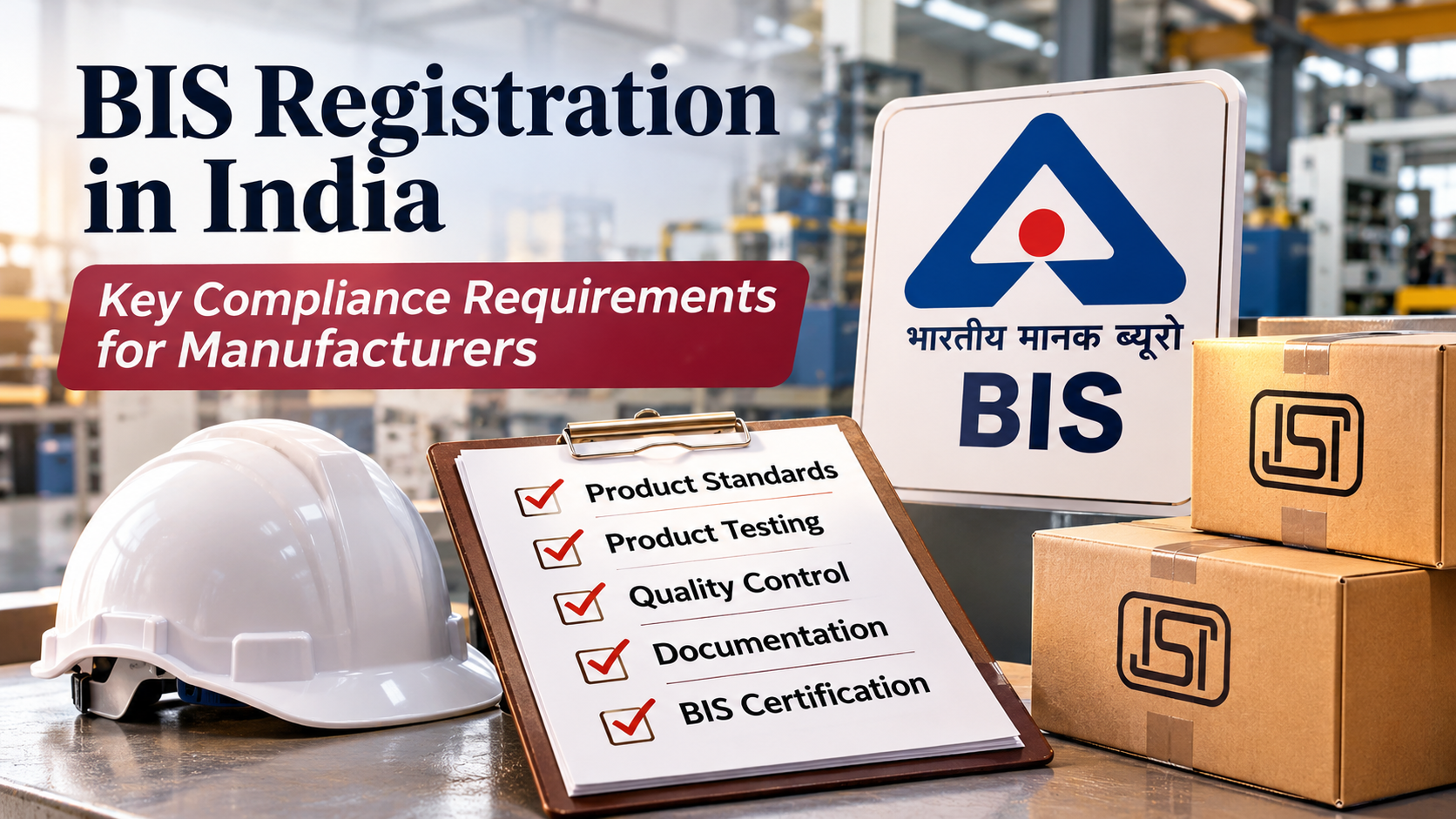
BIS Registration in India: Key Compliance Requirements for Manufacturers

BIS Registration in India

You’ve been working on your product for months. You have a nice factory up and running and are beginning to speak to distributors. All of a sudden you get asked if you need BIS certification to sell your product. Now you need to look into standards, testing requirements and government notifications that you were not previously aware of. This is why understanding BIS Registration in India matters for manufacturers. Depending on the product, BIS approval may be a legal requirement rather than an optional quality certification. Getting familiar with the rules early can help you avoid delays, rejected applications, and problems when launching your products. 

Manufacturers who are unfamiliar with the process may consider professional BIS registration services in India to identify the applicable certification scheme and prepare the required documentation. 

What Are the Key BIS Compliance Requirements for Manufacturers in India? 

First, manufacturers should check if their product requires BIS certification. In general, manufacturers will have to adhere to the relevant Indian Standard, carry out any necessary testing and evaluation, obtain any appropriate approvals and apply the relevant marking. This will depend on the product and scheme of certification. 

The main requirements may include: 

  • Identifying the correct Indian Standard. 
  • Checking applicable Quality Control Orders. 
  • Meeting product safety and quality specifications. 
  • Completing testing through the prescribed process. 
  • Maintaining manufacturing and quality-control records. 
  • Submitting accurate documents and application details. 
  • Using the appropriate BIS Standard Mark only after authorisation. 

Approval is not the end of compliance. Manufacturers must continue meeting the applicable requirements while their licence or registration remains in force. 

Understanding BIS Registration in India 

The Bureau of Indian Standards (BIS) is India’s national standards body. It develops Indian Standards and operates certification schemes that help establish whether products meet specified requirements. For manufacturers, BIS certification provides a recognised way to demonstrate product conformity. 

However, there’s an important distinction. BIS certification is generally voluntary unless a government notification makes compliance compulsory for a particular product. 

Also, not every product follows the same approval route. Some require an ISI Mark licence, while others fall under the Compulsory Registration Scheme. Understanding this difference is the starting point for BIS Registration in India. 

Why BIS Compliance Matters for Manufacturers 

Think about a customer buying an electrical appliance. They cannot personally test every safety feature before purchasing it. 

Product standards help establish measurable requirements that manufacturers are expected to meet. For businesses, BIS compliance can help with: 

  • Meeting mandatory product regulations. 
  • Demonstrating conformity to Indian Standards. 
  • Supporting product quality and consistency. 
  • Reducing the risk of regulatory action. 
  • Building confidence among distributors and customers. 

More importantly, when certification is compulsory, selling products without the required approval can create serious compliance problems. 

Which Products Require BIS Certification? 

Not every product that is made needs BIS approval. The need for it depends on the type of product the Indian Standard that applies to it and the government notification that is, in place. Products covered by mandatory schemes can include certain: 

  • Electrical appliances and equipment. 
  • Electronics and IT products. 
  • Steel and other industrial materials. 
  • Chemicals and construction products. 
  • Consumer and household goods. 

These are broad examples, not a complete list. Requirements can change through new notifications, amendments, or revised implementation dates. 

Manufacturers should check the current BIS list of products under compulsory certification before starting production or entering the Indian market. 

Main BIS Certification Schemes Manufacturers Should Know 

One common mistake is assuming that every BIS application follows the same process. In reality, the certification route depends on the product. 

ISI Mark Certification 

Under Scheme I, eligible manufacturers can apply for a licence to use the ISI Mark on products that meet the Indian Standard. 

The BIS usually checks the manufacturing capabilities quality-control systems. Whether the product meets the standard before giving the licence. 

Compulsory Registration Scheme (CRS) 

CRS, also called Scheme II, covers notified product categories, including various electronics and IT goods. 

Manufacturers generally obtain the prescribed laboratory test reports and apply for registration under the applicable requirements. The registration permits the authorised use of the relevant Standard Mark. 

Foreign Manufacturers Certification Scheme (FMCS) 

Foreign manufacturers supplying applicable products to India may need certification through FMCS. This scheme allows eligible overseas manufacturing units to obtain a BIS licence after satisfying the required assessment and product conformity conditions. 

Notified electronics and IT products generally follow the applicable CRS route instead. Other BIS schemes also exist, so manufacturers should confirm the correct route for their specific product. 

Key BIS Certification Requirements for Manufacturers 

Before submitting an application, manufacturers should understand what BIS expects from their products and production facilities. 

1. Compliance With Applicable Indian Standards 

All products must conform to the relevant Indian Standard(s). These specify aspects such as safety, performance, material, size and test requirements. 

If you choose an old standard or incorrect product category there will be issues when certifying your product. 

2. Product Testing Requirements 

Testing is an important requirement of BIS certification. Testing can be done by BIS approved laboratories, factory testing facilities or other prescribed methods. The manufacturer should ensure that: 

  • Samples represent the intended product. 
  • Test reports cover the required parameters. 
  • Product specifications match the application. 
  • Testing follows the applicable scheme. 

3. Manufacturing and Quality Control 

For schemes involving factory assessment, BIS may examine whether the manufacturer can consistently produce conforming products. This can involve checking equipment, testing facilities, production processes, and quality-control records. A product passing one test does not remove the need to maintain quality during regular production. 

4. Documentation and Product Labelling 

Incomplete documentation can delay an otherwise straightforward application. Depending on the scheme, manufacturers may need: 

  • Business and factory details. 
  • Product specifications. 
  • Manufacturing process information. 
  • Test reports. 
  • Quality-control records. 
  • Authorisation documents. 
  • Applicable marking and labelling details. 

The exact document list should always be checked against the relevant scheme. 

BIS Registration Process: Step-by-Step Guide 

The BIS registration process becomes easier to manage when manufacturers understand the sequence before applying. 

Step 1: Identify the Applicable Scheme 

Start by checking your product category, relevant Indian Standard, and any applicable Quality Control Order. This determines whether certification is compulsory and which application route applies. 

Step 2: Prepare Documents and Submit the Application 

Gather the required business, manufacturing, and product information. Applications are submitted through the relevant BIS system, following the prescribed scheme requirements. 

Step 3: Complete Testing and Verification 

Arrange product. Any factory assessment that is needed under the scheme. If BIS finds that some information is missing or that things are not in line, with the rules those issues may need to be fixed before getting approval. 

Step 4: Obtain Approval and Follow Marking Rules 

Once the applicable requirements are satisfied, BIS may grant the licence or registration. Manufacturers can then use the authorised Standard Mark according to the approval conditions. 

Common Mistakes Manufacturers Should Avoid 

Many problems occur during the submission process. For example if a manufacturer sets up testing but has not identified which standard applies to their product additional testing may be required. Common errors include: 

  • Applying under the wrong certification scheme. 
  • Using outdated standards. 
  • Submitting incomplete documents. 
  • Providing inconsistent product details. 
  • Overlooking factory testing requirements. 
  • Using a BIS mark without authorisation. 
  • Failing to check updated government notifications. 

Getting the basics right early can prevent unnecessary rework. 

Maintaining BIS Compliance After Approval 

Once you’ve received your approval then there are some duties to carry out. These can be based on a scheme and licence conditions so could include ensuring that your products meet quality standards, keeping test records, working with surveillance activities and renewing approvals. 

You should ensure that any design changes, changes to manufacture location or other information which has been approved requires BIS notification or additional approvals. If you have several products under regulation then it can help to use a regulatory compliance service to keep track of your duties. 

Frequently Asked Questions:

Is BIS Registration Mandatory for Every Manufacturer in India?

No BIS certification is usually optional. However BIS certification becomes mandatory for products that are listed in government notifications or that belong to a certification scheme.

How Long Does BIS Registration Take?

There is no timetable for all products. The time needed for BIS registration depends on the certification scheme, the testing that must be done how complete the paperwork is and whether a factory visit is required.

Can Foreign Manufacturers Apply for BIS Certification?

Yes, foreign manufacturers who meet the criteria can apply for BIS certification. They can do so through the BIS scheme, such as FMCS or CRS depending on the type of product.

What Happens If a Manufacturer Sells a Product Without Mandatory BIS Approval? 

If a manufacturer makes or sells a product without the required BIS certification it may face action and penalties as set out in the law.

Is Product Testing Necessary, for BIS Registration?

To show that a product conforms to BIS standards it must go through the testing or assessment method that the BIS certification scheme requires.

Does BIS Certification Need Renewal?

BIS licences and registrations expire after a period and must be renewed. Every manufacturer should read the renewal rules that come with their BIS approval.

Conclusion

Manufacturers find BIS compliance easier to manage when BIS compliance becomes part of product planning of a task that is tackled only before a launch. Knowing the standards preparing accurate documents completing testing and keeping quality controls in place helps manufacturers avoid unnecessary delays. Because BIS Registration in India has rules for different products checking the correct scheme is essential for manufacturers. Working with a BIS registration consultant in India helps manufacturers understand their obligations prepare applications and manage compliance with greater confidence.
BIS Registration in India, its Process and Documents involved

Nowadays it is mandatory for almost every product to have the mark of genuineness and its authenticity in order to get the attention of its target customers. Similarly, BIS registration in India is a way to ensure customers regarding the quality, standard and purity of a product. 

In this blog we will discuss about the concept, process and documents required for BIS registration-

Concept of BIS Registration

BIS registration or Bureau of Indian standards denotes the National standard body of India which ensures the standard and quality of a product, scheme of certification of products, and provides testing and standardization services. This national body comprises 25 members and its office is headquartered in New Delhi. 

It has five regional offices at Kolkata, Chennai, Delhi, Mumbai and Chandigarh.

Objectives of BIS registration in India

The key objectives of BIS registration are as follows-

  1. It aims to protect and safeguard the health of the citizens.
  2. It offers the quality and standard of a product.
  3. It protects consumers from hazardous products.
  4. It boosts consumer confidence.

Regulatory Framework for BIS Registration

In India BIS registration is regulated by Bureau of Indian Standards Act, 1986 and issues BIS registration certificate according to this Act only. Further it was brought into force on 20th November, 1986 and its enforcement has reduced the ambit of the Indian Standards Institution (ISI).

Items covered under BIS Registration

Items that are covered under BIS registration in India are as follows-

  1. Items covered under Scheme 1 or Mark scheme

Items covered under the above category are as follows-

  • Cement
  • Batteries
  • Household electrical goods
  • Oil pressure stoves
  • Food and related products
  • Automobile accessories.
  • Medical equipment
  • Cylinders, valves and Regulators
  • Electrical Motors
  • Steel and Stainless steel products
  • Electrical Transformers
  • Chemicals and Fertilizers
  • Capacitors
  1. Items termed as IT and Electronic Products

 Items covered under the above title are as follows-

  • Electronic Games such as Video Games.
  • Microwave, Oven and OTGs.
  • Laptop, Notebooks, Tablets
  • LCD, Plasma TV, LED Televisions with screen size 32 and above
  • Visual Display Units
  • Optical Disc Players comprising built amplifiers of input power 200w and above.
  • Wireless Keyboards
  • Printers, Plotters
  • Scanners
  • Amplifier with an input power 200W and above
  • Telephone answering machine
  1. Who are eligible to obtain BIS Registration

All the manufacturers or producers notified under compulsory registration scheme need to apply for BIS Registration. However, following are the things which needs to be taken care of-

  • A Separate registration number is required for the products r tems manufactured or produced at different locations.
  • A separate registration number is required for each brand, product or item manufactured or produced at the same place.

Documents Required for BIS Registration in India

Following are the documents required for BIS Registration in India-

  • PCB Layout
  • Schematic diagram
  • User manual
  • Critical components list
  • A copy of Trademark registration
  • Factory’s organizational chart
  • Legal address proof for the factory
  • List of machinery installed
  • List of equipment used
  • All the documents concerning authorized Indian Representative (AIR) when the producer resides is some other country.
  • Test report of the product analysis or examined by the BIS certified lab.
  • Declaration from the CEO of the firm.
  • Invoice concerning sales
  • Packaging list
  • Bills of lading
  • Insurance cover note
  • Certificate declaring the Brand name of the owner
  • Letter of consent (LOC) from the owner of the products
  • Location map
  • Flow chart showcasing the process of manufacture

Procedure for obtaining BIS Registration in India

Following are the steps involved for obtaining BIS Registration in India-

  1. Firstly product samples or batches are to be sent for testing in the BIS recognized laboratory.
  2. After receiving the test report, the applicant requires to enclose some of the basic details such as-
  • Name f the Applicant
  • Name of the Firm
  • Complete Address
  • Signature of the Lab in Charge
  1. Now go to the BIS portal and download form VI and VII
  2. The applicant is required to attach or upload all the documents along with the test reports when applying for the BIS Registration.
  3. After filing an online form, the applicant has to submit a hard copy of the documents and test reports along with the form at the BIS regional office. 
  4. In case of overseas Manufacturers and producers, the applicant needs to hire an AIR, who will be responsible for obtaining certificates on behalf of its producers.
  5. After receiving an application, the comet authities will conduct an examination and scrutiny of all the documents, test reports and application submitted.
  6. If the examiner will be satisfied by the forms and document then only he will issue a BIS registration certificate.

Validity of BIS registration in India

BIS registration in India is valid for a period of two years starting from the date of issuance and after two years applicant is required to renew its registration by filing Form XII.

Conclusion

The Bureau of Indian Standards provides guidelines of quality and standards of a product to every manufacturer or producer. Moreover, BIS acts as an authority to issue BIS registration certificates. However there are chances for new entities to face difficulty in obtaining the BIS registration certificate. 

At BIAT consultants, our experts will provide you end to end assistance with the matter concerning BIS Registration in India.

Registration processes in BIS : Step by step guide

bis registration process

BIS happens to be a national authority which promises the superiority, security and dependability of products in India. The intention of BIS is to check the samples of products when they are in the preliminary and surveillance stage. India has in total eight central, four regional and three branch laboratories of BIS.

BIS Registration Product Scheme

BIS Registration product Scheme happens to be one of the biggest schemes across the world having more than 26500 licenses encompassing in excess of 900 products. It permits the manufacturer the usage of the well-known ISI Mark on their products which assures superior quality. BIS Registration product scheme even runs Foreign Manufacturers Certification Scheme with which international manufacturers can get a license to utilise the BIS standard mark.

Documents needed for BIS Registration

Documents needed for BIS registration process is segregated into two parts:

First part delves into the technical details of the products available for lab tests. The information manufacturer must submit the construction details of the product such as:

  • PCB Layout
  • Schematic Diagram
  • User Manual
  • Critical Components List
  • As for the second part you must submit the Factory Documents & Information to finish the BIS Application Form and Process, that is, all rudimentary details regarding the manufacturing unit:
  • Trademark Registration Copy
  • Organizational chart of the factory
  • Legal address proof of factory
  • List of machinery
  • List of equipments
  • Documents of Authorized Indian Representative (AIR) when the manufacturer is from outside India

The BIS Registration processes usually consume close to 30-35 days to finish including testing time of 15-20 days and the BIS Application processing time which is 10-15 days.

Types of BIS Registration Schemes

The BIS Registration for the product is classified under various types of schemes which is as follows:

Normal Process For Local Manufacturer

The applicant must furnish the BIS registration or BIS Registration application along with some documents and the necessary fees. Post the submission of the application an assessment is done by a BIS officer whereby the samples are checked in the factory and drafted an indigenous testing report. And, if everything goes according to the script then BIS registration is given when the sampling procedure is accepted.The BIS registration is given within 4 months post submitting the application.

Simplified Process for Local Manufacturers

Over here, the applicant along with the application for BIS Registration furnishes a test report of the sample from the accredited lab to the BIS officer. In case the test report is good enough then the BIS officer will validate the factory and give certificate of registration within 30 days of submission of BIS Registration application with a required test report.

The simplified procedure is applicable for grant of license of All India First license cases and for all the products except for the following:

Products such as cylinders, valves, cement, etc. , where it is essential to have the consent from another statutory body;

All other products where BIS license is given as per factory testing;

Packaged Drinking Water (PDW) and Packaged Natural Mineral Water (PNMW).

Eco Mark Scheme

BIS also offers License to eco-friendly products under a special scheme- ECO Mark Scheme where every environmental product is classified in line with the basic requirements under Indian Standards.

Foreign Manufacturers Certification Scheme

The ISI mark for foreign applicants or manufacturers is specifically designed and given under a different scheme within a 6 months period. In the year 2000 the concept of Foreign Manufacturers Certification Scheme (FMCS) was brought in by the Bureau of Indian Standards (BIS) with the objective of enabling the overseas applicants or foreign manufacturers so that they also can utilize Standard Mark on their products. A BIS license that fits into this process can be had in 6 months.

Registration Process for BIS Registration

Licensing Process

As for the licensing process, these steps are needed-

  • Submission of application
  • BIS Officer going for a preliminary Inspection
  • Post the Inspection, the samples get checked
  • After conclusion all the assessment, the final outcome will be given

Surveillance Process

Following the Inspection Process, the next method is called the surveillance process in which the factory’s total survey is done. The following steps are initiated for the surveillance procedure

  • The Inspecting authority will go the factory and verify it
  • Post the testing, the samples are taken
  • The samples will be given to the Independent labs
  • The test report will intimate about the complaint or provide response on the investigation
  • The performance review report will be prepared
  • Upon the review of the report license is granted

BIS Registration Mandatory Products

Not every electronic product or other products require BIS Registration however there are some products that come under the essential requirement. The list of products is given below-

  • Cement and Concrete
  • Diesel Engines
  • Household electronics
  • Food and related products
  • Oil Pressure Stoves
  • Automobile Accessories
  • Steel products
  • Wood Products
  • Leather Product
  • Cylinders, valves, and Regulators
  • Medical Equipment
  • Electrical Transformers
  • Testing instruments
  • Rubber and plastic
  • Machinery and equipment

Validity for BIS Registration

The BIS registration remains active for two years and is renewable if the product and the standard are not modified. License renewal is done for at least a period of one year and maximum up to five years. Though, the renewal hinges on the yearly license fee and advance minimum marking fee. If the renewal application is made post the expiry of validity of the license, the applicant will have to cough up a late fee of rupees five thousand.

What do you mean by Compulsory Registration Scheme (CRS)?

In October 2012, the Ministry of Electronics & Information Technology brought an order that stipulates that no one is permitted to manufacture or store some goods. It gave “Electronics and Information Technology Goods (requirement for Company Registration) Order, 2012 and has provided 15 categories of electronic products that have been exempted from sale, import or distribution. Notify goods that do not follow the Indian Standards. Hence, it is mandatory for the manufacturer of the listed electronic products to apply for BIS registration by following the prescribed procedure:

  • Bureau of Indian Standards (BIS) during that stage enrolls the manufacturers under its registration scheme.
  • The enlisted makers are allowed to announce that their products are in conformity with the specified Indian Standards.
  • The registered manufacturers must specify that their products use the Standard Mark notified by the Bureau.
  • Provisions of Chapter IVA of BIS Rules 1987, regulates Compulsory Registration Scheme.
  • The Ministry of Electronics & Information Technology (MEIT) has swelled its list by including 50 more products, all these products come under the category of products that require Compulsory Registration.

Who all can apply?

  • Manufacturers of the products mentioned in the scheme which is located in India or outside India.
  • The different Registration number for products manufactured at various locations.
  • The separate Registration number for every brand being manufactured at the same location.

ISI CERTIFICATION FOR FOREIGN MANUFACTURER

ISI CERTIFICATION FOR FOREIGN MANUFACTURER

ISI refers to Indian Standard Institute and can be defined as a stamp that provides assurance regarding quality of product and in built trust and safety among customers for the Product.

In India , consumers mostly preferred ISI marked products.Therefore , there are certain products in India to have ISI certification mandatory before being sold in the market.

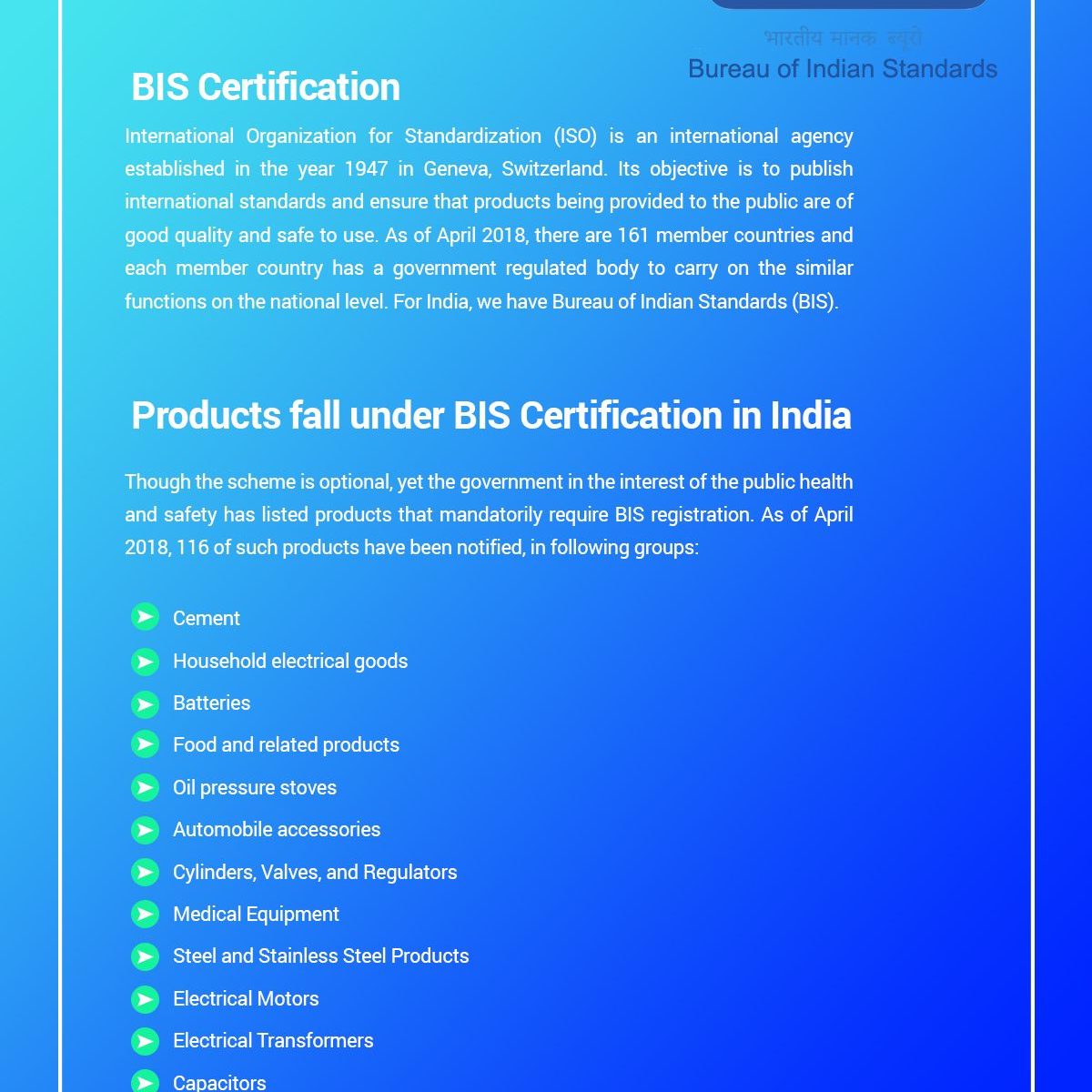
PRODUCTS FALL IN MANDATORY ISI CERTIFICATION  CATEGORY IN INDIA-

There are certain products in India that fall under the category of mandatory ISI certification before being sold in the market. 

The categories are as follows –

A] Household Electrical Products 

B] Cement 

C] Automobiles Industry 

D]Steel Product 

E] Medical Equipment 

F] Electrical Transformers 

G] Cylinders

H] Food related Products 

  •  Foreign Manufacturers – 

 The foreign companies need Product certification which is provided through the ‘’ Bureau of Indian Standard’’ scheme .Therefore a foreign manufacturer  needs a BIS mark certificate to carry on the sale of products in the market. 

Documents Required for ISI Marked Certification License –

There are certain documents required for the ISI Certification License . It begins with filling of application forms and all products have separate application forms to be filled. There are certain documents required to be attached with the prescribed application form –

1] Copy of Test report done in Laboratory 

2] Trademark Registration copy 

3] Manufacturing unit address 

4]Machine details including quantity , capacity 

5] Drawing of product 

6] Raw materials details such as component name , suppliers name etc.

6] installation capacity 

7] Factory layout Plan 

8] Manufacturing process Flow chart 

9] Test equipments detail 

10] Packaging details 

11] Organization staff details such as management and designation 

12] factory details of employee 

13] Location detail and distance detail of factory from airport and city center etc. 

14] Detail of indian representative 

  • INSPECTION – 

After submitting the application , verification will be done by BIS and inspection will be done at the manufacturing unit of the applicant and therefore when all parameters are being satisfied , the BIS License is granted .

  • VALIDITY –

The BIS License is valid for a period of 1year and can be renewed thereafter by filling the prescribed application form.

  • BIS AGREEMENT – 

The applicant shall enter into an agreement with BIS as per BIS certification  Regulation,1988. 

It covers various provisions highlighted below – 

1] Fees 

1] Termination 

3] Responsibility of License 

4] Nomination 

5] License Cancellation 

6] Bank Guarantee 

6] Non Renewal 

7] Indemnity 

  • COMPLAINT REDRESSAL – 

Whenever a complaint is received against a License product then investigation shall take place against it as per IS/ISO 10002 and appropriate action shall be taken against it. 

In case there is high damage then License shall bear entire expenses and BIS will not be responsible for it .

  • RENEWAL OF LICENSE – 

The license is valid for a period of 1 year and will be renewed further by filling the Renewal application form along with nominal fees and will be certified through a chartered Accountant .

How to get BIS certification in India easily

How to get BIS certification in India easily

It is quite vital to ensure that the products that we are using are safe to use and are good in quality.  Keep same into consideration, an international agency in Geneva, Switzerland, established an organization called the International Organization for Standardization ( ISO).


India is also member to it and that is called Bureau of Indian Standards (BIS). Products adhering to the standards mentioned by BIS are certified.  The BIS reviews its standards in every 5 years.


If you want BIS consultation then you must consult, BIATConsultant. BIATConsultant is a leading consultant that offers plethora of services to its client such as Company Registration, GST Registration, Trademark Registration etc.


Now, the question that would be arising in your mind may be why you need to have BIS Registration. Here is the solution for that, in this blog we will discuss about BIS certification and its purpose.


What is the purpose of BIS Certification


Basically BIS works towards maintaining the quality, safety and reliability of products in India. The basic purpose of BIS is to test samples of products during the preliminary and surveillance operations. And therefore several Branch laboratories is being established in the country.


BIS Registration is encouraged by the Government for the following purposes:-


  1. Protecting the consumers from Hazardous products
  2. Providing a safeguard to a public health
  3. Providing quality assurance
  4. Promoting consumer confidence


What Activities does BIS Oversee?

Given below are the following activities that BIS look after:-


  1. Compulsory registration Scheme
  2. Foreign Manufacturers Certification Scheme
  3. Hall marking scheme
  4. Standards formulation
  5. Product Certification Scheme
  6. Laboratory Services
  7. Laboratory Recognition Scheme
  8. Sale of Indian Standards
  9. Sale of Indian Standard


  1. Training services at national and international level
  2. Information services
  3. Consumer affair activities
  4. Promotional activities


Who can apply for BIS Certification?


Here are the List of people or group who can apply for BIS registration:-


  1. Manufacturers of Notified products established in India or outside the country under the Compulsory Registration scheme (CRS)
  2. Separate registration for products producing at different locations
  3. Separate registration for each brand producing at the same location is required to have a BIS certification.

There  are various schemes that can help certified users.


Steps for BIS certification


The certification process is simple and they are as follows-


  1. Sign in with User id and Password. If you are  new user then click, new user.
  2. The next step is to fill form VI.
  3. Then you are required to make payment as required.
  4. After making the payment you have to fill the form fields as required and  then click submit button.
  5. You will receive an auto generated mail with the Application Number.
  6. Submit the hard copy of the application within 15 days, test report in original, which must not be older than 30 days, should be submitted with the application. ( test report must be from a recognised BIS labs).
  7. BIS will scrutinise the application. In case of any query or objection they have to submit their reply online.
  8. Once their objection is addressed and affidavit cum undertaking is submitted, Registration is granted .


Documents Required for BIS Registration:-


Following are the documents which are required for BIS registration and they are as follows-


  1. Application form as per the prescribed format is to be given.
  2. Self evaluation report as per the described format.
  3. Original test reports from the recognized BIS laboratories, not older than 30 days. It must mention all the requirements as per the relevant category.
  4. A scanned copy of the acknowledgment received from the portal screenshot of the online file submission.
  5. Address proof that could be business license or any document issued by the government
  6. Demand draft along with the prescribed fees along with the Xerox of DD and NEFT details.
  7. The undertaking document
  8. Affidavit as per Form C

What Is BIS Registration ? What Is Procedure Of BIS Registration In India

bis registration online in india


  • Documents Required


  1. Firstly you need to provide the details of the technical products for the Lab test. And it is basically about giving information regarding construction details of the business and they are as follows-
  • PCB layout
  • Schematic Diagram
  • User manual
  • Critical Component list ( CCL)
  1. Secondly you need to provide information about the Factory documentation and information to complete the BIS Application  form and Process. It is basically providing the basic information about the manufacturing unit, and for that following documents are required-


  • Legal address Proof of factory ( manufacturing license Copy)
  • Trademark registration Copy ( Brand Name or Logo registration)
  • Organizational Chart of Factory (Top Management + QA Team)
  • List of Machinery
  • List of Equipment (QA)
  • Documents of Authorized Indian Representative ( AIR), in case of Foreign Manufacturer.


  1. Guideline for multiple model and series of product for BIS Registration


In single BIS registration Application, 10 similar models (Series Models) of one brand can be processed together provided they all fall in the series guideline. Only one set top box can have multiple brands of 10 series models in single BIS registration Application. For cell and battery, it can be upto 20 series models (1+19).


  1. Process for BIS registration In India


  • Firstly the sample of the product is given to the BIS approves Indian laboratories which are recognised for testing under defined IS standard.
  • Secondly after getting the test report, apply to BIS office with prescribed format i.e. by filling form VI which is attached with lab test report, factory documents, information and undertaking. And after scrutiny of all submitted documents and information, BIS registration certificate will be issued.


  1. What are the guidelines for BIS Registration


BIS registration certificate is granted to Manufacturing units and not to any individual. All importers and traders need to get BIS Registration for their respective manufacturing units before placing their order for scheduled electronic items.


Importer or Trader can become the Indian Representative for manufacturing unit as it is mandatory to have an Indian representative to get BIS registration.


Validity of BIS registration certificate


BIS registration certificate is valid for 2 years and after that it gets renewed. Few documents and fees is required to be submitted in order to get the renewal of BIS Registration certificate, testing of sample is not required in case of its renewal.


Relevancy and reliability for BIS Registration for consumer Electronics

bis-registration-license

Introduction


India is a growing country that is why demand of consumer electronic Goods is increasing day by day. That is why government has introduced Compulsory registration scheme for consumer electronics and for that Bureau of Indian Standards has been introduced and being implemented.


Types of  BIS Certification Scheme


  • Normal procedure for Domestic Manufacturers-  The applicant is required to submit the BIS Certification Application with required documents and requisite fees. After submitting the application preliminary factory evaluation is being done by BIS Officer. Then those samples are tested in the factory. And BIS Certification is provided when sample is accepted. In this process BIS Certification is being granted within 4 months from the date of filing of the Application.
  • Simplified procedure for domestic manufacturers-  In this the applicant submits the test reports of the sample from the BIS approved lab along with application of BIS Certification. If test report is satisfactory then verification is being done by BIS officer, and BIS Certification is granted if the verification is satisfactory. i n this license is expected to be granted within 30 days.
  • Tatkal scheme-  Those Manufacturers who want BIS Certification mandatorily as per government Notification then they can obtain BIS Certification through tatkal scheme. In this scheme the total time for processing is specified within 30 days, and this scheme is taken on the priority basis and is done as soon as possible as compared to the other.
  • Eco- mark scheme-  In this scheme BIS License is granted for eco friendly products. And these products must qualify the Indian standards. However it is similar to domestic Manufacturers.
  • Foreign manufacturers Certification Scheme-  In this foreign Manufacturers are granted this License for the use if ISI mark under separately designed scheme within 6 months period.


So in case you are looking for BIS Registration Consultant in India to get your ISI mark registered in India , contact BIATConsultant.com .