
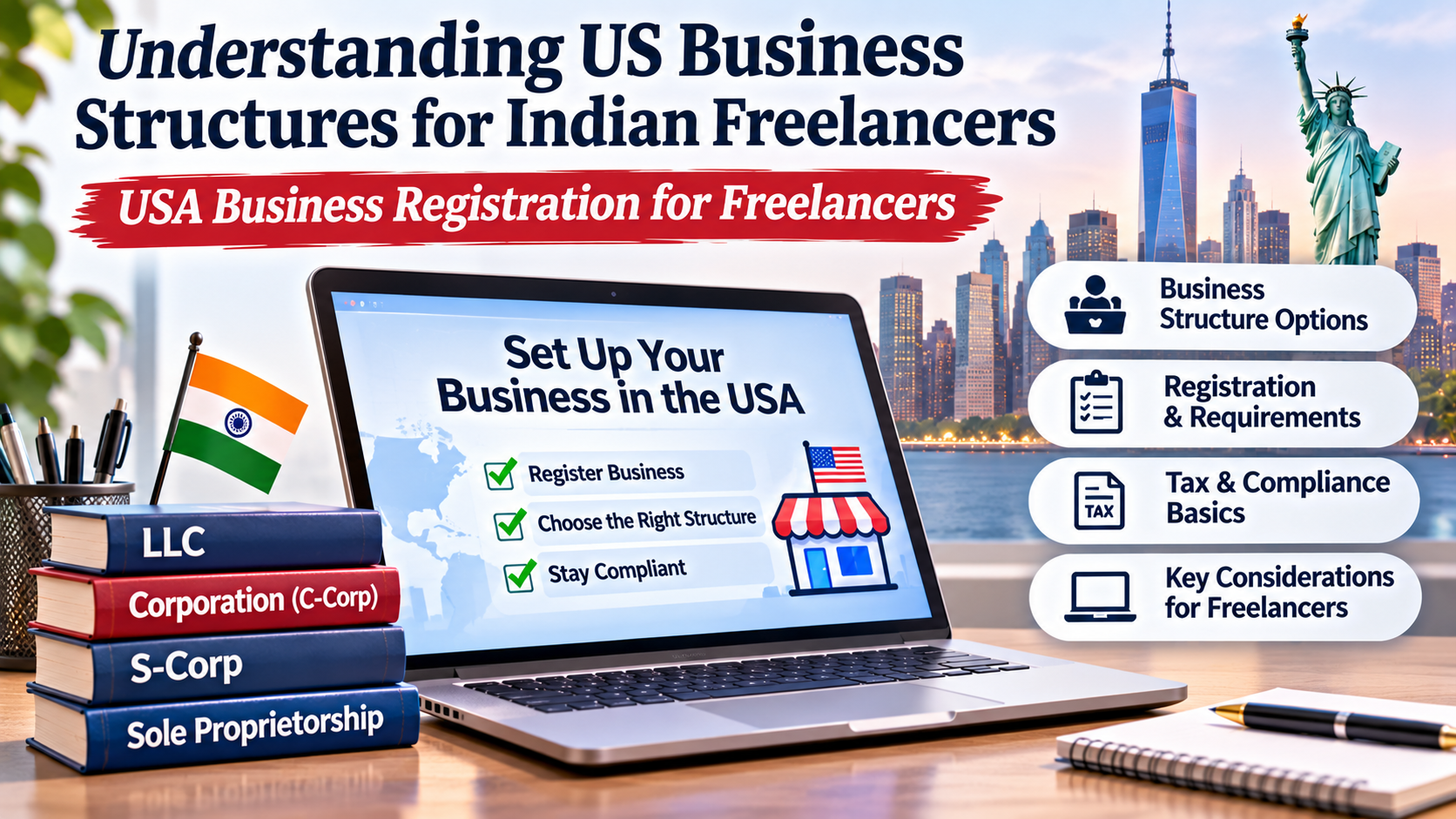
Imagine you’re a freeelancer in India offering design services to clients in the US. As the business grows one of your clients suggests you set up a company in the US to make things easier. But where would you start? Should you set up an LLC or Corporation? Understanding USA Business Registration for Freelancers can help you decide whether establishing a US business makes sense. By understanding USA company registration from India, you can see what legal obligations, tax implications and other complications there could be. There can be some benefits to setting up a company in the US but there are also a number of obligations to consider.
Which US Business Structure Suits Indian Freelancers?
As a freelancer in India, the Limited Liability Company (LLC) structure may be an option to look into. This structure offers a flexible management structure and generally means your company won’t have personal liability.
However, this might not be the best option. You will need to consider:
- What kind of freelance services you offer.
- Whether you’re working alone or with partners.
- How much money you expect to earn.
- Tax implications in the US and India.
- Costs of registering your company and annual compliance.
- Whether you intend to employ staff or invest.
If you’re only offering services occasionally there may not be a need to set up a US entity.
Understanding USA Business Registration for Freelancers
Setting up a business in the US means eligible foreign individuals can create a legal entity within a specific state. An Indian freelance developer may wish to set up a company in the US to sign contracts with international clients.
However, just because you’ve set up a company in the US does not mean you’ll have immigration rights, a bank account or be exempt from Indian regulations. Think about why you want to set up a company in the US and whether the benefits outweigh the ongoing obligations.
Common US Business Structures
There are a few options available to you when setting up a business in the US. Below is a breakdown of common Business Structures.
Sole Proprietorship
A Sole Proprietorship is generally an unincorporated business run by an individual.
Whilst this can be an easy option to set up, it does not create a legal entity so your personal assets may be at risk. As an Indian resident working entirely within India, this may not be the best option.
Limited Liability Company (LLC)
An LLC is a company created under state law. Generally, this will provide limited liability to the owners (members). There can be exceptions.
This will generally be viewed as a disregarded entity for Federal Income Taxes in the US, unless another status has been elected. This should be considered before setting up your company.
C Corporation
A C Corporation is a legal entity and will generally pay Federal Corporate income tax. If you’re intending to take on investors, issue shares or grow your business then this may be a good option. However, this can come with more formalities and possible multiple layers of taxation.
Benefits of Setting up a US LLC
Many freelancers research US LLC benefits for freelancers because an LLC can provide a flexible business structure. Possible benefits include:
- Personal and business liability protection.
- Legal entity in the US.
- Flexible ownership/management.
- Opportunity to organise international business.
- Access to business services, depending on the provider.
However, this is not fully protected and does not automatically reduce tax. The benefits will depend on how the company is run and where the owner is based.
Legal Considerations
Before moving forward, Indian residents should consider the US incorporation requirements and any Foreign Exchange Regulations in India. The process of incorporating in the US will generally involve:
- Choosing the state.
- Appointing a registered agent.
- Completing formation documentation.
Indian residents will need to make sure that their investment falls under the correct overseas investment regulations of the applicable FEMA regulations.
Depending on what kind of business, ownership and investment method you have, this may be allowed. It may be a good idea to seek professional advice before investing any money or committing to ownership.
Choosing the Right State in the US
A common mistake made is to assume all freelancers should incorporate in Delaware or Wyoming.
Each state will have different costs, annual costs, reporting requirements and business requirements. Consider:
- Formation costs.
- Annual costs.
- Taxes and costs.
- Registered agent.
- Where your business will be based.
A state with low formation costs may not be the cheapest for several years.
Documentation Required
Depending on the state and business structure you choose, there may be different documents required. For an LLC you may need:
- Company name.
- Owner details.
- Registered agent details.
- Formation documents.
- Business address.
- Operating Agreement.
- EIN details.
Additional identification may be required for financial accounts. Make sure to keep copies of all your registration documents as you may need them for your banking, tax and future changes.
USA Business Registration for Freelancers: Step-by-Step Process
Once you have decided on the best structure for you, you can proceed with registering your business. Steps include:
- Decide what your business will do and what ownership is required.
- Check what the overseas investment rules are in India.
- Choose the correct state.
- Check your company name is available.
- Appoint a registered agent.
- Complete formation documents.
- EIN (if required).
- Create company documents.
- Check what banking and tax requirements are.
The process will vary between states. Some businesses may also require local licensing and additional registration.
Understanding Tax Obligations in the US
Setting up a company in the US does not automatically mean you will pay tax on every dollar earned. This will depend on:
- Where your services are provided.
- Company type.
- Whether your income is connected to a US trade or business.
For example, a foreign owned single member LLC may have Federal Information Reporting requirements even though there is no Federal Income Tax liability.
Certain foreign owned disregarded entities will need to complete Form 5472 along with a proforma Form 1120, if applicable. Failure to complete these can result in large penalties.
Tax and FEMA in India
If you are a tax resident in India creating a company in the US does not mean you are not liable to pay tax in India. Generally, Indian residents will be taxed on their worldwide income.
Depending on your situation you may need to consider:
- Foreign asset and income reporting.
- Overseas investment requirements in FEMA.
- Investment limits and restrictions.
- Transferring funds between countries.
- Taxation of your business profits in India.
- Double taxation relief.
The tax treaty between India and the USA may be relevant, depending on the facts.
Opening a Business Bank Account in the US
Having a business bank account in the US can help to keep your business finances separate from your personal. However, as a non-resident this may not be easy. Banks and financial service providers will likely ask for:
- Formation documents.
- EIN.
- Identification.
- Business details.
Some will also require further checks and a physical business. Make sure to check what is required.
Annual Compliance
For USA Business Registration for Freelancers, these recurring obligations should be included in the overall business budget. Depending on your state and company type you may have:
- Annual returns.
- State franchise taxes/fees.
- Renewal of registered agent.
- Federal and State tax returns.
- Accounting records.
- Updating company details.
This should be factored into your overall budget when registering your business as a Freelancer in the US. Whilst a company may seem cheap to set up, it can become expensive if you don’t comply.
Common Errors
Many freelancers will try to get their company registered quickly, without thinking about what will happen next. Common errors include:
- Not understanding how an LLC will be taxed.
- Not considering the FEMA requirements in India.
- Assuming you will have a bank account if you set up a company in the US.
- Choosing a state based on how cheap it is to set up.
- Not considering the Federal Information Reporting requirements.
- Mixing personal and company finances.
Taking extra time to understand these can help avoid any extra costs.
FAQ’s:
Yes. Most states in the USA allow eligible foreign individuals to register an LLC or Corporation. However, Indian residents will need to consider the investment and foreign exchange rules in India.
An LLC can provide a simple management structure and flexible ownership. However, the best option will depend on your tax situation, what your business does and your future.
Generally, no. However, banks and other services may have additional requirements.
No. This depends on where you are based, what your business does, what type of entity you have and the laws of both countries.
Yes. Indian freelancers can generally receive payments from overseas clients using the correct banking and payment methods.
Generally, yes. This will depend on your state, company type and Federal tax requirements.
Conclusion
Setting up a company in the USA can provide benefits for Indian freelancers wanting to organise international business, sign contracts and prepare for growth. However, there are more considerations to consider when deciding which structure to use. Understanding USA Business Registration for Freelancers involves reviewing LLC and corporation structures, tax obligations, Indian FEMA regulations and ongoing compliance costs. Consider whether setting up a company in the USA will truly support your business. Having a USA Company Registration Consultant in India can help you understand what structures are available, what documents you will need and plan your registration.