
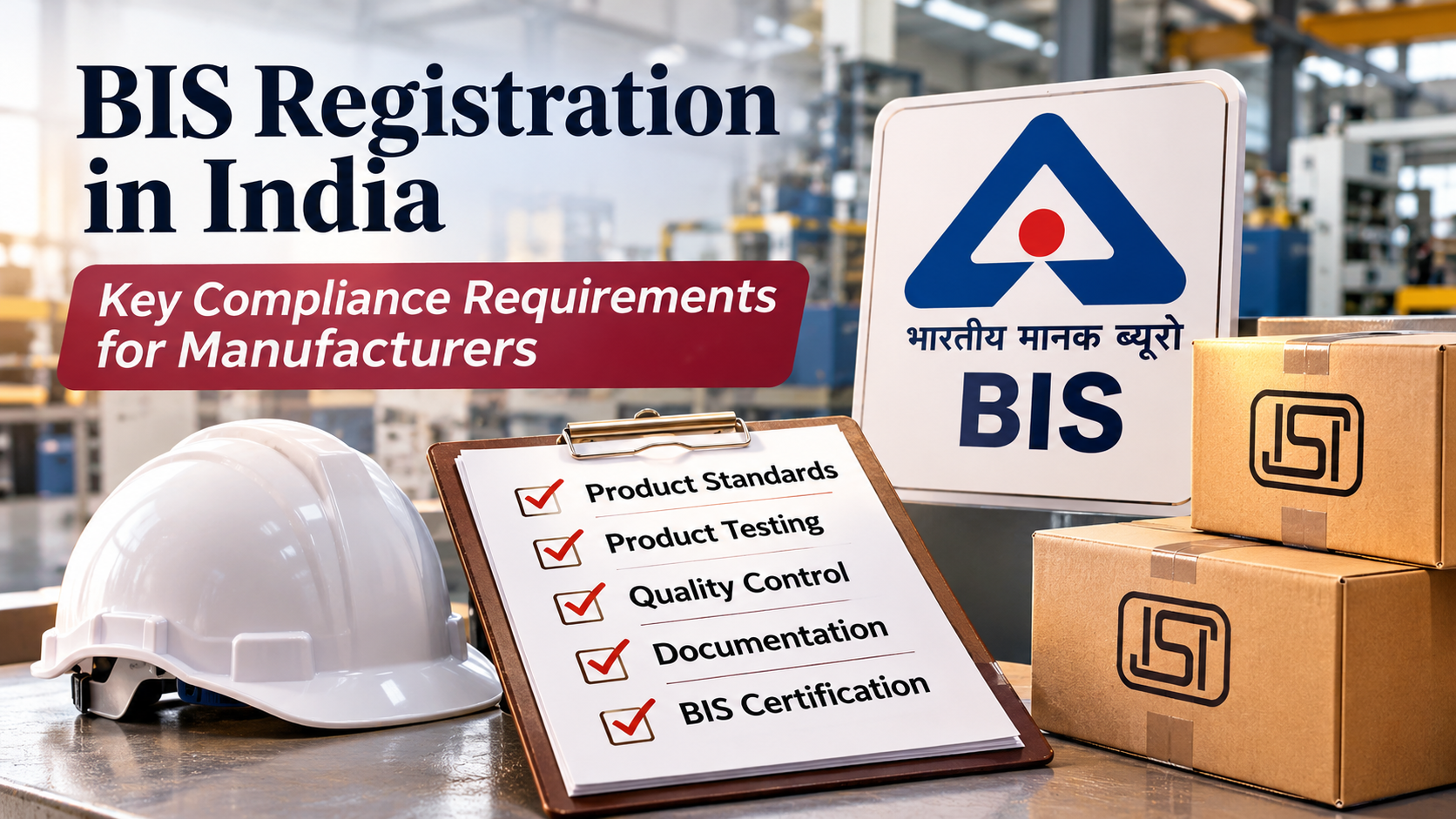
You’ve been working on your product for months. You have a nice factory up and running and are beginning to speak to distributors. All of a sudden you get asked if you need BIS certification to sell your product. Now you need to look into standards, testing requirements and government notifications that you were not previously aware of. This is why understanding BIS Registration in India matters for manufacturers. Depending on the product, BIS approval may be a legal requirement rather than an optional quality certification. Getting familiar with the rules early can help you avoid delays, rejected applications, and problems when launching your products.
Manufacturers who are unfamiliar with the process may consider professional BIS registration services in India to identify the applicable certification scheme and prepare the required documentation.
What Are the Key BIS Compliance Requirements for Manufacturers in India?
First, manufacturers should check if their product requires BIS certification. In general, manufacturers will have to adhere to the relevant Indian Standard, carry out any necessary testing and evaluation, obtain any appropriate approvals and apply the relevant marking. This will depend on the product and scheme of certification.
The main requirements may include:
- Identifying the correct Indian Standard.
- Checking applicable Quality Control Orders.
- Meeting product safety and quality specifications.
- Completing testing through the prescribed process.
- Maintaining manufacturing and quality-control records.
- Submitting accurate documents and application details.
- Using the appropriate BIS Standard Mark only after authorisation.
Approval is not the end of compliance. Manufacturers must continue meeting the applicable requirements while their licence or registration remains in force.
Understanding BIS Registration in India
The Bureau of Indian Standards (BIS) is India’s national standards body. It develops Indian Standards and operates certification schemes that help establish whether products meet specified requirements. For manufacturers, BIS certification provides a recognised way to demonstrate product conformity.
However, there’s an important distinction. BIS certification is generally voluntary unless a government notification makes compliance compulsory for a particular product.
Also, not every product follows the same approval route. Some require an ISI Mark licence, while others fall under the Compulsory Registration Scheme. Understanding this difference is the starting point for BIS Registration in India.
Why BIS Compliance Matters for Manufacturers
Think about a customer buying an electrical appliance. They cannot personally test every safety feature before purchasing it.
Product standards help establish measurable requirements that manufacturers are expected to meet. For businesses, BIS compliance can help with:
- Meeting mandatory product regulations.
- Demonstrating conformity to Indian Standards.
- Supporting product quality and consistency.
- Reducing the risk of regulatory action.
- Building confidence among distributors and customers.
More importantly, when certification is compulsory, selling products without the required approval can create serious compliance problems.
Which Products Require BIS Certification?
Not every product that is made needs BIS approval. The need for it depends on the type of product the Indian Standard that applies to it and the government notification that is, in place. Products covered by mandatory schemes can include certain:
- Electrical appliances and equipment.
- Electronics and IT products.
- Steel and other industrial materials.
- Chemicals and construction products.
- Consumer and household goods.
These are broad examples, not a complete list. Requirements can change through new notifications, amendments, or revised implementation dates.
Manufacturers should check the current BIS list of products under compulsory certification before starting production or entering the Indian market.
Main BIS Certification Schemes Manufacturers Should Know
One common mistake is assuming that every BIS application follows the same process. In reality, the certification route depends on the product.
ISI Mark Certification
Under Scheme I, eligible manufacturers can apply for a licence to use the ISI Mark on products that meet the Indian Standard.
The BIS usually checks the manufacturing capabilities quality-control systems. Whether the product meets the standard before giving the licence.
Compulsory Registration Scheme (CRS)
CRS, also called Scheme II, covers notified product categories, including various electronics and IT goods.
Manufacturers generally obtain the prescribed laboratory test reports and apply for registration under the applicable requirements. The registration permits the authorised use of the relevant Standard Mark.
Foreign Manufacturers Certification Scheme (FMCS)
Foreign manufacturers supplying applicable products to India may need certification through FMCS. This scheme allows eligible overseas manufacturing units to obtain a BIS licence after satisfying the required assessment and product conformity conditions.
Notified electronics and IT products generally follow the applicable CRS route instead. Other BIS schemes also exist, so manufacturers should confirm the correct route for their specific product.
Key BIS Certification Requirements for Manufacturers
Before submitting an application, manufacturers should understand what BIS expects from their products and production facilities.
1. Compliance With Applicable Indian Standards
All products must conform to the relevant Indian Standard(s). These specify aspects such as safety, performance, material, size and test requirements.
If you choose an old standard or incorrect product category there will be issues when certifying your product.
2. Product Testing Requirements
Testing is an important requirement of BIS certification. Testing can be done by BIS approved laboratories, factory testing facilities or other prescribed methods. The manufacturer should ensure that:
- Samples represent the intended product.
- Test reports cover the required parameters.
- Product specifications match the application.
- Testing follows the applicable scheme.
3. Manufacturing and Quality Control
For schemes involving factory assessment, BIS may examine whether the manufacturer can consistently produce conforming products. This can involve checking equipment, testing facilities, production processes, and quality-control records. A product passing one test does not remove the need to maintain quality during regular production.
4. Documentation and Product Labelling
Incomplete documentation can delay an otherwise straightforward application. Depending on the scheme, manufacturers may need:
- Business and factory details.
- Product specifications.
- Manufacturing process information.
- Test reports.
- Quality-control records.
- Authorisation documents.
- Applicable marking and labelling details.
The exact document list should always be checked against the relevant scheme.
BIS Registration Process: Step-by-Step Guide
The BIS registration process becomes easier to manage when manufacturers understand the sequence before applying.
Step 1: Identify the Applicable Scheme
Start by checking your product category, relevant Indian Standard, and any applicable Quality Control Order. This determines whether certification is compulsory and which application route applies.
Step 2: Prepare Documents and Submit the Application
Gather the required business, manufacturing, and product information. Applications are submitted through the relevant BIS system, following the prescribed scheme requirements.
Step 3: Complete Testing and Verification
Arrange product. Any factory assessment that is needed under the scheme. If BIS finds that some information is missing or that things are not in line, with the rules those issues may need to be fixed before getting approval.
Step 4: Obtain Approval and Follow Marking Rules
Once the applicable requirements are satisfied, BIS may grant the licence or registration. Manufacturers can then use the authorised Standard Mark according to the approval conditions.
Common Mistakes Manufacturers Should Avoid
Many problems occur during the submission process. For example if a manufacturer sets up testing but has not identified which standard applies to their product additional testing may be required. Common errors include:
- Applying under the wrong certification scheme.
- Using outdated standards.
- Submitting incomplete documents.
- Providing inconsistent product details.
- Overlooking factory testing requirements.
- Using a BIS mark without authorisation.
- Failing to check updated government notifications.
Getting the basics right early can prevent unnecessary rework.
Maintaining BIS Compliance After Approval
Once you’ve received your approval then there are some duties to carry out. These can be based on a scheme and licence conditions so could include ensuring that your products meet quality standards, keeping test records, working with surveillance activities and renewing approvals.
You should ensure that any design changes, changes to manufacture location or other information which has been approved requires BIS notification or additional approvals. If you have several products under regulation then it can help to use a regulatory compliance service to keep track of your duties.
Frequently Asked Questions:
No BIS certification is usually optional. However BIS certification becomes mandatory for products that are listed in government notifications or that belong to a certification scheme.
There is no timetable for all products. The time needed for BIS registration depends on the certification scheme, the testing that must be done how complete the paperwork is and whether a factory visit is required.
Yes, foreign manufacturers who meet the criteria can apply for BIS certification. They can do so through the BIS scheme, such as FMCS or CRS depending on the type of product.
If a manufacturer makes or sells a product without the required BIS certification it may face action and penalties as set out in the law.
To show that a product conforms to BIS standards it must go through the testing or assessment method that the BIS certification scheme requires.
BIS licences and registrations expire after a period and must be renewed. Every manufacturer should read the renewal rules that come with their BIS approval.
Conclusion
Manufacturers find BIS compliance easier to manage when BIS compliance becomes part of product planning of a task that is tackled only before a launch. Knowing the standards preparing accurate documents completing testing and keeping quality controls in place helps manufacturers avoid unnecessary delays. Because BIS Registration in India has rules for different products checking the correct scheme is essential for manufacturers. Working with a BIS registration consultant in India helps manufacturers understand their obligations prepare applications and manage compliance with greater confidence.