
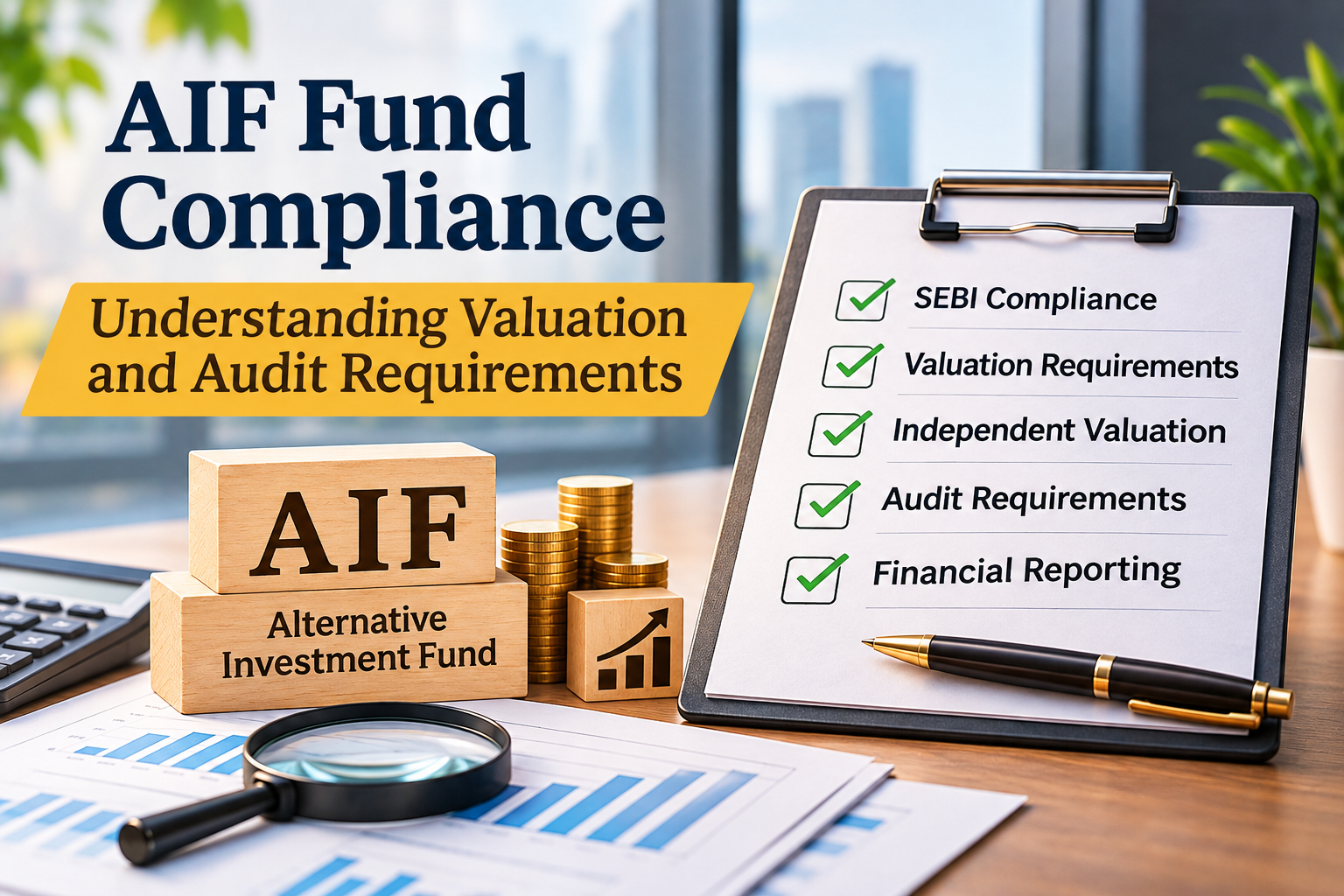
Managing an Alternative Investment Fund (AIF) involves more, than picking the right investments and earning returns. Fund managers must also explain to investors how their money is being handled and confirm that the AIF follows all regulations. This is why AIF Fund Compliance matters, especially when dealing with valuation, audits and financial reporting.
Imagine a fund investing in several private companies. Some businesses are growing, while others are struggling. Since these investments aren’t traded regularly, finding their actual value isn’t always easy. Investors still need reliable information about what their investments are worth.
That’s why SEBI has introduced valuation and audit requirements for AIFs. Businesses planning AIF registration in India should understand these responsibilities before launching a fund.
What Are the Valuation and Audit Requirements for AIFs in India?
In India, AIFs must follow valuation, audit, and reporting requirements prescribed by the Securities and Exchange Board of India (SEBI).
The requirements depend on the fund’s category, investment structure, and applicable regulations. Some important obligations include:
- Valuing investments at prescribed intervals.
- Appointing an eligible independent valuer where required.
- Following applicable valuation methodologies.
- Maintaining financial records and arranging required audits.
- Conducting annual Private Placement Memorandum (PPM) compliance audits, subject to applicable exemptions.
- Providing investors with required valuation and financial information.
These requirements help investors understand the fund’s financial position and how its investments are performing.
Understanding AIF Fund Compliance
An Alternative Investment Fund pools money from investors and invests it according to a defined investment strategy. Unlike traditional mutual funds, AIFs may invest in private equity, venture capital, debt instruments, real estate-related opportunities, and other permitted assets.
SEBI regulates these funds under the SEBI (Alternative Investment Funds) Regulations, 2012. AIF Fund Compliance involves following these regulations throughout the fund’s operations, not just during registration.
Why Valuation and Audits Matter
Suppose an AIF invests ₹10 crore in a private company. A year later, the company’s revenue increases significantly.
Does that automatically mean the investment is worth more? Not necessarily.
The valuation must consider the company’s financial position, business prospects, market conditions, and other relevant factors. Regular valuations and audits help:
- Give investors reliable financial information.
- Identify reporting mistakes.
- Improve accountability.
- Support regulatory compliance.
- Reduce disagreements over investment values.
AIF Valuation Requirements Under SEBI Regulations
Valuation is the act of figuring out how much an investment is worth, at a moment. SEBI has set AIF valuation rules to make valuation more consistent and clear.
Fund managers must ensure that investments are valued using applicable methodologies and that investors receive information about the valuation process.
Valuation Rules for Different AIF Categories
The valuation frequency depends on the AIF category. Category I and Category II AIFs generally must:
- Value their investments at least once every six months.
- Appoint an independent valuer.
- Obtain approval from investors representing at least 75% of investment value to extend the interval to one year.
Category III AIFs must ensure that NAV calculation is independent of fund management and disclose NAV:
- At least quarterly for close-ended funds.
- At least monthly for open-ended funds.
Independent valuation requirements also apply to specified investments held by Category III AIFs.
Role of an Independent Valuer
An independent valuer provides an assessment of investment values without being influenced by the fund’s investment decisions.
For example, a fund manager might think a company in their portfolio has a lot of room to grow. Just having that thought doesn’t show what the company is really worth.
A qualified appraiser looks at details the guesses made and the right ways to figure out value. The fund manager is still, in charge of making sure the value is accurate and honest.
How AIF Valuation Works
Not every investment can be valued in the same way. A listed company’s shares have observable market prices. A private startup may not have a readily available market price. This makes the valuation process more challenging.
Valuing Listed and Unlisted Investments
For listed securities, valuations generally rely on applicable market-based methods. Unlisted investments may require a detailed financial assessment.
Depending on the asset and applicable valuation guidelines, methods may include:
- Discounted cash flow analysis.
- Comparable company analysis.
- Recent relevant transactions.
- Asset-based valuation approaches.
The selected method should reflect the investment’s characteristics and applicable SEBI requirements.
Fund managers should also document important assumptions and explain material changes in valuation methods.
Audit Requirements for Alternative Investment Funds
Valuation tells investors what the fund’s investments are worth. An audit examines financial records or compliance with specified requirements. Both are important, but they serve different purposes.
Financial Statement Audits
AIFs must maintain appropriate financial records and meet applicable financial statement audit requirements. These records help establish how money enters and leaves the fund. Auditors may examine:
- Investment transactions.
- Fund expenses.
- Management fees.
- Financial statement disclosures.
- Supporting accounting records.
Accurate records also make investor reporting easier and help fund managers identify problems early.
Annual Compliance Audits
Generally, SEBI mandates that a compliance audit of an AIF be performed annually (subject to certain exemptions). Such an audit is performed to ensure that provisions mentioned in the AIF’s Private Placement Memorandum are complied with. The PPM contains key information about the fund such as investment strategy, fee structure, risks and terms of operation.
The PPM Compliance Audit ensures that the fund complies with the relevant commitments. The audit report and corrective measures need to be shared with the relevant parties within the stipulated time.
Funds may seek professional audit and assurance services to support their financial reporting and audit preparation.
AIF Valuation and Reporting Obligations
Preparing valuation reports is only one part of the process. Funds must also communicate relevant information to investors and meet regulatory reporting requirements. Proper AIF valuation and reporting helps investors understand how the fund’s portfolio is performing.
Investor Reporting and Disclosures
Depending on the fund category and applicable requirements, reporting may include:
- Investment valuations.
- NAV information.
- Financial performance.
- Material valuation methodology changes.
- Significant investment-related risks.
- Required regulatory disclosures.
SEBI also requires applicable NAV information for AIF units to be reported through the depository framework.
Clear reporting helps investors make informed decisions and reduces uncertainty about the fund’s financial position.
Common Valuation and Audit Challenges
Even experienced fund managers can face difficulties when valuing investments. Private companies may not provide updated financial information on time. Market conditions may change quickly, or certain assets may be difficult to compare with similar investments.
Common challenges include:
- Limited financial data from portfolio companies.
- Difficulty valuing unlisted securities.
- Delays in receiving audited financial statements.
- Inconsistent valuation assumptions.
- Incomplete supporting documents.
- Missed reporting deadlines.
These problems can affect valuation accuracy and create additional compliance work.
Best Practices for Maintaining AIF Fund Compliance
Good compliance practices begin with organised processes. Instead of waiting until an audit is due, fund managers should maintain accurate records throughout the year.
Some practical steps include:
- Maintain a valuation and reporting calendar.
- Appoint eligible independent valuers.
- Document valuation assumptions.
- Review portfolio company financial information.
- Maintain complete investment records.
- Monitor changes in SEBI regulations.
- Address audit observations promptly.
Regular internal reviews can help identify issues before they become serious.
Role of Professional Advisors in AIF Compliance
Fund managers already have several responsibilities, from evaluating investments to communicating with investors. Handling regulatory requirements alongside these activities can become demanding.
Professional advisors can assist with understanding applicable valuation rules, organising audit documentation, reviewing reporting processes, and identifying compliance gaps. For funds holding complex or unlisted investments, this support can be particularly useful.
Frequently Asked Questions:
Generally, at least once every six months through an independent valuer. The interval may be extended to one year with the prescribed investor approval.
Independent valuation is mandatory for Category I and II AIFs. Category III AIFs also have independent valuation requirements for specified investments.
It is an audit that checks whether an AIF has followed the relevant terms stated in its Private Placement Memorandum.
Yes, applicable NAV disclosure requirements depend on the AIF category and structure. Category III AIFs have prescribed monthly or quarterly disclosure intervals.
Changes may be permitted where appropriate, but fund managers must follow applicable valuation requirements and disclosure obligations.
Non-compliance may lead to regulatory scrutiny, corrective directions, or other action depending on the nature and seriousness of the violation.
Conclusion
Understanding your fund’s Valuation and Auditing will provide investors with insight into your fund’s finances. It also helps managers spot any issues that may arise. To keep your AIF Fund compliance, you should have accurate record keeping, correct valuations, timely reporting and regular reviews. By working with an AIF registration consultant, you can understand your obligations as a business looking to start a fund or improve current processes.